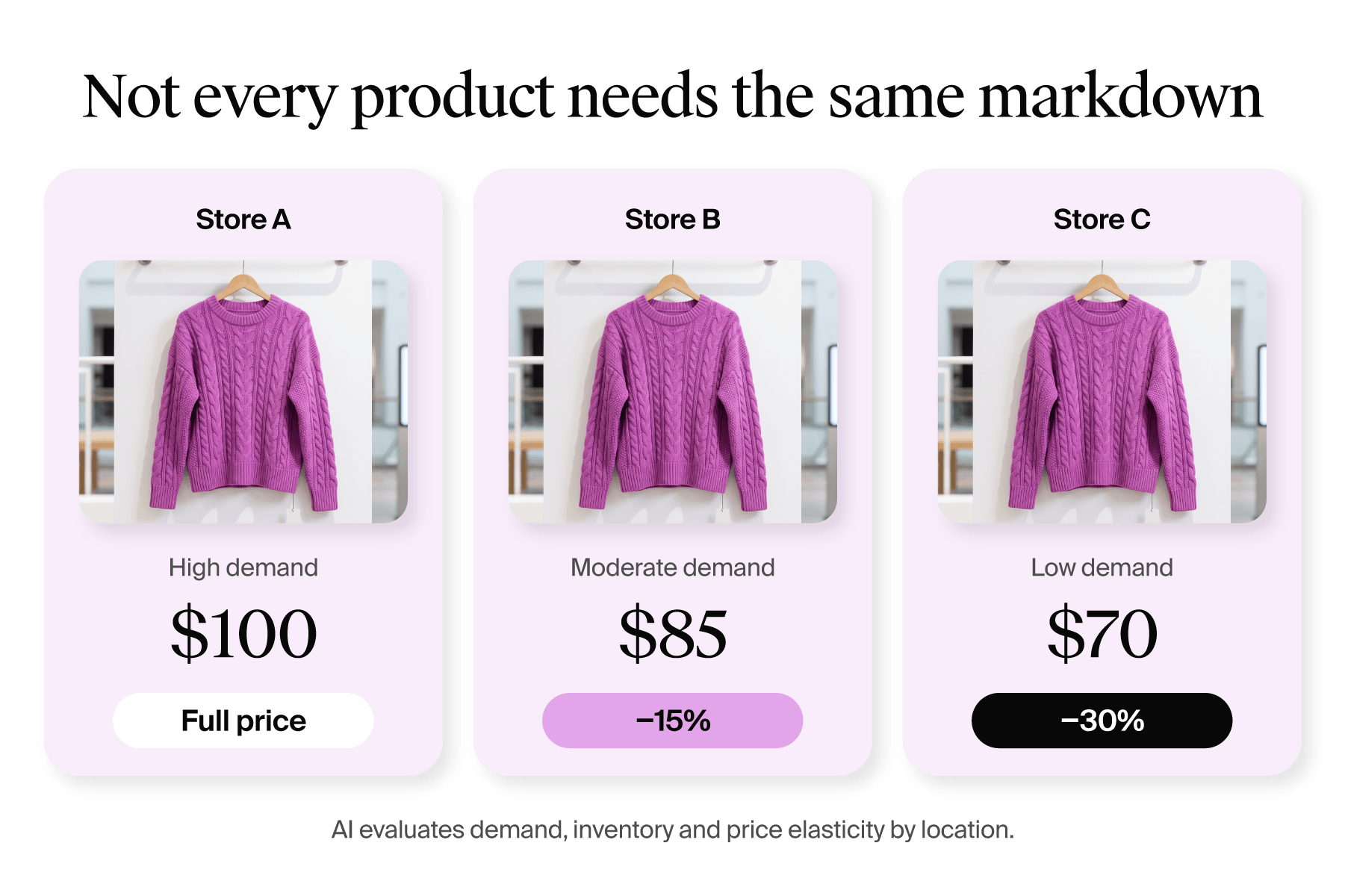
Pricing teams use rule based pricing to set prices through predefined pricing rules. The appeal is straightforward: a team writes if-then pricing logic once and lets automated pricing rules handle repeat work. This approach works well for businesses that need consistency, especially around cost-plus pricing, cost-based pricing and basic price floor and ceiling management.
Conditional pricing formulas often tie to category rules, launch rules or channel rules. A retailer may set one rule for segmented customer pricing, another for geographic price segmentation and a third for bundle pricing logic. Controls keep pricing aligned to policy, but the same controls can slow the response when demand shifts faster than rule updates.
A broader approach to pricing is explored in how pricing intelligence for retailers drives every decision, where demand, competition and inventory signals connect in one decision layer. Pricing teams get the most value from rule based pricing when questions stay narrow and decision frequency stays predictable.
What rule based pricing does in daily execution
Retail teams apply rule based pricing through a fixed response to a defined trigger. A retailer might use cost-plus pricing to apply a standard markup when cost changes. Another team might use competition-based pricing to match a rival within a set band. A third may use psychological pricing rules to keep shelf pricing near a preferred threshold while still protecting margin.
The structure of optimizing for the best financial outcome gives planners a repeatable operating model. It also creates speed where the business values consistency over category-level variation. Predefined pricing rules can support routine assortment updates, promotional calendars and simple channel alignment. Teams gain additional control from pricing strategy automation paired with clear decision rights.
The limitations become more apparent when pricing decisions require teams to balance multiple, changing factors rather than respond to a single predefined trigger.
Rule based pricing vs. AI-driven dynamic pricing
Rule based pricing follows instructions people define ahead of time. AI pricing optimization analyzes demand, inventory, competitor activity and other relevant signals to recommend prices as conditions change. The difference matters most when the business faces frequent exceptions, sharp demand swings or a wide store network with different competitive conditions.
Rule execution gives control, but AI systems add the ability to evaluate more variables and their relationships at scale. A static rule can hold a margin floor yet may not account for how changes in demand, inventory and competitive conditions influence the best pricing decision. AI-driven pricing can evaluate these factors together, recommending adjustments across products, locations and channels while respecting established guardrails. The capability fits retail teams managing high SKU counts and complex local variation.
A practical view from invent.ai's dynamic pricing platform for retail teams shows how elasticity, competitor signals and localized conditions can work together inside one decision process. The contrast matters because rule based pricing relies on predefined responses, while AI decisioning evaluates changing conditions, explains the reasoning behind recommendations and helps teams determine the next action.
The limits of if-then pricing logic in modern retail
Many pricing teams run rule based pricing with threshold pricing triggers. If sales rise above a line, the rule raises prices. If a competitor cuts price, the rule matches the price. If stock falls below a target, the rule moves the price up. Triggers help teams act quickly, but they evaluate conditions according to the logic already established, rather than determining whether the same response still makes sense in a changing market.
Risk increases when retailers rely too heavily on competitive repricing and price floor and ceiling management without a broader demand signal. A rule may hold price in one store while demand drops in another. A rule may match a rival during a temporary promotional event. The pattern can turn into a downward price spiral which erodes margin while adding little volume benefit.
Margin strategy tradeoffs become clearer insurge pricing differences, which reinforces a practical point: predefined pricing triggers can execute consistently, but they cannot independently determine whether a price change is the best response to current market conditions.
Rule based pricing in ecommerce: cost-based, competitive and value-based approaches
 Rule based pricing still has a clear place in ecommerce, especially when teams separate major inputs. Cost-plus rules protect minimum return on each item. Competitive repricing prevents drift outside market norms. Value-based approaches consider willingness to pay and perceived product value, although translating these factors into fixed rules can be difficult when customer demand changes.
Geographic price segmentation adds another layer. A retailer may set one rule for a dense urban market and another for a rural market with a different competitive set. Seasonal pricing automation and inventory-level price adjustment also fit a rules-based pricing engine when assortment cadence stays predictable. Controls support disciplined execution across large catalogs.
Ecommerce still creates faster movement than static logic expects. Product velocity changes quickly. Competitors revise prices often. Customer expectations shift by channel. Teams get better results when they treat rule based pricing as a governance mechanism rather than the sole basis for pricing decisions.
Rule based pricing and the downward price spiral problem
One of the biggest risks of rule based pricing emerges when competitor moves act as the main signal. A team matching every cut can compress margin across an entire category. One retailer drops price, another follows and a third responds again. The category can settle into a lower band which damages margin outcomes for everyone involved.
Margin floor pricing helps contain the pattern, yet a floor alone does not solve the full problem. The floor protects the lower bound, but it does not indicate when a competitor move looks temporary, when willingness to pay still supports a hold or when inventory pressure justifies another action. Price optimization needs more than one guardrail when margin protection stands as the goal.
The challenge is not that the rules fail to execute. They may execute exactly as designed while producing pricing decisions that no longer align with business objectives. AI-driven price optimization helps retailers assess whether responding to a competitor is necessary, where demand supports holding price and when a different action could better protect margin.
How CPQ software enforces rule based pricing across product catalogs
Rule based pricing fits naturally inside CPQ software because CPQ depends on structure, approvals and consistency. Large catalogs need automated pricing rules which reduce manual rework and keep teams aligned on acceptable price boundaries. Alignment matters when pricing decisions cross sales, finance and category management.
Governance brings the core advantage. Approval steps, exception paths and clear guardrails reduce manual errors and create an auditable trail. The structure supports pricing strategy automation while maintaining policy control and discount authority.
For retailers using CPQ to manage complex product configurations or negotiated pricing, these controls are valuable. However, enforcing pricing policy is different from optimizing prices against changing demand and market conditions.
As explored in retail pricing software, execution quality influences both conversion and margin outcomes. The takeaway remains direct: rule based pricing provides the structure needed for consistent execution, but additional intelligence is required to determine which prices best support business goals.
When rule based pricing fits and when it breaks
 Rule based pricing works well when pricing conditions remain relatively stable. It supports launches, simple assortment changes, guardrail enforcement and policy-driven moves which do not require constant re-evaluation. It also helps teams requiring transparent logic for internal review and retailer-specific agreements.
Failure points appear during volatility, frequent exceptions and rapid shifts in demand and competition. In such moments, fixed logic can become a bottleneck. Teams spend more time updating rules than executing strategy, while pricing opportunities can be missed between review cycles.
Hybrid pricing offers a practical progression. Rules can define boundary conditions while AI decisioning handles the evaluation of demand, inventory, competitive conditions and pricing tradeoffs. The model keeps predefined rules as a control layer within a more responsive pricing system, allowing retailers to maintain governance without relying exclusively on static logic.
Move beyond rule based pricing with AI decisioning
Retailers need both control and responsiveness. A pricing system must keep policy intact while continuously evaluating the factors influencing pricing performance. AI decisioning helps teams identify pricing opportunities, understand the reasoning behind recommended adjustments and determine which actions best support margin, demand and category goals.
Pricing now touches inventory, customer behavior and category strategy at once. A hybrid model keeps the guardrails of rule based pricing while enabling more informed decisions across products, stores and channels. Rather than simply executing a predefined response, AI can evaluate the alternatives, explain the tradeoffs and recommend the next best action.
See how invent.ai connects pricing with broader retail planning decisions to help teams protect margin, respond to demand and act with greater confidence. Explore invent.ai's dynamic pricing solution.