
.svg)

Retailers today collect more pricing data than ever before — competitor feeds, historical sales, inventory positions, promotional calendars. Yet most pricing teams still make decisions that lag the market by days. The data exists. The structure to act on it often does not. Pricing intelligence for retailers closes that gap. It converts raw competitive and demand data into a system that tells pricing teams not just what the market looks like, but what to do next.
Visibility without structure produces noise. A spreadsheet full of competitor prices tells you nothing about whether your margin floor holds, whether a gap in your category actually drives volume loss, or whether a competitor's move is permanent repositioning or a short-term promotional flush. Pricing intelligence for retailers answers those questions with actual data — and that distinction separates teams that react from teams that lead.
What is pricing intelligence for retailers
Price monitoring, price optimization and pricing intelligence are not the same thing, and conflating them leads teams to build the wrong tooling. Price monitoring tracks what competitors charge. Price optimization determines what price maximizes a defined objective: margin, volume or sell-through. Pricing intelligence sits above both: it integrates competitive signals, demand data, inventory position and market trend analysis into a system that answers three questions simultaneously: where do you stand versus the market, where are the gaps that matter, and what price makes sense given current demand and stock levels.
As reported by Market.us, the global AI-driven price optimization market is expected to reach USD 11.74 billion by 2034 from USD 2.98 billion in 2024, growing at a CAGR of 14.7% — with Retail & E-commerce holding the leading vertical share at 35.6%. That concentration in retail reflects how central data-driven pricing has become to competitive positioning across the sector.
The definition matters because it shapes how teams build their workflows. A team that treats pricing intelligence as a monitoring tool will build dashboards. A team that treats it as a decision system will build integrations — connecting competitive feeds to inventory data, demand signals and execution layers. The second team captures margin the first one leaves behind.
How pricing intelligence works across channels and categories
The mechanics of pricing intelligence for retailers start with data collection — pulling competitor prices across channels, marketplaces and geographies — and then move immediately into product matching. Product matching logic determines whether a competitor's SKU is genuinely comparable to yours. Without proper matching infrastructure, the system compares the wrong products, generates false gaps and sends pricing teams in the wrong direction. This is where most implementations break down before they deliver value.
Once matching produces clean comparisons, normalization accounts for differences in pack size, bundle configuration and channel-specific pricing structures. The output feeds into analysis layers that surface price gap analysis, competitive price positioning and demand signals — then routes recommendations into pricing workflows. Cross-channel price consistency depends on this pipeline running cleanly across every channel simultaneously, not sequentially. A price change on the e-commerce channel that does not account for the in-store position creates customer confusion and erodes value proposition alignment. The strongest retail pricing models treat channel consistency as a structural requirement, not an afterthought.
Category volatility determines how frequently the system needs to run. Consumer electronics may require hourly monitoring. Seasonal apparel may require daily. Grocery perishables operate on a different cadence entirely. A pricing intelligence system that applies uniform monitoring frequency across all categories wastes resources on stable categories and misses windows in volatile ones.
Pricing intelligence for retailers vs. traditional competitive tracking
 Traditional competitive tracking tells you what a competitor charged last Tuesday. Pricing intelligence for retailers tells you what your price needs to be today to be competitive. That distinction carries real margin consequences. Periodic manual price checks produce a snapshot. A structured pricing intelligence system produces a continuous signal — one that accounts for promotional strategy analysis, inventory-driven moves and permanent repositioning, not just the price value itself.
Manual tracking also fails at scale. A team monitoring 50 SKUs manually can function. A team monitoring 50,000 SKUs manually cannot. The volume of competitor price monitoring required across a full catalog, multiple channels and geographies, exceeds what any manual process can sustain without degrading data quality. Understanding where pricing data mistakes originate — and how they compound — makes the case for structured intelligence over periodic checks.
What features matter most in a retail pricing intelligence platform
Four capabilities separate a pricing intelligence platform that delivers decisions from one that delivers reports. First, competitor price monitoring at scale — the system must handle full-catalog coverage without degrading match quality as SKU count grows. Second, product matching quality — the accuracy of the match layer determines the accuracy of everything downstream. Third, connection to inventory position and demand signals — inventory-level pricing and demand-based pricing require the platform to ingest stock data and demand velocity, not just competitor prices. Fourth, output flexibility — APIs, feeds and dashboards that connect to execution systems rather than requiring manual export and re-entry.
Teams that evaluate platforms on monetary investment alone and ignore match quality or integration depth consistently find that the cheaper tool costs more in downstream errors and manual correction time. Data-driven decisions require data that arrives clean, matched and connected to the systems where pricing actually executes.
How to protect margins with competitive pricing data
Profit margin protection requires knowing when you can hold price and when you cannot. That determination depends on two inputs: your margin floor management rules and your read on price sensitivity analysis for the category. A competitor dropping price does not automatically mean you follow. If your category carries low price elasticity, holding price while a competitor discounts captures the customers who are not price-driven. If elasticity runs high, holding price leads to lost volume.
Willingness to pay assessment feeds directly into this. Retailers that understand the ceiling — what customers will pay before switching — can hold price with confidence rather than reacting to every competitive move. Inventory-based pricing adds another layer: when stock runs tight, the margin floor can rise. When stock runs long, the floor may need to flex. Dynamic pricing strategies that connect inventory position to price execution — rather than treating them as separate decisions — capture margin that static pricing leaves unrealized. The relationship between dynamic pricing and retail margins depends entirely on whether the system operates with guardrails that prevent margin erosion while still responding to market conditions.
How to close price gaps through competitor price monitoring
Not every price gap warrants a response. Price gap identification is the first step — but price gap analysis determines which gaps actually affect volume and which are noise. A 3% gap in a low-elasticity category may generate zero volume impact. The same gap in a high-velocity, price-sensitive category may be driving measurable defection. Closing every gap without that analysis produces a margin erosion strategy, not a competitive one.
Promotional strategy analysis plays a critical role in distinguishing temporary competitor moves from permanent repositioning. A competitor running a two-week promotional discount does not require a permanent price adjustment. A competitor that has reset its everyday price downward does. Treating both the same way — either always matching or never matching — leaves margin on the table in one scenario and cedes volume in the other. Competitive pricing discipline means reading the signal correctly before acting on it.
Pricing intelligence for retailers managing high-volatility categories
 High-volatility categories punish slow reactions. Consumer electronics, seasonal apparel and perishables all share a common characteristic: the window between the right price and the wrong price closes fast. In consumer electronics, a competitor's stock-out can shift demand to your shelf within hours. In seasonal apparel, a week of mispricing during peak sell-through can require markdowns that eliminate the season's margin. In perishables, inventory-level pricing tied to remaining shelf life determines whether the product sells at margin or gets written off.
Operationally, high volatility means monitoring frequency must match category cadence, match quality must hold under rapid SKU turnover and predictive pricing models must account for demand shifts before they fully materialize in sales data. Demand forecasting feeds this directly — a system that waits for sales velocity to confirm a demand shift has already missed the pricing window. Predictive analytics that surface the signal earlier give pricing teams the lead time to act before the margin window closes. Understanding how pricing data mistakes compound in high-volatility categories underscores why the infrastructure behind the data matters as much as the data itself.
How AI and predictive analytics change what pricing intelligence delivers
AI moves pricing intelligence from data display to recommendation. A dashboard that shows competitor prices requires a human to interpret the gap, assess the demand context and decide on a response. A system with AI-driven predictive analytics surfaces the recommendation directly — here is the gap, here is the demand signal, here is the suggested price adjustment and here is the projected margin outcome.
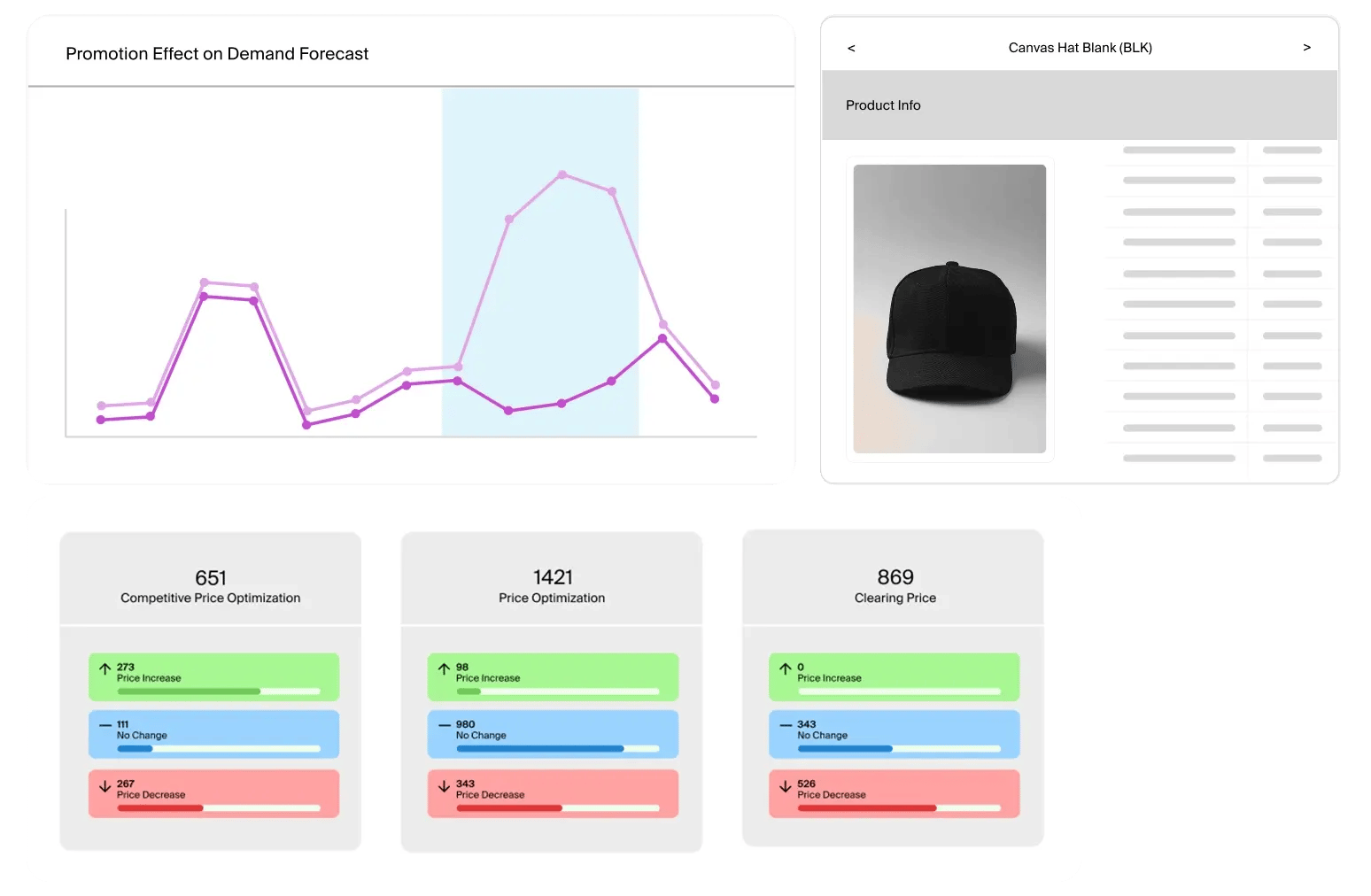
Category-level modeling and item-level optimization serve different purposes. Category models identify structural positioning — where the brand sits relative to the competitive set across a full assortment. Item-level optimization handles the execution — the specific price for a specific SKU on a specific day given current inventory, demand velocity and competitor position.
Predictive pricing models that operate at item level, fed by category-level positioning rules, produce the most precise output. Scenario analysis modeling and A/B testing for pricing allow teams to validate assumptions before committing to a price change at scale — testing the response to a 5% increase in a subset of stores before rolling it across the full network. Price point optimization at this granularity requires AI; no manual process operates at the required speed and volume.
What retail pricing teams need from a pricing intelligence tool in 2026
The gap between a pricing intelligence tool that informs and one that integrates into daily decision-making is where most implementations stall. Informing means producing a report that a pricing analyst reads and then manually translates into a price change. Integrating means the output connects directly to the execution layer — ERP, PIM or pricing engine — so the recommendation becomes an action without a manual handoff.
Integration requirements in 2026 extend beyond basic API connectivity. Pricing teams need bidirectional data flow: competitive signals and demand data flowing in, price decisions flowing out and outcome data flowing back to improve the model. MAP enforcement tools have become a non-negotiable requirement for brands managing reseller networks — violations surface at scale only when the monitoring layer covers the full channel footprint. Brand positioning signals feed into psychological pricing tactics and price positioning decisions that protect brand equity while maintaining competitive relevance. Regulatory compliance pricing adds another layer for retailers operating across jurisdictions with different pricing rules. Teams that treat these as separate workstreams rather than integrated inputs into a single system create the manual overhead that pricing intelligence was built to eliminate.
How to connect demand forecasting, price elasticity and margin protection in one system
Demand forecasting tells you where volume is going. Price elasticity analysis tells you how sensitive that volume is to price changes. Profit margin protection tells you the floor. A pricing intelligence system that connects all three produces decisions that are simultaneously market-aware, demand-calibrated and margin-protected. A system that handles only one or two of those inputs produces decisions that optimize one dimension at the expense of the others.
Feedback loop pricing closes the loop: every price decision generates an outcome, and that outcome feeds back into the model to improve the next recommendation. Without this mechanism, the system operates on static assumptions that degrade as market conditions shift. Data-driven pricing at scale requires this feedback architecture — not just data in, but outcomes back. Explore how invent.ai's pricing solutions connect these inputs into a unified decision system.
How dynamic pricing and pricing intelligence work together
Dynamic pricing without pricing intelligence is automated guessing. The engine adjusts prices based on rules, but without competitive context, demand signals and margin floors feeding those rules, the adjustments optimize for the wrong objective or create price moves that damage brand equity. Pricing intelligence for retailers provides the inputs that make dynamic pricing strategies defensible — not just technically executable.
Guardrails prevent automated systems from making technically correct but commercially damaging moves. A price ceiling prevents the system from moving above a threshold that triggers customer perception damage. A price floor enforces margin floor management rules. Category-level constraints limit how far a price can move within a defined window.
Demand-based pricing calibrates the dynamic rules to actual demand velocity rather than arbitrary triggers. Competitive price positioning ensures the system does not drift outside the range where the brand competes effectively. Promotional pricing rules prevent the dynamic engine from conflicting with planned promotional calendars. Together, these guardrails make dynamic pricing a margin tool rather than a margin risk.
How to enforce MAP compliance with pricing intelligence software
MAP violations affect margin and brand perception simultaneously. A reseller pricing below MAP undercuts the brand's value proposition alignment and creates channel conflict that erodes full-price sell-through across the network. Pricing intelligence software surfaces violations at scale by monitoring reseller prices across channels continuously — not through periodic manual audits that catch violations after the damage has accumulated.
MAP enforcement tools within a pricing intelligence platform connect violation detection to workflow triggers: flag the violation, route the alert to the appropriate team and log the response. Brand positioning signals feed into MAP threshold decisions — where the floor sits relative to the brand's competitive position and customer price expectations. Retailers that treat MAP enforcement as a standalone compliance function rather than an integrated component of their pricing intelligence system see violations persist longer and occur more frequently than retailers that automate detection and response.
Put pricing intelligence for retailers to work with invent.ai
Pricing intelligence for retailers delivers value only when it connects to the decisions that move margin — not when it sits in a dashboard that a team checks once a week. The retailers gaining ground in 2026 use actual data to enforce margin floors, identify the gaps worth closing, calibrate dynamic pricing strategies with guardrails and feed outcomes back into the model.
Every element covered here — from competitor price monitoring to price elasticity analysis to MAP enforcement tools — functions as part of a connected system, not a collection of separate reports.
Invent.ai builds that connected system for retailers who need pricing decisions that execute at the speed and scale the market demands. Connect with the invent.ai team to see how data-driven decisions translate into measurable margin outcomes across your full pricing operation.
 Linda Marley, VP of Strategic Accounts, invent.ai