
.svg)
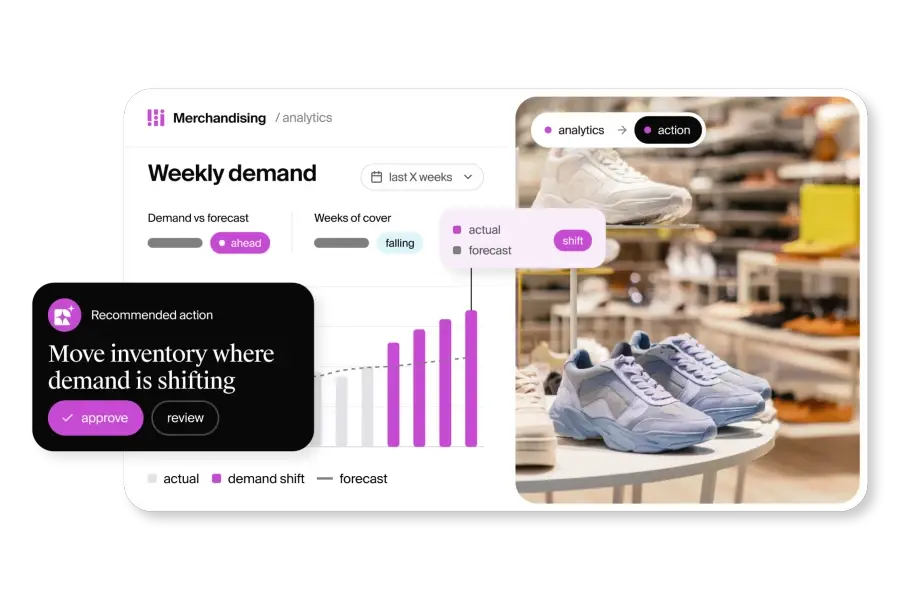
Retailers have more merchandising data than ever. Teams can track SKU performance, category performance, sell-through, inventory turnover, customer behavior and pricing trends across channels and locations.
The challenge is no longer getting visibility. It’s turning that visibility into a decision while there is still time to change the outcome.
A report can show that a category is underperforming. An assortment view can show which products are missing their targets. A sales forecast can flag a demand shift. However, none of those signals, on their own, tell a merchandising team what to do next.
That gap between analytics and action can become expensive.
A slow response to changing demand can leave inventory in the wrong place. A pricing decision made too late can increase markdown exposure. An assortment that does not reflect local demand can weaken sell-through and tie up inventory.
This is where merchandising analytics needs to evolve into merchandising decisioning. Invent.ai connects operational data with AI agents that help retail teams move from questions and signals to recommended actions. AI agents for retail decisioning help teams work with the data behind merchandising decisions without making planners translate every insight into a separate manual workflow. The goal isn’t more analytics to sort through, it’s better decisions, made while those decisions can still affect the business.
Why merchandising analytics alone is not enough
Traditional retail analytics is built to answer questions about what sold, where sales missed plans, which SKUs are underperforming and where inventory is building.
Those answers matter. But they’re only the starting point.
Merchandising teams also need to understand what should change, where inventory should move, which products need more or less depth and whether pricing or promotion needs to change. That second set of questions is where decisioning comes in.
Retail merchandising analytics gives teams visibility into the business. Retail decision intelligence connects that visibility to the decisions that shape the next outcome.
That distinction becomes more important as retail organizations manage more SKUs, channels and localized demand. The volume of information can make manual analysis slower rather than more useful.
Deloitte has highlighted the shift toward technology-enabled merchandising models as retailers respond to volatility and margin pressure. The underlying need is straightforward: merchandising teams need to make decisions faster as the variables behind those decisions multiply.
Margin pressure starts with merchandising decisions
Margin doesn’t depend on one decision. It’s shaped by the relationship between assortment, inventory, pricing, promotions and demand.
Consider a product that's selling below the plan. The issue could be the product itself, the price, its placement, its availability or the amount of inventory sitting in the wrong locations.
A traditional analytics workflow may require several teams to investigate each piece separately. A decision-led approach connects those signals.
Demand forecasting can identify a shift in expected sales. Inventory data can show where product is accumulating. Pricing analytics can reveal whether price is affecting demand. Sell-through performance can show which locations are responding differently.
Together, those signals give merchandising teams a stronger basis for deciding what happens next. This is particularly important before a margin problem becomes a markdown problem.
From predictive signals to earlier action
Markdowns are often treated as a pricing issue, but the conditions that lead to markdowns can develop much earlier. A product may enter the season with the wrong assortment depth. Demand may shift after the buy. Inventory may become concentrated in locations where it is not selling. Promotions may generate volume without delivering the expected return.
By the time a markdown becomes the obvious solution, several earlier decisions may already have contributed to the problem. Predictive merchandising decision support helps teams identify those changes earlier.
Demand forecasting and sales forecasting can indicate where actual demand is moving away from plan. Inventory management can show where stock is building or becoming constrained. Pricing optimization can help teams evaluate the relationship between price and demand. Promotional effectiveness can show whether an offer is producing the expected result.
The value isn’t simply knowing that something changed. It’s giving the right team enough context to decide what to do about it. Invent.ai explores this approach through advanced analytics and AI for retail decisions, where signals from messy retail data can be used to support faster decisions.
Analytics vs. decisioning in merchandising
 The difference can be simple.
- Analytics asks: What happened?
- Decisioning asks: What should we do next?
Analytics remains essential. Retailers need accurate reporting, dashboards and performance measurement. But reporting becomes less valuable when teams have to manually move information from one system, spreadsheet or meeting into the next decision.
Decisioning adds another layer by connecting demand, inventory, assortment, pricing and action. That connection matters because merchandising decisions rarely exist in isolation.
A change to product assortment affects inventory. Inventory affects availability and sell-through. Pricing affects demand. Promotions affect both sales and margin. A decision in one area can create a downstream consequence somewhere else.
The objective is not to replace merchandising expertise. It is to give merchandising teams better information and recommendations at the point where expertise is applied.
Better assortment decisions start with demand
Product assortment is one of the biggest levers merchandising teams control. The challenge is deciding how much of each product to carry, where to carry it and when to adjust the mix.
Assortment optimization can combine demand signals with product, store and category characteristics to help teams identify where the current mix is no longer aligned with expected demand.
That can support decisions around SKU rationalization, assortment gap analysis, inventory depth and category performance without treating each decision as a separate exercise.
The same principle applies to space. Planogram optimization and store layout optimization help translate assortment strategy into physical execution. If the products customers want are not available in the right locations or are not given appropriate space, the assortment decision is only partially complete.
Invent.ai's work around predictive assortments for category and SKU planning shows how predictive approaches can support product mix decisions before teams are forced to react later in the season.
Pricing and promotions need the same decision context
Pricing strategy cannot be separated from merchandising. A price change can influence demand, sell-through and inventory. A promotion can increase units sold while producing a different margin result than expected.
That is why pricing optimization and promotional effectiveness are stronger when considered alongside the rest of the merchandising picture. Price elasticity modeling can help teams understand how demand responds to price changes. Promotion ROI can show whether increased sales justify the commercial cost. Sell-through rate can show how the product is performing after the decision is made.
Instead of treating each metric as a separate report, merchandising decisioning connects the signals around the decision. For category managers, that means a pricing conversation can start with the broader question of what action best supports the category based on demand, inventory, price and expected response. That is more useful than simply knowing that last week's sales were above or below plan.
What category managers need from merchandising analytics
Category managers already spend significant time reviewing performance. The opportunity is to spend less time assembling the picture and more time deciding what to do with it.
A useful merchandising decision system should help teams understand which categories are changing, which SKUs are creating inventory risk, where demand is moving away from plan and where pricing or assortment changes could affect performance.
That changes the role of analytics. Instead of being the final destination of the merchandising process, analytics becomes part of an ongoing decision loop.Teams can investigate a signal, understand the drivers, evaluate the options and act. The next set of results then feeds the next decision.
This creates a more connected operating model across merchandising, planning, inventory and pricing.
The next step for retail analytics
 Retailers don’t need fewer data points. They need fewer disconnected decisions.
The next generation of merchandising analytics needs to connect forecasting, assortment, inventory and pricing so teams can move from what happened to what should happen next.
That means decision support needs to be predictive enough to identify where demand or inventory may move next, connected enough to bring the relevant commercial signals together and actionable enough to help teams determine what to change.
It also needs to keep human judgment in the process. Planners and merchants should be able to review recommendations, adjust them, approve them or override them based on the context the system cannot see.
This is the difference between an analytics workflow and a decision workflow.
Move from merchandising analytics to merchandising decisioning
Merchandising analytics gives retailers visibility into performance. Decisioning helps turn that visibility into action. For retail teams managing margin pressure, the distinction matters. Assortment decisions affect inventory. Inventory decisions affect availability and sell-through. Pricing decisions affect demand. Promotions affect both sales and margin. These decisions are connected, so the systems supporting them should be connected too.
Invent.ai brings forecasting, planning, inventory and pricing together through AI-driven decision support, helping retail teams move from signals to action while keeping human judgment in the loop.
The next question for merchandising teams isn’t simply "What does the data tell us?" it’s "What decision should we make while there is still time to change the outcome?" Connect with a retail AI expert to get started.