
.svg)

Merchandising directors are driving retail's AI revolution through strategic decisions that are reshaping how products reach customers. To succeed, these leadership roles must balance customer demand with inventory investment while navigating rapidly changing market trends. AI agents provide merchandising teams with predictive capabilities that turn assortment planning from reactive guesswork into proactive strategy.
AI-driven assortment decisions fundamentally change how retail leadership teams approach product assortment planning. Modern retail planning systems enable merchandising teams to predict demand patterns, optimize inventory placement and align merchandising strategy with financial goals.
The strategic role of merchandising directors in using AI
Merchandising directors serve as the bridge between technology and commercial strategy, translating AI data into actionable procurement operations. Retailers using AI in optimization have realized average annual savings well into the millions. Meanwhile, according to Deloitte, up to 68% of retailers are expected to either deploy agentic AI to assist customers with purchases or to improve management in 2026, which will directly improve how merchandising teams apply and act on information.
Merchandising team responsibilities extend beyond traditional category management to encompass vendor relationships and distribution center coordination. As such, they must understand how AI agents process projected sales growth data against actual sales and translate those findings into inventory management decisions that drive retail operations efficiency.
AI implementation requires merchandising teams to develop new competencies and company culture in business administration while maintaining focus on customer experience. Predictive data analysis enables faster decision-making and reduces the manual overhead that previously constrained assortment planning speed.
AI-powered demand pattern analysis
 Merchandising directors leverage predictive data analysis to identify customer preferences and seasonal trends with unprecedented accuracy. AI systems analyze historical sales data, weather patterns and demographic shifts to predict demand at the SKU level and then execute on those decisions, reallocating inventory. Using AI insights and automated decisions, teams are able to shift from reactive to proactive assortment planning through data-driven findings.
Demand pattern recognition also helps merchandising leaders optimize general merchandise selection for specific stores, regions or even SKU-specific details and attributes. AI identifies micro-trends that human analysis might miss, enabling more precise product assortment decisions that align with local customer preferences and shopping behaviors.
Optimizing product mix through machine learning
AI helps merchandising teams balance inventory investment with demand forecasting through sophisticated algorithms that consider multiple variables simultaneously. Machine learning systems analyze vendor relationships, warehouse operations capacity and market trends to recommend optimal product mix decisions. Plus, reduced uncertainty in allocation turns into customized replenishment based on actual turn times, growing margin.
At the same time, machine learning reduces markdowns by 20% and improves sell-through rates through intelligent product selection. Merchandising directors reap the rewards of all these high-performing assortment plans that balance breadth and depth while minimizing excess inventory risk and keeping carrying costs in check.
Revenue growth through data-driven assortment decisions
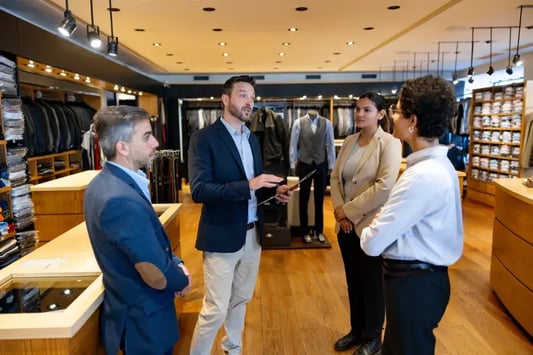 Every company has a goal of growing revenue, and for merchandising team leaders using AI, it is far easier to customize product selection for individual stores while maintaining operational efficiency across the distribution center network.This also translates into improved customer experiences.
Customer experience data and sales performance metrics help leaders to understand the complete effect of planning, inventory and pricing decisions.
Since teams are able to use AI to automate routine tasks, like reordering stock or balancing inventory across multiple locations, customers get the right product, at the right place and at the right price. Furthermore, automated systems handle or even entirely eliminate data management processes that previously required manual intervention, such as trying to clean and update data in spreadsheets, freeing merchandising directors to focus on strategic planning and vendor relationships.
Maximize assortment success with invent.ai
Merchandising directors who embrace AI analytics as part of their day-to-day can also maintain a better competitive advantage, improve their standing within the company itself, and drive sustainable growth in the changing retail landscape. Predictive data analysis, automated decision-making and integrated retail operations create opportunities for improved sales growth and enhanced customer experience.
AI-powered assortment planning changes merchandising strategy and drives measurable results across all aspects of retail operations. Contact invent.ai to learn how these capabilities can benefit your organization.