
.svg)

Retailers generate more data today than at any prior point in the industry's history, yet the quality of inventory decisions has not kept pace with that volume. AI decisioning and retail operations are converging precisely because the old infrastructure (rule-based planning, static reorder points, weekly batch forecasting runs) cannot process the number of variables a modern retailer faces across thousands of SKUs, dozens of locations and a shifting demand signal. The gap between data and decision quality is not a data problem. It is a decisioning infrastructure problem. The answer lies in a category of tools built specifically around AI decisioning, and understanding what separates the best of them from the rest is what this blog covers. Explore what an AI-decisioning platform can do for your retail operation before your next planning cycle begins.
Why inventory optimization needs AI decisioning now
The scale problem in retail planning has become structural. A mid-size specialty retailer carrying 30,000 active SKUs across 200 stores faces millions of individual replenishment, allocation and pricing decisions every week. Rule-based planning systems assumed a world where planners reviewed exceptions manually and adjusted parameters quarterly. That world no longer exists.
Getting inventory wrong carries a measurable cost on both ends. Excess stock ties up working capital, accelerates markdown cycles and compresses margin. Stockouts erode customer engagement, damage brand trust and push buyers toward competitors who have the product in stock. Neither outcome is acceptable at scale, and neither can be prevented by systems that run forecasting as a periodic batch process rather than a continuous optimization loop.
The distinction between reporting tools and AI decisioning matters here. Reporting tools surface what happened and sometimes what might happen. Decisioning tools act on that information: adjusting replenishment quantities, reallocating inventory between locations and flagging procurement risk, without waiting for a human to translate a report into an action. As reported by Grand View Research, the global artificial intelligence in retail market size was estimated at USD 11.61 billion in 2024 and is projected to reach USD 40.74 billion by 2030, growing at a CAGR of 23.0% from 2025 to 2030. That growth rate reflects how urgently retailers are moving toward tools that do more than report.
What separates AI-decisioning tools from standard forecasting software
Standard forecasting software produces a number. An AI-decisioning tool produces an action. That distinction, often called the action gap, defines the difference between a tool that informs a planner and a tool that executes on behalf of the business.
Predictive AI generates a forecast based on historical patterns and statistical modeling. It answers the question: what will demand look like? Agentic AI goes further. It answers: given that forecast, what do we do right now, and how do we adjust as actual sell-through data comes in? The architecture behind agentic AI enables the system to monitor outcomes, compare them against predictions and update its own decision logic continuously. That learning loop, powered by reinforcement learning, means the system gets more accurate over time without requiring manual reconfiguration.
Actual data is the foundation of every decision this architecture makes. Systems that rely on static historical baselines will drift as consumer behavior shifts. Systems built on agentic AI architecture ingest actual sell-through, actual supplier lead times and actual demand signals continuously, recalibrating decisions as conditions change rather than waiting for the next planning cycle.For a deeper look at how this plays out in retail planning, the distinction between predictive and agentic approaches becomes even clearer when examined against real planning workflows.
Core capabilities to evaluate in any AI inventory optimization tool
 Not every platform marketed as an AI tool for inventory optimization delivers the same depth of capability. When evaluating options, three capability areas separate tools that move the needle from those that add complexity without adding value.
Demand forecasting with external signals. A credible demand forecasting engine does not rely solely on internal sales history. It incorporates external signals: weather patterns, local events, competitor pricing activity, macroeconomic indicators and sentiment analysis tools that capture shifts in consumer preference before those shifts appear in the sales data. The ability to weight these signals appropriately, and to update that weighting as conditions evolve, separates a capable forecasting engine from a basic statistical model.
Replenishment and allocation logic that adjusts daily on actual sell-through. Replenishment rules set at the beginning of a season become stale within weeks. The right tool adjusts replenishment quantities and allocation decisions daily, based on what is actually selling at the SKU and location level. This prevents the twin failure modes of over-replenishing slow movers and under-replenishing high-velocity items.
Transfer and procurement recommendations with full supply chain context. Inventory decisions do not exist in isolation. A transfer recommendation that ignores freight cost, lead time and downstream replenishment impact can create as many problems as it solves. The best tools generate transfer and procurement recommendations with full visibility into supply chain constraints, so every action taken at the store level connects back to a coherent plan at the network level. For a detailed breakdown of what these capabilities look like in practice, the guide to inventory optimization solution features covers the full set of requirements worth evaluating.
AI-decisioning platforms for inventory optimization and supply chain planning
 A retail AI platform built on AI decisioning operates differently from a forecasting tool or a BI dashboard with AI features bolted on. The core difference lies in how the system handles the relationship between prediction and execution. A decisioning platform does not hand a recommendation to a planner and wait. It monitors whether that recommendation was acted on, tracks the outcome and feeds that result back into the next decision cycle.
Agentic AI architecture enables multi-agent coordination across planning, pricing and inventory simultaneously. A multi-agent platform coordinates decisions across functions so that a pricing change automatically triggers a review of replenishment quantities and allocation priorities, eliminating the siloed pipelines that slow separate systems down. This coordination eliminates the lag that occurs when separate teams work from separate systems with separate update cycles.
Invent.ai operates as one example of this category. Built as an AI-decisioning platform from the ground up rather than retrofitted from a legacy planning tool, invent.ai's multi-agent system coordinates decisions across forecasting, inventory and pricing through its core agent, Remi. Other platform categories in this space include supply chain optimization suites from enterprise vendors, standalone replenishment automation tools and demand sensing platforms that focus specifically on short-horizon forecasting. Each serves a different part of the problem, and the right choice depends on where a retailer's decisioning gaps are most acute.
A unified commerce platform approach, where inventory, pricing and planning decisions feed each other continuously, represents the direction the category is moving. Retailers evaluating platforms now are well-positioned to select for that architecture rather than inheriting integration debt later.
What makes agentic AI different from predictive AI in retail
The shift from predictive AI to agentic AI in retail is a shift from delayed action to autonomous execution. Predictive AI produces an output that a human must interpret, prioritize and act on. Agentic AI closes that loop. The system identifies the condition, determines the appropriate response and executes or escalates based on pre-defined guardrails, all without requiring a planner to open a dashboard.
Two capabilities that matter here are price elasticity modeling and algorithmic bias mitigation. Price elasticity modeling allows the system to evaluate how demand responds to price changes at the SKU and location level, enabling more precise markdown and promotional decisions rather than applying blanket discount rates. Algorithmic bias mitigation addresses a real risk in any AI system: those historical data patterns encode past biases into future recommendations. A well-designed agentic AI architecture includes mechanisms to detect and correct for these patterns so that decisions reflect current demand rather than outdated assumptions.
The guardrails question matters for enterprise adoption. Retailers need to know that an autonomous system will escalate decisions that exceed defined thresholds rather than executing them without review. The learning loop in reinforcement learning-based systems means the system improves with every decision cycle, but that improvement needs to happen within boundaries the business controls. For retailers working through what that governance model looks like in practice, the guide to implementing agentic AI for retailers covers the structural steps in detail.
Getting AI-decisioning tools into production: what retailers need to know
Retailers who audit their data infrastructure before vendor selection move faster post-launch. The gap between prepared and unprepared deployments compounds quickly. Systems requiring clean, consistently tagged historical data stall during implementation when that preparation work lags behind.
Adoption is the factor most often underestimated in AI deployments. A system that planners do not trust will be overridden constantly, which degrades the learning loop and reduces the value of the investment. Successful adoption requires planners to understand how the system decides, see the reasoning behind recommendations and flag disagreements through a defined process. Vendors who invest in explainability and training alongside the technology itself tend to produce better adoption outcomes than those who treat implementation as a technical handoff.
Phased pilots reduce risk and accelerate learning. Starting with one region, one category or one decision type allows a retailer to validate the system's performance against actual outcomes before expanding scope. It also creates internal proof points that support broader organizational buy-in. Vendor partnership post-launch matters as much as the technology itself. The retailers who see the strongest results from AI-decisioning tools are those whose vendors remain actively engaged after go-live, monitoring performance and adjusting model parameters as the business evolves.
Capabilities like 1:1 personalization and lifecycle marketing extend the value of AI decisioning beyond inventory into how retailers communicate with customers across the purchase journey, creating a feedback loop between demand signals and marketing execution that further sharpens forecast accuracy over time.
Advance your inventory outcomes with invent.ai
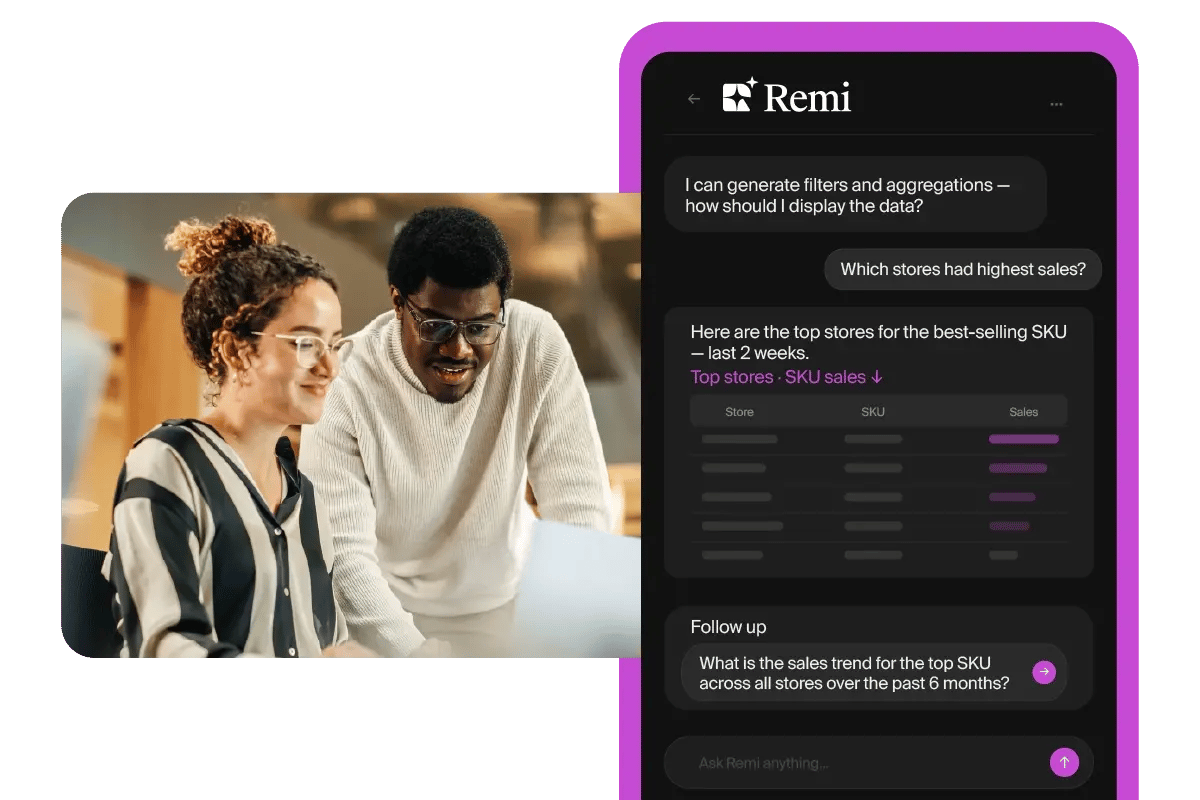
Retailers deploying AI-decisioning tools act on what is happening, not just describe what happened. AI decisioning and retail operations are converging at a pace that rewards early movers. Explore the invent.ai AI-decisioning platform and see how multi-agent coordination across planning, pricing and inventory optimization can close the gap between your data and your decisions.
The best AI tools for inventory optimization do not wait for a planner to act. The best tools monitor, decide and execute: continuously, at scale, across every SKU and every location. That capability, built on agentic AI architecture and reinforcement learning, represents where AI-decisioning and retail planning is headed. The retailers who build that infrastructure now will carry a structural advantage into every planning cycle that follows. Get in touch to learn how our AI-decisioning platform can work for you.