
.svg)
Retail planning has reached a point where isolated systems can no longer keep up with the pace and scale of decision-making. Forecasting, inventory, allocation and pricing are tightly connected, yet many platforms still rely on disconnected workflows or a single-agent architecture that limits coordination.
The invent.ai platform is purpose-built to address this gap through a multi-agentic architecture, a system where specialized AI agents work together to monitor operations, analyze signals and guide decisions across the retail planning lifecycle. Rather than treating each function separately, this approach connects them through shared data, continuous analysis and coordinated outputs.
Moving beyond single-agent systems
Traditional AI solutions in retail are often designed around a single model handling a defined task. While effective in narrow use cases, this structure creates limitations when decisions need to extend across multiple workflows.
A forecast may identify a change in demand, but without alignment to allocation or pricing, execution remains incomplete. Teams are left bridging these gaps manually, slowing response times and increasing operational friction.
A multi-agentic architecture addresses this by distributing responsibilities across specialized agents. Each agent operates with a level of autonomy, but contributes to a broader system where decisions are connected rather than isolated.
A system built on orchestration and collaboration
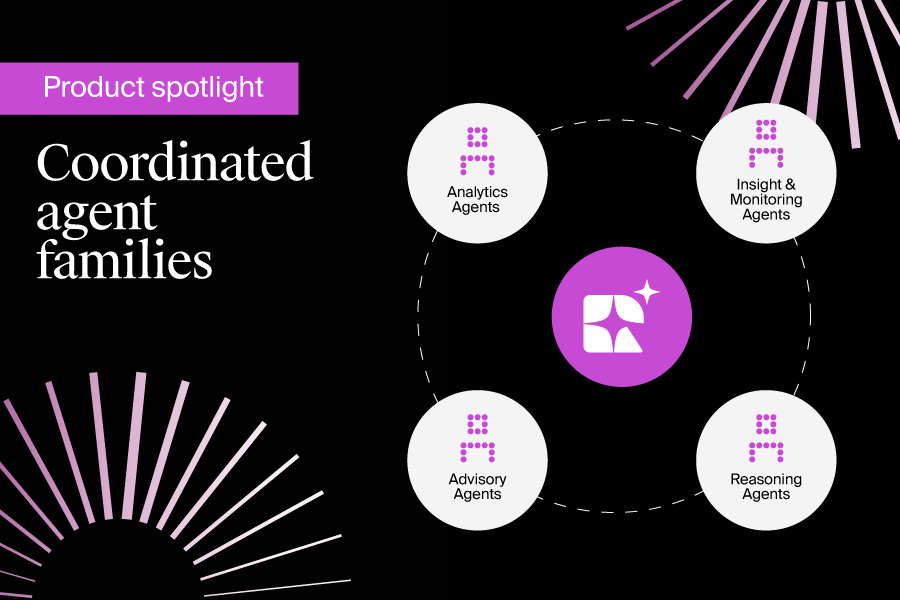
At the core of invent.ai’s platform is a network of agents designed for specific roles including monitoring, reasoning, planning, guidance and analysis. These agents continuously share signals, enabling orchestrating decisions across workflows.
This collaboration allows the system to move beyond static outputs. Monitoring agents detect changes in demand or inventory conditions. Reasoning agents evaluate why those changes are occurring. Planning and advisory agents guide next steps, while analytics agents provide deeper visibility when needed.
The result is a system that supports decision-making as an ongoing process rather than a series of disconnected tasks. By coordinating outputs across agents, invent.ai ensures that actions taken in one area are aligned with others.
Powered by a unified retail knowledge base
Effective coordination depends on a consistent data foundation. The invent.ai platform combines transactional retail data with operational knowledge such as product information, workflows and system guidance.
This unified knowledge base allows agents to operate with shared context, improving reasoning and enabling more reliable recommendations. As new signals are introduced, including external factors, the system adapts and refines its outputs over time.
This approach supports inventory intelligence AI, where decisions are informed not just by historical data, but by a continuous understanding of how inventory behaves across the network.
Continuous analysis at scale
.png?width=533&height=355&name=image%20(30).png) Retail generates a constant stream of demand signals across products, stores and e-channels. The invent.ai platform ingests and analyzes these signals continuously, allowing agents to detect changes as they happen.
Retail generates a constant stream of demand signals across products, stores and e-channels. The invent.ai platform ingests and analyzes these signals continuously, allowing agents to detect changes as they happen.
Through scalability, the system operates across large SKU–store networks without losing visibility. Agents maintain awareness of conditions at both the micro and macro levels, supporting decisions that reflect the full operational picture.
The inclusion of memory and reflection enables the system to learn from past patterns, improving how it evaluates new signals and adapts to changing conditions.
Designed for modularity and interoperability
One of the defining strengths of a multi-agentic approach is its flexibility. The invent.ai platform is built with modularity, allowing new agents, tools or workflows to be introduced without disrupting the overall system.
This structure also supports interoperable environments, where the platform can integrate with existing retail systems and data sources. As business needs evolve, the architecture can expand while maintaining coordination across workflows.
Built on secure large language models
The invent.ai AI-Decisioning Platform leverages enterprise-grade large language models with configurable endpoints designed to meet strict data privacy and security requirements. These models support conversational interactions, contextual understanding and continuous learning across agents.
By combining LLM capabilities with a multi-agentic structure, invent.ai enables more natural interaction with data while maintaining control over sensitive information.
How invent.ai connects multi-agentic architecture to retail execution
The value of a multi-agentic architecture lies in its ability to connect insight to execution. By combining agentic AI, autonomy, collaboration and coordinated workflows, invent.ai transforms how retail decisions are made.
Rather than relying on isolated outputs, retailers gain a system that produces coordinated insights, system alerts, recommendations and clear explanations behind operational changes. Teams are supported with decision guidance that reflects the full context of the business.
This approach brings inventory intelligence AI into everyday workflows, ensuring that forecasting, inventory, allocation and pricing decisions remain aligned.
As retail continues to evolve, platforms built on a multi-agentic architecture provide a foundation for more connected, adaptive and scalable planning, helping organizations operate with greater clarity and consistency across their entire network.
Retail leaders are rethinking how decisions are made across the business. To explore how invent.ai supports coordinated, scalable planning, download our Multi-Agentic AI white paper.