
.svg)

Retail supply chain analytics solutions give planners something they have always needed: visibility.
The ability to aggregate data, surface demand forecasting signals, flag inventory risk visibility and track forecast performance across SKUs and locations marks a genuine operational step forward. But visibility and action are not the same thing and the gap between them marks exactly where retail planning falls apart.
Most analytics tools stop at the report. A planner sees a demand shift, a variance flag or a replenishment risk and then manually decides what to do next. That manual translation step creates the problem. Retail supply chain analytics solutions surface what happened and what may happen next. Closing the gap between that signal and an executed decision requires something more.
What analytics software in retail planning actually does
Retail supply chain analytics software for planners performs three core functions well: it aggregates data from across the business, applies predictive analytics to surface likely outcomes and tracks planning performance evaluation metrics over time. Without them, planners operate on instinct and lagging reports.
The supply chain analytics market, valued at USD 10.97 billion in 2026, tells its own story. Demand heads toward action, not more reporting. According to Mordor Intelligence, prescriptive analytics advances at a 27.4% CAGR through 2031. Managers want recommended actions, not static hindsight.
Traditional analytics models were built to explain. The market now demands tools that decide. That distinction defines the gap between analytics as a reporting layer and analytics as a planning engine.
How to evaluate supply chain analytics solutions for retail planning
 Planners evaluating retail supply chain analytics solutions need to ask a different set of questions than IT buyers.
The criteria that matter operationally center on four areas: data quality management, ERP system integration depth, planning workflow alignment and whether the tool supports scenario planning and what-if analysis — or only reports on what already happened.
The most important distinction: does the solution support planning performance evaluation in a way that feeds forward into decisions, or does it only measure outcomes after the fact?
A tool that scores well on dashboards but requires manual interpretation at every decision point adds process overhead without closing the execution gap. Once planners know what to look for, the next question becomes whether analytics tools can close that decision gap on their own.
Supply chain analytics solutions vs. AI powered decision intelligence platforms
The difference between analytics tools and AI powered platforms comes down to what each one produces at the end of a planning cycle. Analytics tools deliver data driven signals, visibility, planning variance detection and forecast performance tracking.
A planner who understands where variance occurred and why makes better decisions than one operating on instinct.
AI powered platforms deliver something different: recommended actions, automated decisions and closed loop planning. As explored in invent.ai's look at inventory analytics versus AI, the argument rejects either/or, the analytical foundation remains essential.
But the decisioning layer determines what planners can actually execute, and analytics alone does not provide that layer.
What features matter most in a retail AI analytics platform
Evaluating features in a retail AI analytics platform requires prioritization, not a checklist. The capabilities that move the needle on planning outcomes fall into five areas.
- Demand sensing alongside traditional demand forecasting, capturing near-term signals that batch models miss.
- Inventory optimization that produces recommended actions, not just performance reports.
- Scenario planning and what-if analysis that feed directly into executable decisions rather than slide decks.
- Planning workflow alignment with sales and operations planning and production planning and scheduling cycles.
- Cloud computing scalability that handles data volume and processing speed without requiring infrastructure investment from the planning team.
Invent.ai's piece on retail data decisions examines how these features connect to actual planning outcomes, and why data driven decision making depends on the quality of the decisioning layer, not just the data layer. Features only matter when they translate to measurably better forecasting and faster execution.
How to improve demand forecasting accuracy with retail planning analytics
Demand forecasting accuracy improves when models operate at the SKU and location level, update continuously on actual transaction data and incorporate demand sensing signals alongside historical patterns.
Promotional lifts, seasonal shifts and supplier lead time changes all introduce forecast drift, and planning variance detection that catches drift early prevents it from becoming a cost problem downstream.
Data driven decision making produces different outcomes than gut feel override culture, where planners manually adjust forecasts based on experience rather than signal. Override culture introduces inconsistency at scale.
When planning performance evaluation reveals where overrides degraded accuracy, planners gain the evidence needed to shift toward model driven decisions. Better forecasting serves as a means to an end, the real question marks where AI changes the equation entirely.
How AI changes what supply chain analytics solutions can deliver for planners
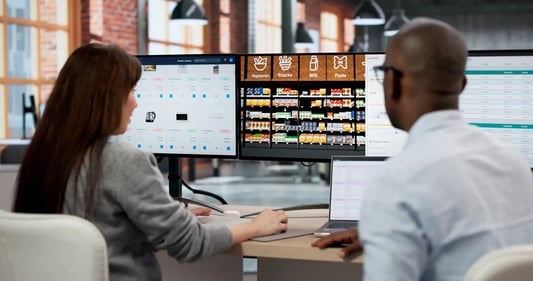 AI agents executing decisions within defined parameters represent the operational shift that retail supply chain analytics solutions alone cannot deliver. Where analytics tools generate alerts, AI agents generate actions. Inventory risk visibility that triggers an automated response, rather than a notification waiting for a planner to act — compresses the time between signal and execution.
Change management adoption determines whether AI driven planning sticks. Teams that understand what the system decides and why adopt it faster than those handed a black box.
That adoption curve directly affects planning outcomes. And as invent.ai's analysis of supply chain optimization makes clear, carbon footprint reduction becomes a byproduct of better inventory optimization, not a separate sustainability initiative. Fewer excess units, tighter replenishment cycles and reduced transportation waste follow naturally from decisions grounded in actual data.
What retail planning and inventory teams need from a supply chain analytics platform in 2026
The convergence of predictive analytics and prescriptive analytics in a single planning workflow defines what separates adequate tools from ones that support data driven decision making at scale. Planners no longer need to choose between visibility and action — the platforms that deliver both in a unified workflow earn the evaluation.
ERP system integration that doesn't require a data science team to maintain removes a barrier that has historically kept AI powered planning out of reach for mid-market retailers. Inventory management outcomes depend on the quality of the decisioning layer, not just the data layer and that distinction now drives platform selection across the market.
What invent.ai's retail planning platform delivers reflects exactly this convergence: a system where the analytical foundation and the decisioning layer operate as one.
Advance your retail planning outcomes with Invent.ai
The market has already moved. Retail supply chain analytics solutions that stop at reporting leave planners holding a signal with no clear path to action. AI decisioning closes that gap, connecting demand forecasting, inventory optimization, planning workflow alignment and automated execution into a single continuous loop.
Connect with the invent.ai team to see what that looks like for your planning cycle.
Daniel Foxman is Strategic Account Executive at invent.ai.