

Retailers are already making decisions that will shape their performance in 2027. Financial targets, assortment strategies and inventory commitments establish the foundation for the year ahead, influencing everything from product availability to revenue and margin.
But even the most carefully developed plans can quickly lose relevance when demand shifts, inventory arrives late or customer preferences change. Decisions made months before a selling season must still support what happens when products reach stores and actual demand begins to unfold.
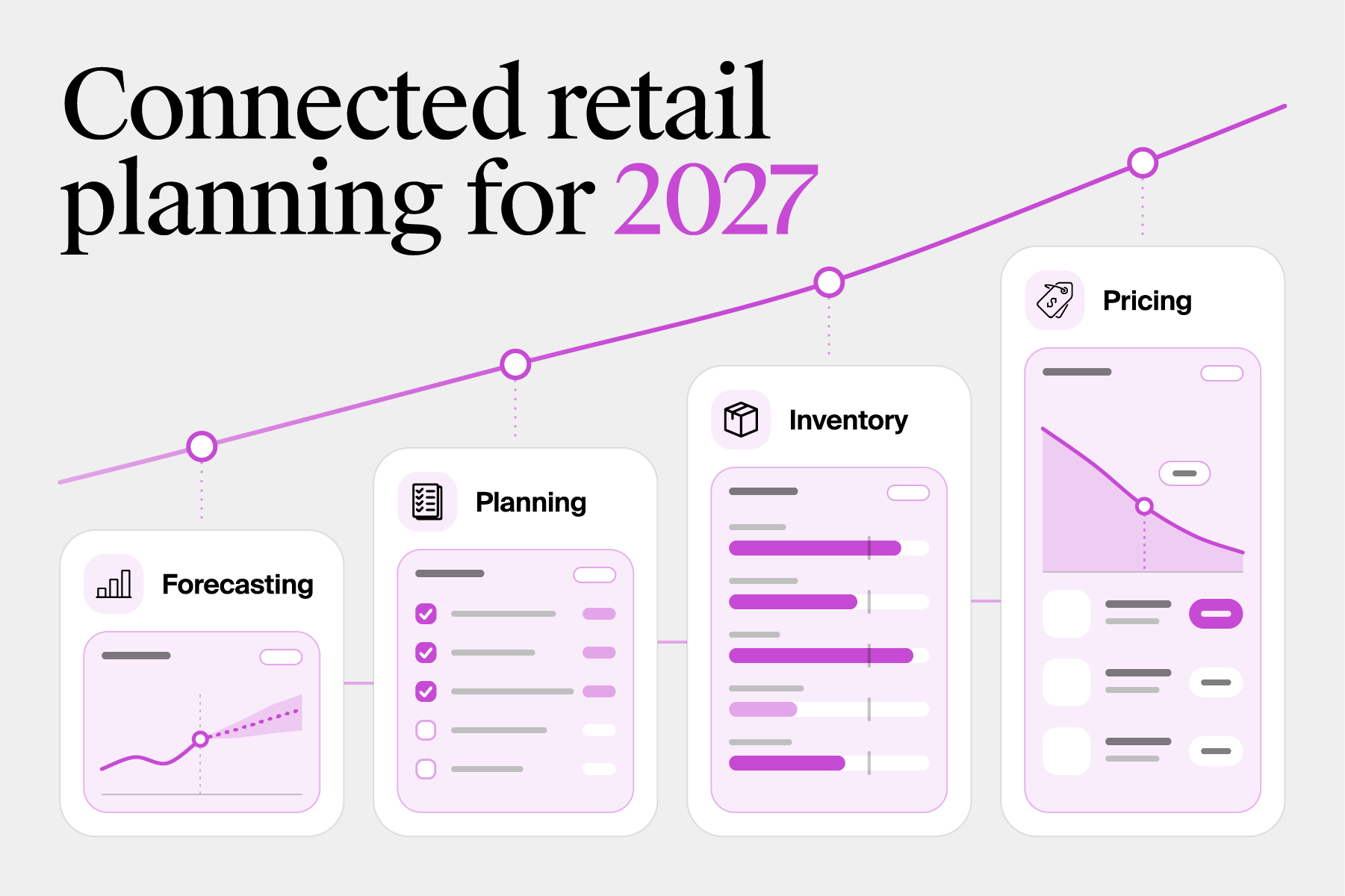
The challenge isn't simply creating a more accurate plan. Retailers must make sure forecasting, merchandise planning, inventory and pricing decisions remain connected as conditions quickly evolve. Retailers that build flexibility into their planning processes will be better positioned to respond to demand, protect margins and make faster decisions throughout 2027.
Connect retail planning across merchandising, supply chain and finance
As retailers prepare for 2027, financial targets are taking shape, buying calendars are being finalized and merchandising teams are determining which products will drive growth.
Yet these decisions often happen across separate functions. Finance establishes revenue and margin expectations, merchandising develops assortment strategies and supply chain teams determine how inventory will move through the network. When these plans rely on different assumptions, retailers risk committing to inventory that doesn't support their financial objectives or anticipated demand.
Connected retail planning brings these decisions together. By aligning merchandise planning, financial planning and supply chain planning around a shared view of demand, retailers can evaluate how one decision affects the rest of the business before commitments are made.
According to McKinsey's State of Fashion 2026, the global fashion industry was expected to experience low single-digit growth in 2026. In a challenging growth environment, retailers have less room for planning errors that create excess inventory, missed sales or unnecessary markdowns.
The priorities for 2027 planning teams should be connecting decisions across the end-to-end value network so teams can act on changing conditions without repeatedly rebuilding their plans.
Turn demand signals into accurate retail forecasts
Forecasting is one of the most consequential parts of retail planning. Demand predictions influence purchasing commitments, assortment depth, inventory placement and financial expectations. Before an item reaches the shelf, the forecast has already shaped how much a retailer commits to buying, which products get the deepest buys, where that inventory goes and what sales the business is counting on.
But relying too heavily on historical sales or static assumptions can create problems before the season starts. Consumer preferences shift, promotional activity changes and demand patterns vary across channels and locations.
Retailers preparing for the next year need forecasting processes that account for these differences while remaining responsive to new information.
AI-driven sales forecasting helps teams identify demand patterns across products, locations and time periods. Rather than relying on broad averages, planners can develop more granular forecasts that reflect local selling behavior, seasonality and changing demand signals.
Scenario planning adds another layer of flexibility. Teams can evaluate how different demand outcomes might affect inventory requirements, financial targets and buying decisions before committing resources.
Just as importantly, forecasting shouldn't stop once the annual plan is approved.
Continuous performance monitoring allows retailers to compare actual sales against expectations and identify where assumptions no longer hold. With effective exception management, planners can prioritize meaningful deviations and adjust replenishment, allocation or purchasing decisions before small gaps become larger financial problems.
For retailers entering 2027, forecast accuracy matters. But the ability to turn updated forecasts into timely decisions matters just as much.
Build localized assortments without excess inventory
 Assortment decisions made before the season can determine whether retailers capture demand or spend months correcting inventory imbalances.
One of the biggest risks is treating stores with different customer preferences as though they require the same product mix.
A product that performs well in one market may struggle in another. Differences in climate, demographics, purchasing behavior and local demand can significantly affect which products sell, how quickly they move and how much inventory each location needs.
Localized assortment planning helps retailers account for these differences before buying commitments are finalized.
Through store clustering and range optimization, retailers can group specific locations with similar demand characteristics and develop assortments that reflect their specific needs. This creates opportunities to improve product availability while reducing unnecessary inventory commitments.
However, assortment planning cannot operate independently from financial targets or inventory constraints. The buying calendar determines when commitments must be made, while open-to-buy budgets influence how much inventory retailers can purchase. Without coordination, teams may select the right products but commit to the wrong quantities or distribute inventory across locations where demand is weaker.
Retailers should connect assortment planning with forecasting, buying and inventory optimization from the beginning. This helps teams determine not only which products belong in each assortment, but also how much to buy, where inventory should be positioned and how those decisions support revenue and margin goals.
Balance financial targets with inventory realities
Planning for the year ahead requires retailers to establish revenue targets, margin expectations and inventory investments. These financial goals provide direction, but they become difficult to execute when they aren't connected to the operational decisions required to achieve them.
Merchandise financial planning establishes the financial framework for the season. Open-to-buy planning translates that framework into purchasing capacity, helping retailers determine how much inventory they can commit to while maintaining control over stock levels and cash flow. The challenge comes when financial assumptions and actual demand begin to diverge.
A category may outperform expectations, requiring additional inventory investment. Meanwhile, another may experience slower sales, leaving excess stock and increasing markdown exposure. If financial planning and inventory planning operate within silos, retailers can struggle to respond without lengthy reviews or manual adjustments.
Connected planning allows teams to evaluate these tradeoffs together. For example, if demand increases for a high-margin category, planners can assess whether additional purchasing or inventory transfers would generate more profitable sales. If another category underperforms, teams can evaluate changes to receipts, allocation or pricing before excess inventory accumulates.
Financial optimization also helps retailers evaluate decisions based on their expected contribution to revenue and margin, rather than relying on isolated inventory or sales targets. The goal should be to make financial plans adaptable, allowing retailers to respond to changing conditions while maintaining control over inventory investments and profitability.
Optimize allocation, replenishment and markdown decisions
A strong preseason plan establishes the foundation for performance, but in-season execution determines how much of that opportunity retailers capture.
Allocation, replenishment and markdown decisions are closely connected. Inventory placed in the wrong location can create stockouts in high-demand stores while leaving excess elsewhere. Replenishment decisions based on outdated assumptions can compound the problem, increasing the likelihood of markdowns later in the season.
Retailers preparing for 2027 should consider how their initial planning decisions will influence these downstream outcomes. Allocation rules should reflect localized demand, available inventory and financial objectives. Replenishment strategies should account for changing sales patterns, lead times and inventory requirements rather than simply repeating historical ordering behavior.
Omnichannel fulfillment adds another layer of complexity, as inventory must support demand across stores, distribution centers and digital channels. When these decisions are connected, retailers gain more flexibility to respond as demand changes.
For example, if a product begins selling faster than expected in one region, teams can evaluate whether to replenish from available supply, transfer inventory from slower-moving locations or adjust future purchasing commitments. Similarly, identifying slow-moving inventory early creates opportunities to rebalance stock or adjust pricing before deeper markdowns become necessary.
Markdown optimization remains important, but retailers should aim to reduce the inventory imbalances that make aggressive discounting necessary in the first place. By connecting allocation, replenishment and pricing decisions, retailers can improve product availability, protect full-price sales and reduce excess inventory throughout the season.
Measure planning performance and adapt faster
 The plans developed ahead of 2027 provide a starting point, not a fixed set of instructions for the entire year.
Retailers need a consistent way to measure whether their decisions are delivering the expected results and identify where adjustments will create the greatest value.
Performance monitoring should extend beyond forecast accuracy to include sell-through, product availability, inventory productivity, revenue and gross margin.
These measures help teams understand not only whether performance is changing, but also which planning decisions may be contributing to the results.
For example, declining sell-through may indicate an assortment mismatch, excess purchasing or demand that hasn't materialized. Repeated stockouts may point to forecasting gaps, allocation constraints or replenishment decisions that aren't keeping pace with actual sales.
KPI tracking becomes more valuable when it connects performance changes to recommended actions.
Rather than reviewing disconnected reports and manually determining what needs attention, retailers can use AI decisioning to identify emerging risks, evaluate potential responses and prioritize actions based on expected business value.
This also changes the role of exception management. Instead of presenting planners with long lists of issues, AI can help surface the decisions most likely to affect revenue, margin and inventory performance.
As highlighted in retail planning lessons from 2026, effective planning increasingly depends on the ability to adapt as business conditions evolve.
For 2027, retailers should measure success not only by the accuracy of their original plans, but by how effectively they recognize changes and act on them.
Turn 2027 plans into profitable decisions with invent.ai
The planning decisions made today will influence how retailers perform throughout 2027. But success won't just be dependent on how closely teams follow their original set plans for the coming year, but how effectively they're able to adapt when their reality changes.
Invent.ai connects forecasting, merchandise financial planning, assortment, inventory and pricing decisions through one AI-decisioning platform. Built on unified forecasting and financial optimization, the platform helps retailers make coordinated decisions that grow revenue, protect margins and reduce excess inventory.
Remi, invent.ai's AI orchestration agent, works continuously across the platform with specialized agents to identify emerging opportunities and risks, explain recommendations and prepare actions for team approval.
From initial buying decisions to in-season replenishment and end-of-season markdowns, retailers can respond to changing conditions without losing sight of their financial goals.
Planning leaders evaluating their priorities for the year ahead can explore what to look for in a retail planning vendor and how a unified MFP data foundation supports connected decisions across merchandising, inventory and finance.
The strongest retail plans aren't simply built to predict what will happen. They're built to support better decisions when conditions change. Start 2027 with a plan built to adapt. Learn how.