
.svg)
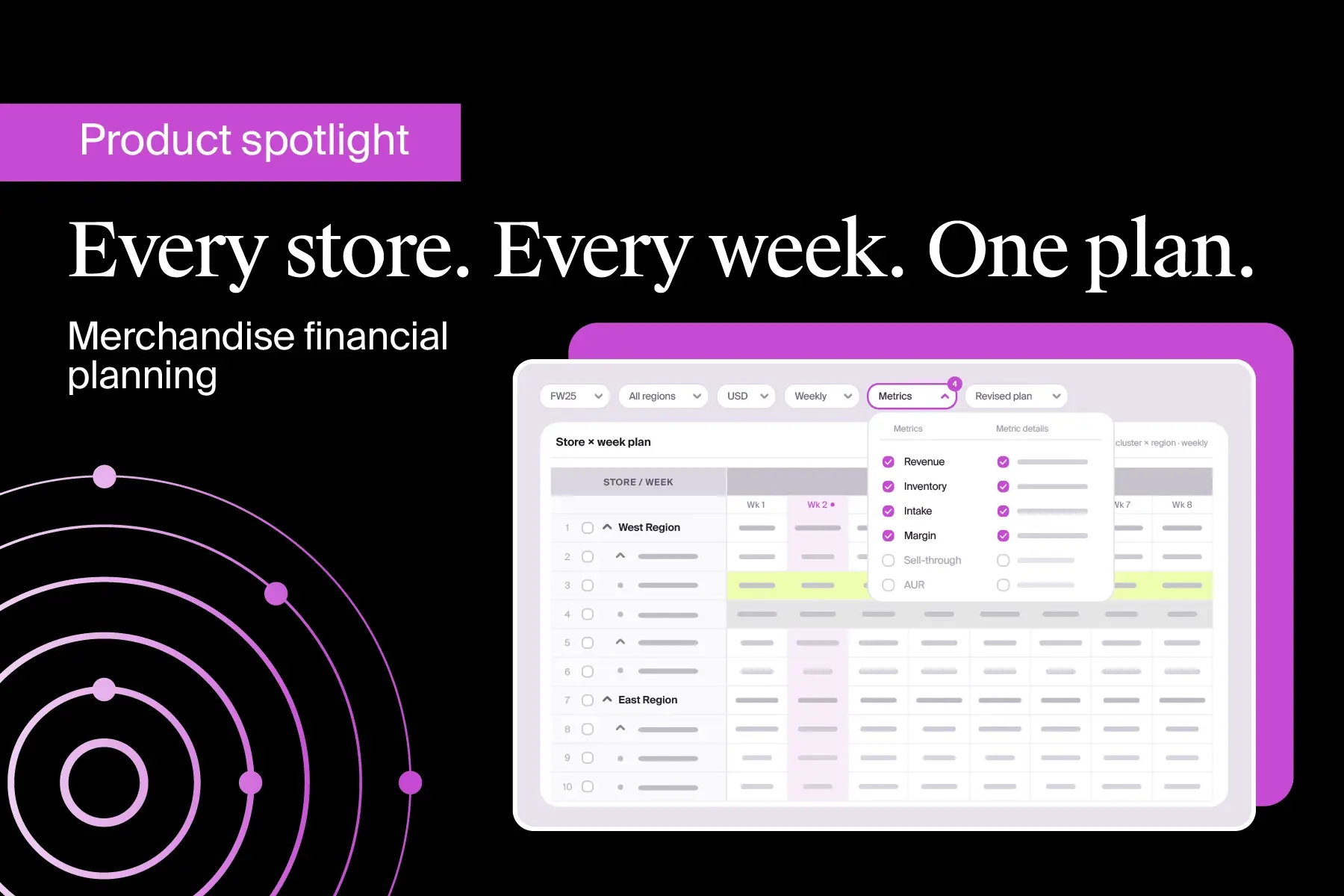
Merchandise financial planning (MFP) only works when every decision is built on a consistent, connected data foundation. In most retail environments, that condition doesn’t exist. Data is split across planning systems, merchandising tools, finance models and inventory platforms, each with its own structure and definitions. As a result, plans don’t align cleanly across teams, reported performance differs depending on where it’s viewed, and decision cycles slow down because numbers need to be reconciled before they can be used.
MFP by invent.ai connects store, product, channel, inventory and financial data into a single store and week view. The goal is simple: every planning decision should sit on the same structure, not a collection of disconnected views.
In many retail organizations, sales targets are planned in one system, margin in another and open-to-buy (OTB) somewhere else. By the time those plans are reconciled, the opportunity to act has often passed. MFP brings these decisions into a single connected workflow, keeping planning synchronized from initial targets through in-season execution.
One structure for all planning decisions
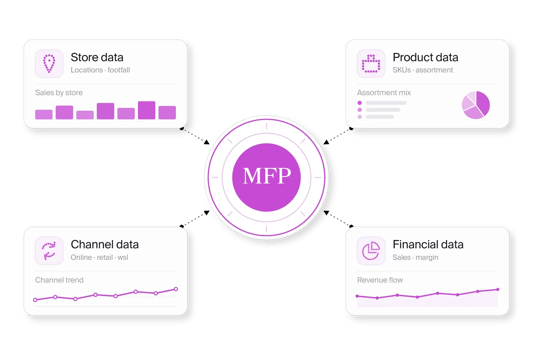 Retail planning only works when structure is consistent across every layer of the business. MFP standardizes that structure so that store, product and channel hierarchies behave the same way across planning, reporting and analysis.
Instead of maintaining separate logic for different functions, all teams operate on the same underlying model.
- Store performance rolls up to the same regional structure used in financial planning
- Product hierarchies align across merchandising, allocation and intake
- Channel performance follows a consistent definition across retail, e-commerce and wholesale
This removes the need to translate or rebuild data between systems. A number means the same thing regardless of where it is viewed. That consistency is what allows planning to stay stable across teams and time periods.
But a connected data foundation is only the beginning. Each planning step builds on the one before it, from AI-assisted seeding and sales planning through margin, inventory and OTB, keeping the entire planning cycle synchronized within one connected workflow instead of disconnected planning activities.
Every planning cycle starts with a baseline. With invent.ai demand forecasting and Remi, planners begin with statistically grounded baselines that reflect underlying demand patterns instead of relying solely on last year's performance or manually adjusted spreadsheets. They can then refine those plans for promotions, new stores, assortment changes and market conditions rather than rebuilding them from scratch.
Planning breaks when definitions don’t match
Most planning issues in retail are not caused by missing data. They come from inconsistent definitions applied to the same data.
Revenue may be calculated differently across finance and merchandising. Inventory positions may vary depending on whether warehouse, transit or store stock is included. Intake and receipt logic is often split between planning and execution systems. Even basic hierarchy structures can differ between tools, making it difficult to compare performance cleanly.
These inconsistencies force teams to spend time reconciling numbers instead of using them. Every planning cycle begins with alignment work before any decisions can be made.
MFP removes this layer of friction by enforcing a consistent structure across all planning data. Once structure is aligned, definitions stop drifting between systems and metrics become usable without rework.
OTB and receipt planning: where financial decisions happen
OTB is one of the most consequential decisions in retail planning. Buy too conservatively and retailers leave revenue on the table. Buy too aggressively and margin erodes through markdowns and excess inventory.
MFP connects margin planning directly into OTB and receipt workflows so planners understand the financial implications of inventory commitments before they're made. Changes to the sales plan automatically flow into margin, inventory, receipt timing and channel allocation, allowing teams to adjust intake within one connected workflow instead of reconciling across multiple systems.
From periodic planning to continuous decisions
When planning is built on inconsistent data, it naturally becomes a cycle: plan, execute, reconcile, repeat. Each cycle depends on rebuilding confidence in the numbers before decisions can move forward.
With a connected data foundation, that cycle changes. Planning no longer resets at fixed intervals because the underlying structure remains stable throughout the season.
Retail teams can track revenue and margin, inventory, intake and margin continuously as conditions evolve. Variance doesn’t need to be recalculated across systems, it’s visible within the same structure used for planning.
Actual performance flows directly into the planning model, allowing planners to monitor live KPIs, continuously track variance and adjust sales, margin, inventory and receipt plans directly within MFP. Instead of relying on a separate reporting layer or waiting for a reconciliation cycle, planners can respond as soon as performance changes, keeping plans aligned with what's happening in the business while opportunities still exist.
Planning becomes less about restarting analysis and more about adjusting based on live performance within a consistent framework.
A shared foundation across retail planning
A unified MFP model connects every major planning function into one structure.
Revenue and margin are tracked using the same hierarchy logic that governs store and product performance. Inventory is visible across store, warehouse and transit in a single view rather than separated systems. Intake and OTB follow consistent rules that align with financial planning instead of operating independently. Like-for-like and non-like-for-like performance are calculated using the same structural definitions across time periods.
Because everything sits on the same model, comparisons stay consistent. A change in one part of the business can be traced through the same structure without needing to translate between systems or rebuild context.
Finance, merchandising and supply chain teams work from the same planning model. Conversations begin with shared context rather than competing versions of the numbers, allowing teams to spend less time validating data and more time making coordinated decisions. Supply chain teams can immediately see receipt commitments generated from OTB decisions, while finance and merchandising continue working from the same planning model. Rather than asking which numbers are correct, teams can focus on evaluating options and making coordinated decisions faster.
From data checks to decisions with invent.ai
When planning is built on a unified structure, teams stop spending time reconciling numbers before decisions can be made. Instead of validating multiple versions of the same metric across systems, discussions focus on what is driving performance. Inventory positions are read the same way across merchandising, finance and supply chain, and planning no longer depends on rechecking data before action can be taken.
The result is a simple shift in how time is used: less effort spent confirming what the data says, more time spent deciding what to do about it.
Retail performance isn't typically limited by data availability. It's limited by the time required to translate data into decisions that everyone can act on.
At invent.ai, MFP removes that friction by combining a unified data foundation with AI-assisted planning workflows, connected Sales, margin and OTB planning, and continuous in-season decision-making. From the initial seeded plan through live KPI monitoring and receipt adjustments, every planning decision happens within one connected workflow, allowing retailers to move directly from insight to action instead of from report to report.
See how MFP works in a connected planning environment. Talk to invent.ai to explore how a unified data foundation changes in-season retail decisions.