
.svg)
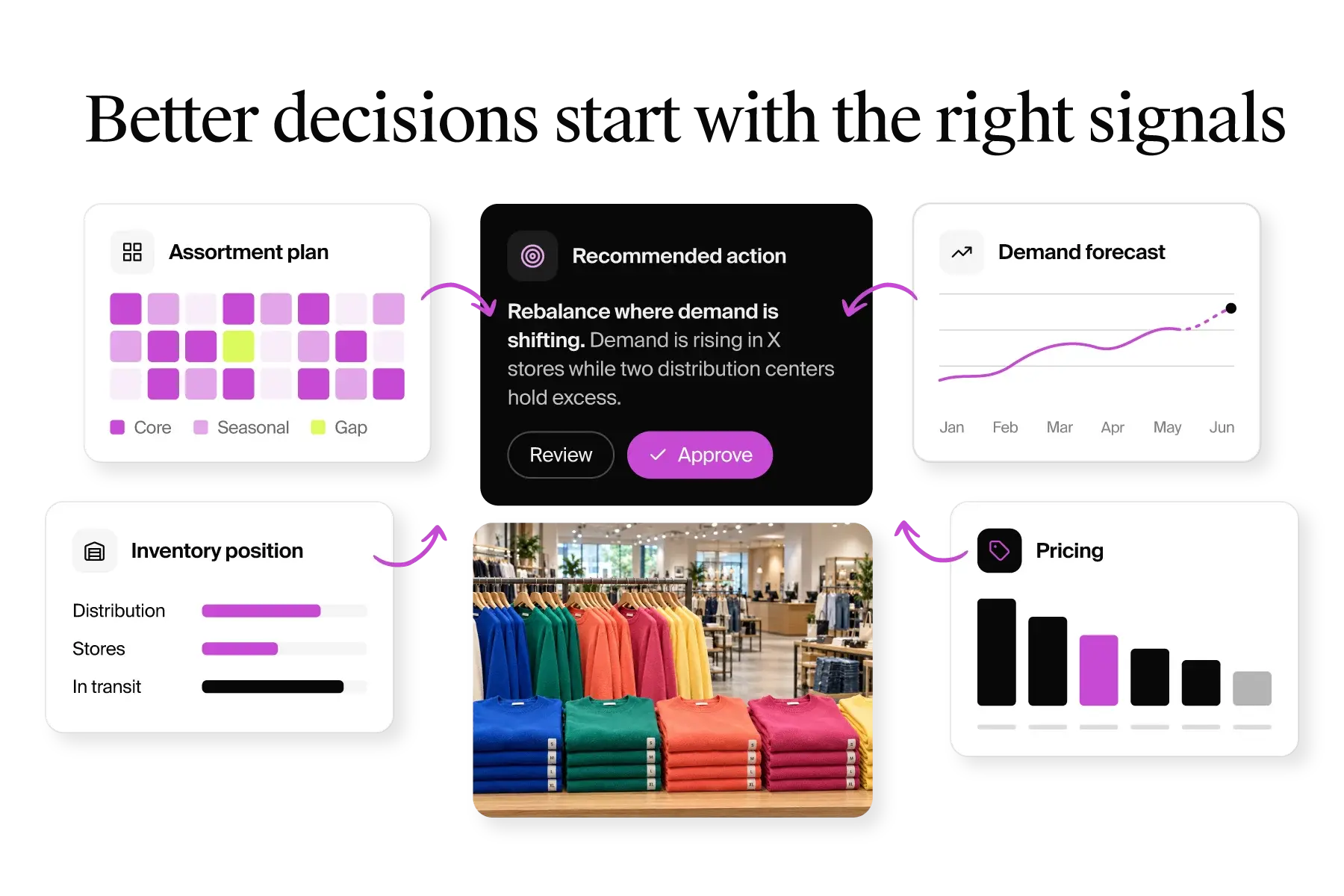
Great merchandising has always required a mix of commercial instinct, customer understanding and experience. Buyers recognize emerging trends, understand their customers and know when a product deserves a bigger bet. But even the most experienced merchant cannot manually account for every shift in demand, size-level sales, regional preferences and inventory constraints across hundreds of stores.
That is where data-driven merchandising comes in. By combining merchant expertise with demand forecasting, inventory optimization and product-level performance data, retailers can make better-informed decisions about what to buy, where to place it and when to adjust. Instead of relying on historical reports or intuition alone, teams can identify emerging opportunities and risks while there is still time to act.
The goal is not to replace merchant judgment with data. It is to give buyers and planners better information to act on, with the speed and consistency today's retail environment demands.
Data driven merchandising vs. gut-based buying decisions
Intuition remains valuable in merchandising. A buyer may recognize a trend before it appears in historical sales, understand why a particular collection will resonate or identify an opportunity that the numbers alone cannot explain.
The challenge comes when intuition becomes the only input.
A product may look like a strong bet, but demand can vary significantly by location, size, price point and season. A successful style in one region may underperform elsewhere. A promising trend may peak earlier than expected. Without the right data, merchants may commit too much inventory to the wrong products or miss opportunities to replenish strong sellers.
These decisions can lead to familiar problems:
- Overbuying: Too much inventory is committed to products with limited demand.
- Missed sales: Strong sellers run out of stock before teams recognize the opportunity.
- Late markdowns: Slow-moving products accumulate until price reductions become harder to avoid.
- Misaligned assortments: Product mix and inventory depth fail to reflect differences in local demand.
Data-informed decisions help merchants test their assumptions against actual performance. Sales trends, inventory positions and demand forecasts can highlight where a buying decision is working and where it needs another look.
The strongest approach combines commercial experience with structured scenario planning. Retailers can evaluate buying options against financial goals, expected demand and inventory constraints through connected retail planning workflows.
How AI is changing what data driven merchandising can deliver
Traditional retail analytics can tell merchants what happened. Forecasting helps estimate what may happen next. AI decisioning can take the process further by helping teams evaluate what to do about it.
This distinction matters when merchandising decisions affect one another. Increasing a buy for a strong-selling product changes inventory requirements. Moving stock between locations affects availability elsewhere. Adjusting a price can influence demand, sell-through and future replenishment needs. Treating these decisions separately can create competing priorities across buying, planning, allocation and pricing teams.
AI decisioning helps retailers evaluate these connected factors together. Specialized AI agents can assess changing demand, identify exceptions and recommend actions based on business objectives and operational constraints.
Merchant expertise remains central. Teams still set commercial direction, interpret customer behavior and apply their knowledge of the market. The technology helps them assess more variables and respond to changes without relying entirely on manual analysis.
For merchandising directors, this creates an opportunity to evaluate assortment choices earlier and adjust plans before inventory exposure grows. It also supports more coordinated decisions across the product lifecycle, as explored in how merchandising directors can use AI to plan future assortments.
Data driven merchandising for assortment planning and inventory alignment
Assortment planning establishes the foundation for retail performance. Decisions about product breadth, depth, size ranges and store placement influence availability, sales and markdown exposure long before the season ends.
The challenge is getting the right products into the right locations in the right quantities.
A national assortment may not reflect the preferences of every market. One store may need greater depth in core sizes, while another may sell through seasonal products much faster. Online demand may also differ from store-level demand, creating additional pressure to coordinate inventory across channels.
Product assortment optimization helps teams account for these differences by bringing together demand forecasts, product performance, inventory availability and business targets.
Consider a fashion retailer preparing for a seasonal collection. Early sales indicate that several styles are outperforming expectations, but the strength of demand varies by region. Meanwhile, other products are moving more slowly than planned.
With connected planning, teams can evaluate whether to increase replenishment, redirect inventory or adjust future allocations. These decisions can be assessed against stock availability and demand across the network rather than made in isolation.
This approach also supports cross-functional team alignment. Buyers, planners and allocation teams can work from shared assumptions and evaluate the downstream consequences of a decision before committing to it.
For retailers managing complex seasonal assortments, fashion merchandising software and connected AI planning can help close the gap between merchandising intent and in-season execution.
The role of demand forecasting in data-driven merchandising
 Demand forecasting helps retailers estimate future sales using historical performance, current trends, seasonality and other relevant signals. Within data-driven merchandising, those forecasts provide a foundation for buying, allocation, replenishment and pricing decisions.
But a forecast is only useful when teams can act on it.
A product forecast that does not reflect current size-level demand may lead to the wrong replenishment decision. A seasonal projection that fails to account for regional differences can leave some stores overstocked while others miss sales. And a forecast that is not updated as conditions change can quickly become less useful.
Retailers need forecasting that responds to product movement and changing demand throughout the season. They also need the ability to translate those projections into decisions about inventory and assortment.
Useful measures include:
- Sell-through rate: How much of the available inventory has been sold during a defined period.
- Forecast accuracy: How closely predicted demand matches actual sales.
- Stock availability: Whether the right products are available where customers want to buy them.
- Inventory turnover: How efficiently inventory moves through the business.
- Markdown rate: How much merchandise is sold at reduced prices.
These metrics help merchants understand performance, but their value increases when viewed together. Strong sell-through, for example, may indicate an opportunity to replenish rather than a reason to wait for the next reporting cycle.
The objective is not simply to produce a more accurate forecast. It is to use that forecast to make better decisions while there is still time to influence the outcome.
How to reduce markdown pressure with data-driven merchandising
Markdowns are a necessary part of retail, but poorly timed decisions can turn manageable inventory risk into unnecessary margin pressure.
When teams identify slow-moving products late, they may have limited options beyond deeper discounts. By contrast, earlier demand signals give merchants more time to evaluate alternatives, including adjusting replenishment, reallocating inventory or changing pricing.
Effective markdown management begins before a product reaches the clearance stage.
Retailers can monitor sales pace, weeks of supply, inventory age and forecast demand to identify products at risk of underperforming. Merchants can then assess whether the issue reflects weak demand, excessive inventory, poor placement or a mismatch between the product and its intended market.
Pricing decisions also require context. A discount may accelerate sales, but it may also reduce margin without generating enough additional volume to justify the reduction.
Price elasticity modeling helps retailers estimate how demand may respond to price changes. Combined with inventory positions, sales forecasts and commercial objectives, these estimates can support more informed pricing strategy and revenue growth management.
For example, a product with strong demand and limited remaining inventory may not require an early discount. A slow-moving product with substantial stock may need a different response, particularly if the season is approaching its end.
The right action depends on the product, its remaining selling window and the retailer's objectives. Connected planning and AI decisioning for merchandising and retail optimization can help teams evaluate these trade-offs earlier and coordinate pricing, allocation and replenishment decisions.
Data-driven merchandising tools for fashion and apparel retailers
Fashion and apparel retailers face a particular challenge: demand can change quickly, while buying commitments are often made months before products reach stores.
A trend can gain momentum unexpectedly. A popular style may sell well but only in a narrow range of sizes. Regional demand can diverge from the original buying plan. By the time these patterns appear in a monthly report, the opportunity to respond may already be shrinking.
Merchandising teams need tools that connect product-level performance with decisions across the season.
Key capabilities include:
- Assortment planning: Evaluate product breadth, depth and size distribution against expected demand.
- Demand forecasting: Anticipate sales by product, location and time period.
- Inventory optimization: Identify where stock is needed and where excess inventory may create risk.
- Allocation and replenishment: Adjust inventory placement as demand develops.
- Pricing and markdown optimization: Evaluate price changes against demand, stock levels and margin objectives.
- Performance monitoring: Detects exceptions and changes that require merchant attention.
Additional information, including consumer sentiment, market trends and behavioral segmentation, can provide useful context for buying decisions. However, these signals should complement product performance and operational data rather than replace them.
Store execution matters, too. Planogram compliance and category management strategy help retailers understand whether the intended assortment is being presented and maintained as planned.
For omnichannel retailers, the challenge extends across physical stores and ecommerce. Teams need a coordinated view of demand and inventory so that decisions made for one channel do not create avoidable availability problems in another.
How real-time data transforms merchandising decisions
Merchandising decisions are time-sensitive. A report showing what sold last month may explain performance, but it may not help a buyer decide what to do today.
More frequent data updates help teams identify changes earlier. The key is turning those signals into useful actions rather than simply generating more alerts.
Consider a retailer whose best-selling product begins to outperform its forecast in several locations. An effective decision process should help the team assess whether the increase is likely to continue, where additional stock is available and whether inventory can be moved or replenished in time.
The same process can flag products falling behind expectations, allowing merchants to investigate before excess inventory builds.
Real-time analytics can support this process, but not every decision requires second-by-second updates. The appropriate frequency depends on the product, the selling cycle and the cost of waiting. Fast-moving categories may need more frequent monitoring, while longer-lifecycle products may follow a different rhythm.
What matters is that teams receive relevant signals at the right time and have a clear process for acting on them.
Connected planning also supports omnichannel consistency by helping teams coordinate decisions across stores, distribution centers and ecommerce operations.
Data-driven merchandising and the move to proactive planning
Reactive merchandising addresses problems after they appear. Proactive merchandising uses forecasts, performance signals and scenario analysis to identify risks and opportunities earlier.
The difference is not simply how quickly a team responds. It is whether the team has enough time and information to choose among several options.
A reactive process might identify excess stock after a product has missed its sales target for several weeks. A proactive process can flag the risk earlier, compare expected demand with available inventory and evaluate possible actions before markdown pressure builds.
This approach requires more than a retail analytics platform. It depends on connected planning processes, clear business objectives and coordination across teams.
Market basket analysis, for example, can help retailers understand which products are commonly purchased together. Category management strategy can inform how assortment decisions support broader commercial objectives. Forecasting and inventory optimization then help teams evaluate how those decisions affect stock requirements and availability.
The value comes from connecting these inputs to practical decisions.
Instead of reviewing assortment, inventory and pricing independently, merchants can assess how one action affects the others. That makes it easier to identify trade-offs, prioritize exceptions and adjust plans as conditions change.
What buyers and planners need from a data driven merchandising platform in 2026
 In 2026, buyers and planners need more than dashboards that summarize historical performance. They need a reliable way to connect demand signals with decisions across the retail business.
The most useful platforms support five core requirements:
1. A connected view of merchandising decisions
Assortment, demand forecasting, inventory management and pricing should work together. Decisions made in one area need to account for their consequences elsewhere.
2. Product-level and location-level detail
Category averages can conceal meaningful differences in style, size, store and channel performance. Teams need sufficient detail to identify where action is required.
3. Recommendations tied to business objectives
A recommendation should account for the retailer's priorities and constraints, including sales targets, margin requirements, inventory availability and timing.
4. Clear exception management
Merchants should be able to focus on the decisions that require attention rather than spend hours reviewing reports and manually reconciling information.
5. Human oversight and practical execution
Buyers and planners need to understand why an action is recommended, evaluate the trade-offs and approve, adjust or override decisions when business context requires it.
Technology should fit the retailer's existing operating model and systems, with a clear path from the first live decision to broader adoption.
Ultimately, a merchandising platform should help teams spend less time assembling information and more time making commercial decisions.
Improve merchandising decisions with invent.ai
The strongest merchandising teams do not choose between intuition and data. They combine the two.
Merchant experience brings an understanding of customers, products and commercial opportunities. Forecasting and AI decisioning help teams evaluate those instincts against changing demand, inventory constraints and financial objectives.
Invent.ai helps retailers connect demand forecasting, inventory optimization, allocation, replenishment and pricing decisions so teams can move from identifying a performance issue to evaluating what to do next.
For buyers and planners, that means a more connected approach to merchandising, with decisions informed by current signals and evaluated across the retail network.
Ready to connect merchandising plans with in-season execution? Talk with invent.ai's planning team.