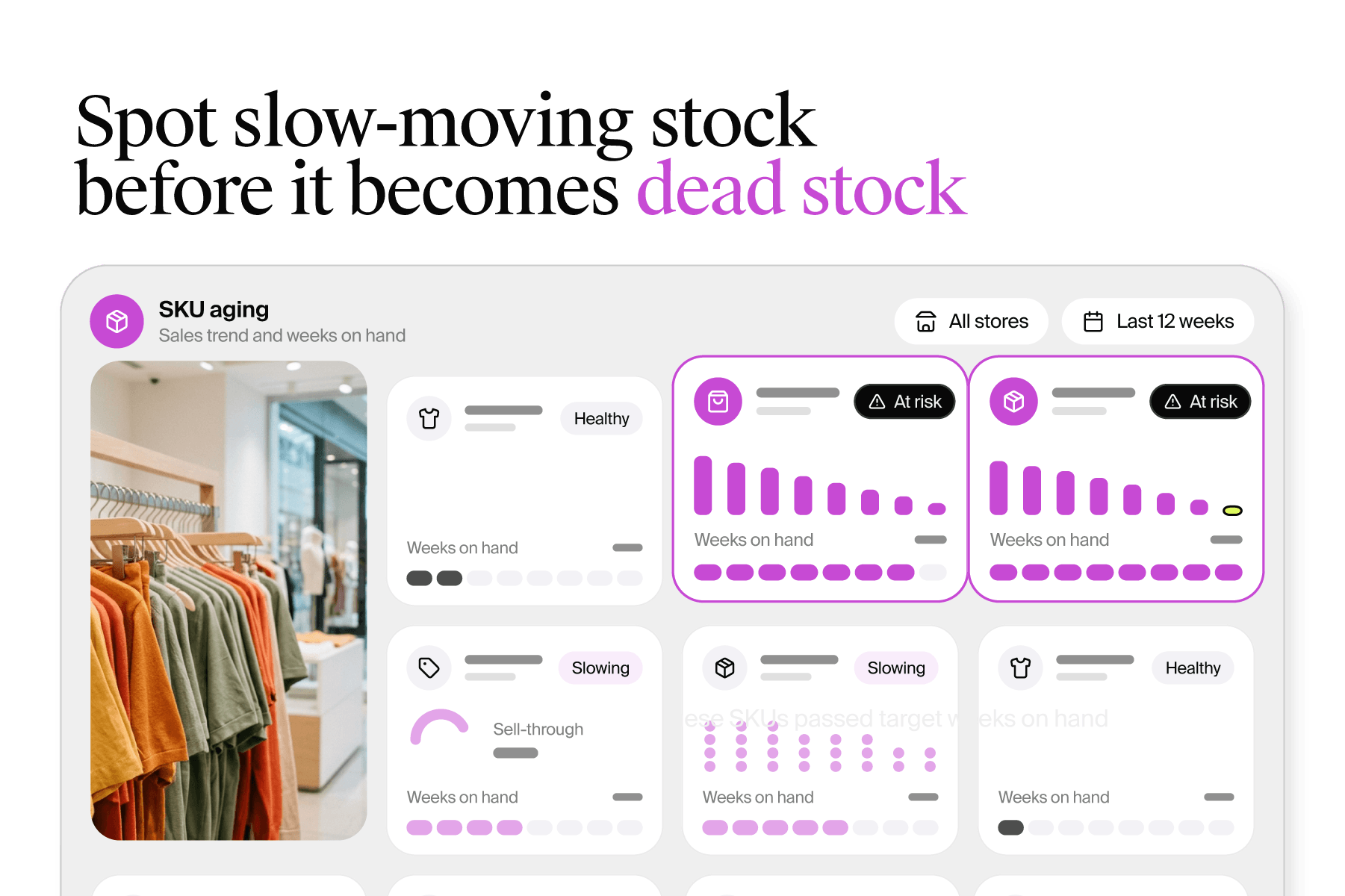
Dead stock ties up cash, consumes valuable space and erodes margin when products stop selling within their normal sales cycle. Retailers often feel the consequences in working capital first, followed by rising storage costs and deeper markdowns on merchandise that has missed its selling window.
By the time inventory becomes difficult to sell at full price, the underlying problem may have been developing for months. Dead stock inventory is often the result of earlier decisions about buying, allocation, replenishment and pricing that were not adjusted as demand changed.
According to Shopify, dead stock generally refers to inventory that has remained unsold for an extended period. For retailers, the challenge is distinguishing a temporary slowdown from a product that is unlikely to sell at its expected price. Unsold inventory is not necessarily dead stock, and slow moving inventory may still have a viable path to sale if teams act before demand fades further.
The goal is to identify risk early, recover value where possible and prevent the same patterns from creating excess stock in future seasons.
What dead stock inventory means for retailers
Dead stock is inventory that has lost much of its ability to sell through normal channels at the expected price. It may include seasonal merchandise past its peak, unpopular sizes or colors, products affected by changing customer preferences or items purchased in quantities that exceed actual demand.
Related terms describe different aspects of the problem. Excess inventory exceeds what the business needs to meet expected demand. Aged inventory has remained in stock beyond a target period. Nonmoving inventory has recorded little or no sales activity, while obsolete inventory has lost much of its commercial relevance.
These categories can overlap, but they do not always require the same response. Excess inventory may be redistributed before it becomes aged stock. A slow seller may respond to a targeted markdown. A discontinued product may need to be returned, liquidated or sold through a secondary channel.
The longer retailers wait to distinguish between these situations, the fewer recovery options they typically have. Inventory that could have sold at a modest discount may eventually require a much deeper markdown or liquidation.
Where dead stock enters the inventory cycle
 Dead stock often starts with a mismatch between the original plan and actual demand.
A retailer might buy heavily ahead of a seasonal launch based on historical sales, only to see customer preferences shift. A forecast that is not updated quickly enough can leave replenishment feeding locations that already have sufficient stock. Meanwhile, stores experiencing stronger demand may run short of the same product.
Minimum order requirements can make the problem worse. When suppliers require retailers to purchase more units than expected demand supports, excess stock accumulates before the selling season has fully developed.
Other problems emerge when teams work with disconnected systems or review inventory too infrequently. A product may be selling well in one region while sitting idle in another. Without a clear view of stock across locations, retailers can miss opportunities to transfer units before demand declines.
Seasonality makes timing particularly important. Once a product passes its peak selling window, even a small delay can leave merchandise with fewer opportunities to sell at full price.
Retailers can reduce these risks by connecting demand signals to inventory decisions. As discussed in our guide to inventory planning software, better visibility helps teams identify imbalances and respond before they become harder to correct.
Measure dead stock with aging and sales data
Retailers need more than a list of products that have not sold recently. They need to understand how long inventory has been on hand, whether it is still selling and how much time remains to recover its value.
Three measures provide a useful starting point:
- Inventory aging reports: Show how long stock has remained in inventory and help flag units approaching or exceeding expected selling windows.
- Days on hand: Estimate how long current inventory will last at the observed rate of demand. High days on hand can signal overstock when supply exceeds realistic demand.
- Inventory turnover: Measures how frequently inventory is sold and replaced over a given period. Declining turnover can indicate that stock is moving more slowly than expected.
These measures are most useful when viewed together. High days on hand may be reasonable for a seasonal product ahead of its peak, but concerning for a product nearing the end of its selling window. Low turnover may reflect a temporary lull or a more persistent decline in demand.
Accurate records matter just as much as the metrics themselves. Regular cycle counts help identify discrepancies between system records and physical stock, including misplaced units and inventory that appears available but cannot be found.
Once risk is identified, teams can classify products by their likely next action: continue selling, transfer, adjust pricing, pause replenishment or exit the inventory. This approach helps planners prioritize decisions rather than treating every aging SKU the same way.
Our overview of AI inventory management explores how better inventory signals can support more informed replenishment decisions.
Reduce markdown waste before products stop moving
Markdowns are an important recovery tool, but timing determines how much value retailers retain.
Discount too early and the retailer may give away margin on products that would have sold at full price. Wait too long and demand may have weakened enough that a much deeper discount is required. The challenge is identifying the right moment to act.
Retailers can establish thresholds based on sell-through, days on hand, remaining selling time and changes in demand. These thresholds should account for product differences rather than applying the same rule across an entire assortment.
For example, a seasonal item with high stock levels and declining demand may need a markdown before its selling window closes. A basic product with steady demand may be better served by adjusting future replenishment rather than cutting its price.
This is where the true cost of late markdowns becomes important. Teams should consider not only the eventual discount but also storage costs, tied-up working capital and the value of alternative actions that were missed.
Earlier decisions do not eliminate markdowns. They give retailers more time to choose the action most likely to recover value without discounting more than necessary.
Recover value through transfers, returns and liquidation
When inventory begins to stagnate, markdowns are not the only option. Retailers should assess whether products can sell elsewhere before accepting a lower recovery value.
Transfers can move inventory from locations with weak demand to stores where the product is still selling. The decision should account for expected demand, available sizes, transfer costs and the time remaining in the selling window.
Returns to suppliers may be possible under existing agreements, although eligibility and timing depend on the retailer's terms. Where neither transfers nor returns make commercial sense, secondary marketplaces may offer another route to sale, depending on the product and brand.
Liquidation is generally a later-stage option when other channels cannot recover enough value within a reasonable timeframe. Retailers should compare expected proceeds with handling, storage and disposal costs before deciding how to exit the stock.
In some circumstances, a potential tax deduction may be available for qualifying inventory write-offs or donations. Eligibility and treatment vary by jurisdiction and circumstances, so retailers should consult a qualified tax professional.
The key is to establish a recovery sequence before stock becomes critically aged. As inventory loses value, the cost of waiting can outweigh the potential benefit of holding out for a better selling price.
Use actual demand to improve replenishment decisions
 Clearing existing dead stock addresses the immediate problem. Preventing the next wave requires retailers to revisit the decisions that created it.
Replenishment should reflect what is happening across products and locations, not simply repeat orders based on historical patterns. Changes in sales velocity, available stock, incoming deliveries and the remaining selling window can all affect whether another order is appropriate.
For example, if sales slow while days on hand rise, the next step may be to reduce or pause replenishment rather than add more inventory. If demand strengthens in a particular location, transferring stock or adjusting future allocation may be more effective than placing a new order that arrives too late.
Stock rotation practices also matter for products with expiration dates or defined shelf-life requirements. FIFO and FEFO methods can help teams prioritize older stock or stock with the earliest expiration date, as appropriate to the product.
Retailers should also review how minimum order requirements, lead times and supplier commitments influence purchasing decisions. Where these constraints cannot be changed, planning teams may need to account for them earlier when setting order quantities and evaluating demand risk.
AI decisioning can help connect these considerations by evaluating changing demand and inventory conditions alongside the available actions. Rather than relying on a single forecast or static threshold, teams can assess whether to replenish, transfer, hold or markdown stock as conditions evolve.
Improving inventory visibility is an important part of this process. Accurate on-hand data, timely demand signals and regular reviews help teams identify emerging imbalances and adjust decisions before excess stock becomes difficult to sell.
Improve replenishment discipline before dead stock returns
Dead stock is rarely just a problem with products that failed to sell. It can reveal a wider gap between the original inventory plan and the decisions teams make as demand changes.
Retailers that monitor aging inventory, days on hand and turnover can identify emerging risks sooner. Combining those signals with timely transfers, measured markdowns and demand-based replenishment gives teams more opportunities to recover value and protect working capital.
The objective is not simply to clear old stock. It is to make better inventory decisions early enough that fewer products reach that point.
Connect with an invent.ai retail AI expert to explore how AI decisioning can help your team respond to changing demand and make more informed replenishment decisions.