
.svg)

Retail inventory visibility determines whether a retailer can act on what stock exists, where it sits and whether it matches demand at any given moment. When that visibility breaks down, the consequences move fast: shelves run empty, warehouses fill with product nobody ordered in the right quantity and customers walk. The inventory visibility platform a retailer chooses to operate on either closes those gaps or compounds them. Understanding what causes poor visibility in the first place gives operations and planning teams a clear starting point for fixing it.
What poor inventory visibility actually costs retailers
The financial toll of poor retail inventory visibility goes well beyond the obvious. IHL Group reports that the global retail industry hemorrhages $1.73 trillion annually due to inventory distortion, the combined cost of out-of-stocks and overstocks, and that retailers deploying AI and machine learning achieve sales growth 2.3 times higher and margin growth 2.5 times higher and profit growth 2.5 times higher than competitors.
That number, $1.73 trillion, represents the combined cost of two failure modes: too much stock in the wrong place and not enough stock where demand exists. Both trace back to the same root cause: retailers cannot see their inventory clearly enough to act on it accurately. Stockout prevention and overstock reduction represent two sides of the same visibility gap, not separate problems.
Inventory holding costs accumulate on product that sits too long. Order fulfillment accuracy degrades when stock records do not reflect physical reality. Loss prevention and shrinkage go undetected when no system tracks discrepancies at the unit level. The cost of poor visibility compounds across every SKU, every location and every season.
Cause 1: Legacy systems that were never built for modern retail
Many retailers still run core operations on systems built decades ago, before multi-channel fulfillment, before cross-channel inventory management and before the data volumes that modern retail generates daily. Legacy architecture never accounted for the speed or complexity modern supply chains demand.
Legacy platforms often lack the API connectivity and system integration needed to communicate with newer tools. Teams export data manually, reconcile records in spreadsheets and re-enter numbers into downstream systems. Every handoff introduces lag and error. The result: inventory data integrity erodes at every step, and planning teams make decisions based on numbers that no longer reflect what actually exists on shelves or in warehouses.
Cause 2: Siloed data across systems and teams
Even retailers that have invested in modern tools frequently run them in isolation. The POS system holds one version of stock data. The warehouse management system holds another. The e-commerce platform holds a third. None of them talk to each other in a way that produces a single, accurate picture.
Centralized inventory data requires more than just having data in multiple places. It requires those sources to reconcile continuously and feed a unified record. When demand planning teams work from different data than replenishment teams, decisions conflict. Allocation runs on assumptions that purchasing has already invalidated. Without inventory optimization at the data layer, every downstream decision loses reliability.
Cause 3: Gaps in cross-channel stock synchronization
 A customer checks online availability, drives to the store and finds the shelf empty. That failure has a name: a cross-channel stock synchronization gap. Stock sold through one channel does not update fast enough across others, and the result erodes customer trust while creating phantom availability that misleads both shoppers and planners.
Retailers operating across brick-and-mortar, e-commerce and wholesale channels face this challenge at scale. Cross-channel inventory management requires that every channel draws from and updates the same inventory record. Without that, retail inventory visibility becomes channel-specific at best, and actively misleading at worst. Inventory auditing across channels becomes nearly impossible when each channel maintains its own stock ledger.
Effective retail allocation depends on knowing exactly where stock sits across every channel before making distribution decisions.
Cause 4: Manual processes and cycle counting that cannot keep pace
Manual stock counts were the standard for decades. At the scale modern retail operates, manual counts cannot keep up. Cycle counting programs that rotate through store sections on a fixed schedule produce snapshots, not continuous accuracy. Between counts, stock moves, shrinks, gets misplaced and gets sold. The record drifts from reality.
Manual processes also consume labor that could go toward higher-value work. Associates spending hours on inventory auditing tasks that a connected system could handle automatically represent a direct cost with a diminishing return. Automated replenishment and continuous tracking replace the periodic snapshot with an ongoing, accurate record and free teams to focus on decisions rather than data entry.
Cause 5: ERP limitations and integration debt
Enterprise resource planning systems serve as the operational backbone of a retail business. Many still serve that function, but their inventory modules lack the granularity modern retail inventory visibility demands. ERP systems often aggregate data at a level that obscures store-level or SKU-level accuracy.
ERP integration debt accumulates when retailers layer new tools on top of aging ERP infrastructure without resolving the underlying data architecture. Each new system added without proper integration creates another source of discrepancy. Distributed inventory management across a large store network requires that the ERP either handles granular data natively or connects cleanly to systems that do. When neither condition holds, visibility gaps widen with every new location or channel added.
Outdated inventory planning methods often persist because ERP systems make change difficult, locking teams into processes that no longer serve the business.
Cause 6: No unified view across multiple locations
Multi-location inventory management breaks down when each location operates as an independent data silo. A retailer with 200 stores may have 200 separate stock records that no single system consolidates into an accurate network-wide view. Planning teams cannot see where excess stock sits, where shortages are developing or where transfers would resolve both problems simultaneously.
Safety stock management across a distributed network requires knowing actual stock levels at every node, not estimates. Stock level optimization at the network level depends on the same. Without a unified view, retailers over-stock some locations as a buffer against uncertainty while under-stocking others, driving up inventory holding costs across the network and creating dead stock reduction challenges that compound season over season.
Strong inventory planning treats stock as a network-wide asset, not a location-specific liability. That shift in perspective starts with unified visibility.
Cause 7: Absence of continuous, automated stock tracking
Periodic reporting tells retailers what happened. Continuous tracking tells them what to do next. The gap between those two capabilities defines the difference between reactive and proactive retail inventory visibility.
Retailers without automated replenishment and continuous tracking rely on reports already outdated by the time a planner reads them. Replenishment planning built on stale data produces orders that arrive too late or in the wrong quantities. Vendor-managed inventory arrangements that lack actual data feeds from the retailer's systems produce the same result from the supplier side. A lean inventory approach requires accurate, current data to function. Without continuous tracking, lean becomes guesswork.
Inventory optimization at scale requires that stock data updates continuously as product moves, sells, transfers and returns. A system that captures those movements automatically eliminates the manual reconciliation burden and keeps inventory data integrity intact across every location and channel.
What retail inventory visibility actually requires in 2026
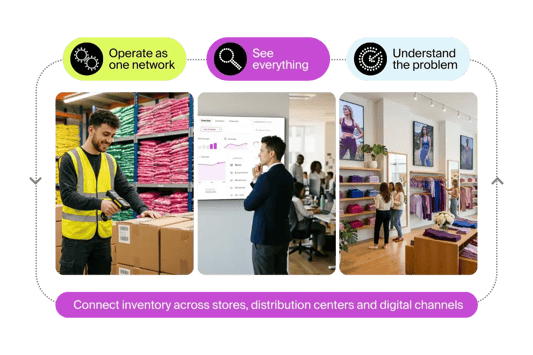 Closing the visibility gap requires more than adding a new reporting tool. It requires addressing the structural causes outlined above: legacy architecture, siloed data, disconnected channels, manual processes, ERP limitations, fragmented location data and the absence of continuous tracking.
Retail inventory visibility in 2026 means having a single, accurate record of stock across every location and channel, updated continuously, connected to demand planning and replenishment planning workflows and capable of surfacing exceptions before those gaps become losses. Distributed inventory management at scale requires that every system in the stack contributes to and draws from that unified record.
The retailers closing the performance gap identified in IHL Group's research do not do so by working harder on the same processes. Those retailers replace outdated processes with connected, automated systems that produce the inventory data integrity accurate decisions require. Dead stock reduction, stockout prevention and overstock reduction all follow from that foundation.
Strengthen retail inventory visibility with invent.ai
Invent.ai's inventory visibility platform connects forecasting, allocation, replenishment and transfers into a single AI-powered execution layer. Stock data updates continuously as product moves, sells, transfers and returns, feeding a unified record that planning teams act on with confidence. If poor retail inventory visibility costs your operation in stockouts, excess stock or fulfillment failures, connect with the invent.ai team to see what closing those gaps looks like in practice.