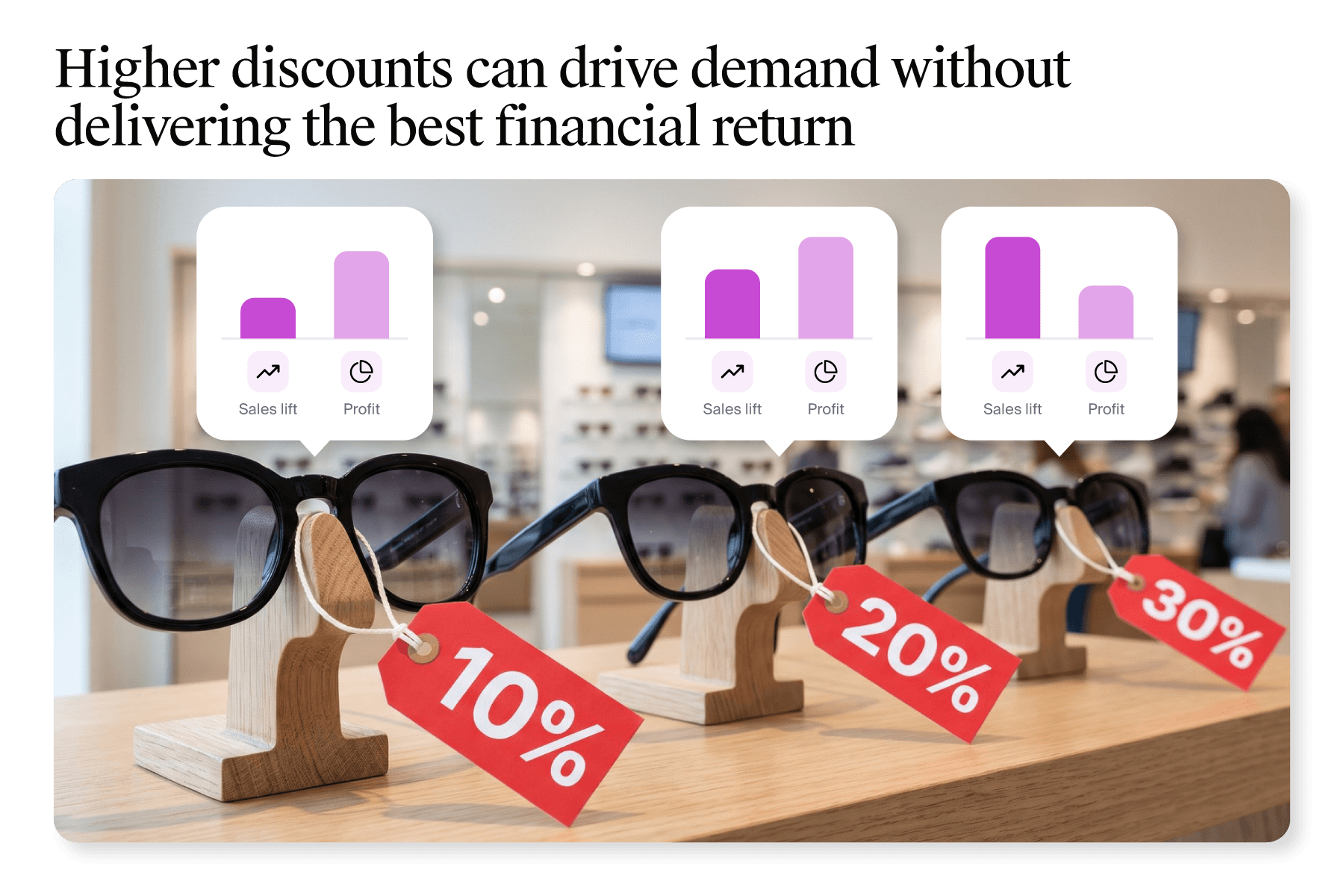
Retailers have spent decades refining how they plan, execute and measure promotional campaigns. Yet one of the most important questions remains difficult to answer: Did the discount actually make the business more profitable?
Higher transaction volumes, increased revenue and stronger sales lift are often treated as signs of success, but they don't always tell the full story. An offer may encourage customers to buy products they would've purchased anyway, shift demand away from higher-margin alternatives or create inventory imbalances that lead to further markdowns. However, more sales don't necessarily translate into greater profitability.
When margins are tight and shoppers expect discounts, a bump in sales only tells part of the story. Good promotion planning means asking how much more shoppers will buy at a lower price, how quickly inventory will sell and whether the extra sales will make up for the discount. Retail promotion optimization makes that possible by connecting these factors, helping teams identify which opportunities deserve investment and which are unlikely to deliver meaningful returns.
The problem with measuring promotional success through sales lift
For years, sales lift has been a central measure of promotional effectiveness. If revenue increases during an event, the strategy appears successful. But that growth doesn't necessarily represent additional demand or profit.
Consider a popular product discounted by 25% that experiences a temporary substantial increase in unit sales. Some shoppers may have been willing to pay full price, while others might have switched to a more cost effective alternative or purchased earlier than planned, reducing demand in subsequent weeks. The campaign generated transactions, but its actual contribution to the business is less clear.
This distinction between total revenue and incremental sales lift is critical. Traditional promotion performance analysis often struggles to capture these relationships, particularly when pricing, merchandising and inventory teams work from separate systems. An event may perform well within one category while reducing profitability elsewhere, or generate short-term revenue at the expense of higher replenishment costs and excess stock.
A more complete assessment considers what would've happened without the discount, how purchasing behavior changed and whether the additional volume justified the financial tradeoffs. Without that context, businesses risk repeating campaigns that generate activity without creating much additional value.
Why retail promotion optimization needs to move beyond historical calendars
Much of retail promotion planning still starts with last year's calendar. Seasonal events are repeated, familiar discount levels are applied and budgets are distributed according to previous results. This approach provides structure for teams coordinating merchandising, marketing, supply chain and store operations, but it can also preserve outdated assumptions.
An event that performed well last season may produce very different results today as customer preferences evolve, competitors adjust their prices and stock availability changes. Relying on past performance assumes that the conditions behind earlier success still exist, even when market signals suggest otherwise.
Effective retail promotion optimization uses historical results as a starting point rather than a fixed template. Current demand, inventory positions, margin objectives and customer behavior all contribute to determining whether an offer remains commercially justified. This changes the role of the promotional calendar from a predetermined schedule into a framework that can adapt as business conditions evolve.
The objective isn't to abandon established events, but to evaluate their relevance and identify where adjustments to timing, pricing or product selection could improve sell-through, protect margins and better align inventory with demand across individual stores and online channels.
The economics of discounting go beyond price elasticity
Discounting is often approached as a straightforward relationship between price and demand: lower the price, stimulate purchases and increase revenue. In practice, the economics are far more complicated because every offer can influence other products, categories, channels and inventory positions.
A deeper price reduction may increase demand for one item while taking sales away from a higher-margin alternative. An aggressive clearance campaign could accelerate stock movement but sacrifice more revenue than necessary. These relationships make discount depth one of the most consequential elements of promotional pricing strategy, particularly when businesses must balance immediate sales targets with longer-term financial objectives.
Retail promotional and pricing tools help teams assess these tradeoffs by estimating how customers will respond to different price points and identifying where additional reductions are unlikely to generate enough volume to justify the lost margin. Increasing a discount from 15% to 25%, for example, might stimulate purchases without producing a proportional improvement in gross profit. In another situation, a deeper reduction could be justified if it prevents seasonal inventory from requiring even larger markdowns later.
The appropriate strategy depends on the commercial objective, which is why discount optimization can't be separated from forecasting, assortment planning or inventory management. The goal is to find the price that delivers the greatest value, not simply the highest sales volume in the short term.
How AI changes what retail promotion optimization can deliver
 Retail businesses already collect extensive information about transactions, customer behavior, pricing and inventory. The challenge lies in connecting those signals and understanding how different variables influence one another. Traditional approaches often require teams to reconcile spreadsheets, manually compare alternatives and work through competing assumptions, limiting the range of options they can assess.
AI changes the scale and speed of this analysis. Modern retail promotion optimization can evaluate combinations of products, prices, timing and supply constraints that would be impractical to assess manually. Demand forecasting estimates how shoppers may respond to different offers, while financial optimization considers their expected contribution to revenue and margin.
This creates opportunities for more sophisticated scenario testing. Instead of reviewing a single proposal, merchandising teams can compare whether a smaller discount could produce similar volume, whether shifting an event to another week would improve returns or whether targeting selected locations would reduce unnecessary markdowns. Through what-if simulation, these alternatives can be evaluated before resources are committed.
The same approach supports promotional budget allocation, allowing businesses to direct spending toward events with stronger expected returns rather than relying primarily on historical expenditure. It also strengthens data-driven promotions by incorporating current conditions into recommendations.
The greater opportunity, however, extends beyond forecasting. AI decisioning can identify potential issues, explain the financial reasoning behind suggested actions and evaluate alternatives within the retailer's operating constraints. This allows merchandising and pricing leaders to focus on selecting the most valuable course of action rather than spending hours assembling the information needed to reach a conclusion.
Why promotion planning and inventory can't operate separately
Even a compelling offer can underperform when the right products aren't available where customers need them to be. A pricing team might identify an attractive discount but lack sufficient stock in high-demand stores or across online channels, where customers can easily compare prices and switch between retailers. An online promotion might drive a surge in demand that available inventory or fulfillment capacity can't support, resulting in missed sales and disappointed customers. Conversely, an event that generates less interest than expected can leave excess inventory across stores and distribution centers, requiring additional markdowns. Both outcomes weaken the financial return.
These risks become more significant when promotion planning and replenishment operate independently. Pricing teams may develop strategies around expected demand, while supply chain teams rely on forecasts that don't fully reflect upcoming campaigns. By the time execution begins, product availability and commercial objectives may already be misaligned.
Connecting forecasting, allocation and replenishment with promotional strategy allows businesses to assess whether stock levels can support an event, where inventory should be positioned and how the expected increase in demand will influence future requirements. It also makes alternative responses easier to evaluate. When availability is constrained, reducing the discount, adjusting the timing or limiting the offer to selected stores may be more profitable than increasing replenishment.
This connected approach recognizes that successful execution depends on more than choosing the right price. It requires aligning commercial priorities with the operational capacity to deliver them.
From promotional ROI to a more complete view of profitability
Measuring promotional ROI requires more than comparing campaign revenue with its direct costs. Retailers also need to understand how an event changes purchasing behavior and affects financial performance beyond the discounted products.
An offer may increase sales while cannibalizing demand from another item, or encourage shoppers to purchase earlier than usual, reducing revenue in subsequent weeks. A clearance campaign, meanwhile, may create value by reducing future markdown exposure even if its immediate gross margin contribution is modest. These relationships make promotion effectiveness measurement more complex than reviewing transaction totals.
A more thorough complete evaluation considers incremental revenue, margin, substitution effects, inventory costs and changes in purchasing patterns. Post-event attribution modeling helps estimate which sales resulted from the campaign and which would've occurred anyway, providing a stronger basis for calculating return on promotional investment (ROPI).
For grocery and CPG businesses, these calculations can be particularly challenging. Frequent discount cycles, narrow margins and relationships between complementary products mean cross-promotion bundling and category-level demand shifts must be assessed alongside individual item performance. Customer segmentation targeting and loyalty program integration can add further context by showing how different shopper groups respond to offers and whether incentives encourage new purchases or primarily reward existing demand.
The value of this analysis depends on how it's used. If a campaign consistently produces limited incremental revenue, its structure may need to change. If a smaller reduction generates comparable volume at a higher margin, that finding should inform future pricing. A/B testing promotions can help validate these assumptions, while subsequent forecasts incorporate the results to improve future recommendations.
Connecting promotional performance analysis with forward-looking planning creates a continuous learning process, allowing teams to refine their approach rather than repeat strategies that no longer deliver sufficient value.
The next evolution of promotional calendars is continuous decisioning
Traditional calendars are built around scheduled events and established planning cycles, but market conditions rarely follow the same timetable. Demand fluctuates, competitors adjust prices, supply constraints emerge and customer behavior changes. An offer that appeared attractive during the initial planning period may no longer represent the best commercial choice when execution approaches.
AI-driven promotional calendar planning allows teams to reassess upcoming activity as new information becomes available. Instead of treating every event as a fixed commitment, businesses can monitor changes in expected demand, stock availability and financial performance, then evaluate whether the original strategy remains appropriate.
When conditions shift, AI can identify emerging risks, explain why an adjustment may be warranted and compare possible responses. This also enables more flexible promotional budget allocation, helping businesses redirect investment toward opportunities with greater expected value.
For omnichannel retailers, coordination becomes even more important. Offers running across physical stores, ecommerce platforms and marketplaces can overlap, create inconsistent pricing or reduce margins unnecessarily. Dynamic pricing models can help assess these relationships, while personalized offer delivery supports more relevant incentives across different customer groups.
However, personalization alone doesn't guarantee better results. Excessive discount frequency can encourage shoppers to wait for the next offer, making customer fatigue management an important consideration. Whether a retailer is planning flash sale execution, seasonal campaigns or targeted incentives, each activity needs to be evaluated against its contribution to the wider business.
Continuous optimization doesn't remove the need for human judgment. Instead, it gives teams clearer recommendations, supporting evidence and alternative options, so they can respond to changing conditions without relying entirely on decisions made months earlier.
What retail leaders should demand from promotion optimization technology
 As AI becomes more widely adopted across merchandising and planning, the distinction between generating predictions and supporting commercial decisions is becoming increasingly important. A forecast might indicate that an offer will increase demand by 15%, but it doesn't necessarily establish whether the event should proceed, whether the reduction is too aggressive or whether another strategy could produce a better financial result.
Modern retail promotion optimization software needs to connect demand forecasting, pricing, inventory and financial evaluation within a single decision-making process. It should allow teams to compare alternatives, understand constraints and assess the expected consequences of different actions before committing to a strategy.
Explainability is equally important. If AI identifies an event that's unlikely to deliver sufficient incremental value, buyers and category managers should understand the demand signals, margin considerations and supply constraints behind that recommendation. They should also be able to review alternatives and determine which option best aligns with commercial priorities.
This approach moves beyond the limitations of traditional trade promotion management, which primarily focuses on funding, supplier agreements and promotional expenditure. While those functions remain important, retailers also need to understand how offers influence customer demand, inventory productivity and overall financial performance.
The objective isn't to replace commercial expertise, but to make it more effective. By bringing relevant information, analysis and recommended actions together, teams can spend less time reconciling disconnected data and more time addressing the opportunities that matter most.
Moving from promotional activity to profitable growth
Retailers have become highly effective at executing discounts, but the next challenge is determining which offers genuinely deserve investment. That starts with changing how success is measured. Higher transaction volumes and stronger sales lift matter when they contribute to broader commercial goals, but without understanding incremental demand, margin and inventory consequences, businesses can mistake activity for profitable growth.
Retail promotion optimization helps close that gap by connecting forecasting, promotional price optimization, inventory and financial analysis across the planning lifecycle. With invent.ai's AI-decisioning platform, merchandising and pricing teams can identify opportunities, understand the reasoning behind recommendations and evaluate alternatives before approving actions.
Rather than relying on what worked previously, businesses can determine which strategies are most likely to create value under current conditions. The most profitable promotion isn't always the one that generates the greatest increase in sales. Sometimes, it's knowing which discount not to offer.