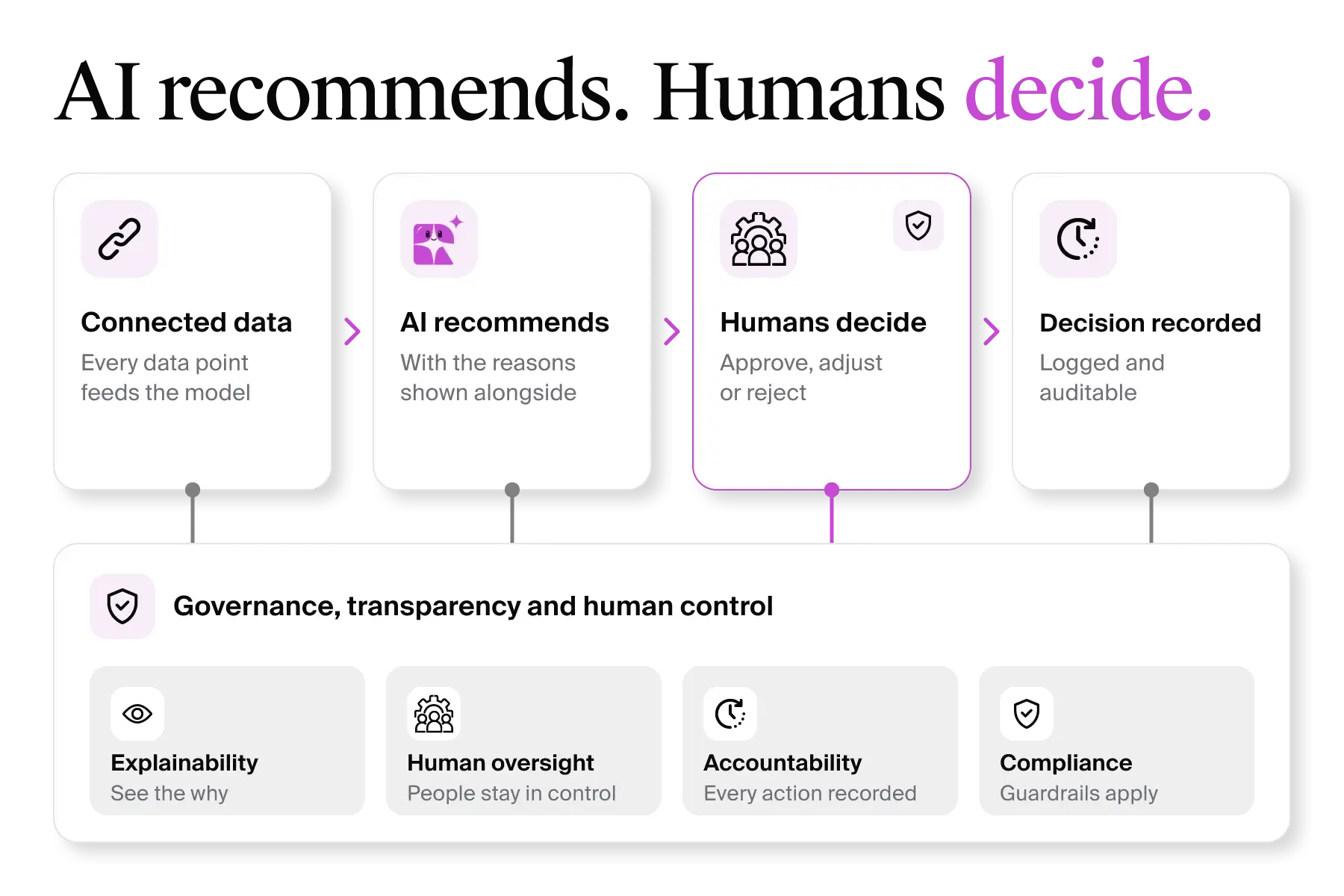
Retail pricing has always involved balancing competing priorities. Teams need to protect margins, stay competitive, respond to demand and keep customers coming back. AI makes it possible to evaluate these trade-offs and act faster, but it also raises an important question: who is responsible for the decisions AI makes?
As retailers use AI to recommend prices, adjust promotions and respond to market changes, AI governance becomes an essential part of retail pricing strategy. Without clear controls, even a well-designed system can produce recommendations that conflict with business objectives, introduce unintended bias or create compliance risks. Effective governance doesn't mean slowing every decision down. It means establishing clear rules for how AI operates, when people need to intervene and how decisions are reviewed. For pricing leaders, the goal is to move faster without giving up visibility, accountability or control.
What is AI governance and why does it matter for pricing leaders?
AI governance refers to the policies, processes and controls that determine how AI is developed, deployed and used within an organization. It establishes who is accountable for AI-driven decisions, how risks are managed and what safeguards are needed to ensure systems operate as intended.
In retail pricing, those safeguards have direct business implications.
Consider an AI system that recommends a significant price reduction to improve sell-through. The recommendation might increase sales, but what happens if it pushes margins below an acceptable threshold? What if the same adjustment conflicts with a supplier agreement or creates an inconsistent pricing experience across channels?
These are the situations where a clear AI governance framework matters. Pricing teams need to understand why a recommendation was made, whether it meets business requirements and who has the authority to approve or reject it.
The objective isn't to eliminate automation, but to make sure that decisions remain aligned with business priorities.
AI governance frameworks vs. responsible AI programs
Although closely related, AI governance frameworks and responsible AI programs serve different purposes.
An AI governance framework establishes the formal structure for managing AI. It defines policies, approval requirements, risk thresholds and decision ownership.
A responsible AI program focuses on how those principles are applied in practice. It promotes the responsible use of AI through ethical guidelines, employee training, ongoing monitoring and clear expectations for how systems should behave. For retail pricing teams, both are necessary.
A governance framework might require approval before an automated price change exceeds a defined threshold. A responsible AI program helps ensure pricing analysts understand why that threshold exists, how to evaluate exceptions and when to challenge a recommendation. Together, they turn governance from a set of written policies into a practical operating model.
This becomes especially important as retailers introduce AI agents capable of recommending and executing actions across multiple workflows.
Establishing accountability for AI-driven pricing decisions
When AI influences pricing, accountability can't be left solely to the technology. Retailers need clear accountability mechanisms that establish who owns each decision, who can approve changes and what happens when something goes wrong.
For example, an AI system might identify an opportunity to increase prices on products with strong demand and limited inventory. Before that recommendation is executed, the business needs to know whether it falls within approved pricing rules and whether additional review is required. Instances like this are where accountable AI becomes practical.
Decision logs and audit trails should make it possible to trace a recommendation from the underlying inputs through approval and execution. Teams should be able to see what changed, why it changed and who authorized the action.
Clear ownership also matters when exceptions occur. If a recommendation conflicts with a business rule, pricing teams need an established escalation path rather than having to determine responsibility after the fact. The more decisions AI supports, the more important these controls become.
Why transparency and explainability matter in pricing
Pricing leaders shouldn't have to accept an AI recommendation simply because a system produced it. Transparency and explainability help teams understand the factors behind a recommendation and evaluate whether the proposed action makes business sense.
Imagine an AI system recommends a 15% markdown on a seasonal product. A pricing manager needs more than the suggested percentage. They need to understand what's driving it. Is demand falling faster than expected? Is inventory building in certain stores? Is the remaining selling window getting shorter? Would a smaller markdown protect more margin while still clearing enough inventory?
Explainable AI makes these trade-offs easier to evaluate by presenting the reasoning behind recommendations in terms business teams can understand. That visibility helps pricing teams challenge assumptions, compare alternatives and make informed decisions without having to interpret complex model outputs. It also supports adoption. People are more likely to trust AI when they can understand its recommendations and retain the ability to question them.
This balance is central to effective human-AI collaboration in retail planning, where technology handles complex analysis while people provide business context and judgment.
Managing bias and fairness in AI pricing
 AI pricing systems learn from data, and that data doesn't always tell the full story. Historical sales patterns, promotional activity and differences between stores can influence recommendations in ways that produce unintended outcomes.
For example, a model trained primarily on high-volume locations might perform poorly in smaller stores with different demand patterns. Similarly, historical promotions could cause a system to repeatedly recommend deeper discounts for certain products, even when those discounts are no longer necessary. Bias mitigation helps retailers identify and address these patterns before they become persistent pricing problems. An effective AI governance program should include regular testing for unusual recommendations, performance differences across locations and changes in model behavior over time.
Bias and fairness also require business context. Different prices aren't automatically unfair, and legitimate differences in demand, costs and inventory can justify different pricing decisions. The important question is whether those decisions follow consistent, defensible rules and comply with applicable requirements. By monitoring outcomes and reviewing exceptions, retailers can reduce unintended bias while maintaining the flexibility needed for effective pricing.
Protecting customer and commercial data
AI pricing systems can rely on large amounts of information, including transaction histories, inventory levels, competitor prices and customer behavior. That makes data privacy and data protection essential parts of governance. Pricing teams need to know what information their AI systems can access, how that information is used and whether sensitive data is appropriately protected.
For example, a pricing model may use aggregated purchasing trends to identify demand changes without needing access to individual customer identities. Limiting unnecessary data exposure can reduce privacy risks while preserving the information needed for effective decisions.
Strong governance includes role-based access controls, data retention policies and clear rules for handling sensitive information. It also requires visibility into where data originates and how it moves between systems. These safeguards support regulatory compliance while protecting commercially sensitive information and customer trust. As AI becomes more connected across retail operations, data governance needs to extend beyond individual pricing tools to the broader planning environment.
Building risk management into everyday pricing decisions
AI systems don't operate in a static environment. Demand changes, competitors adjust prices and unexpected events can quickly make yesterday's assumptions less relevant. That's why risk management needs to continue well beyond initial deployment. A practical AI risk assessment should consider what could go wrong, how significant the consequences might be and what controls are needed to prevent or contain those outcomes.
For pricing teams, poorly managed AI tools can lead to excessive markdowns, unexpected margin erosion, inaccurate demand signals and recommendations that violate established pricing policies. Retailers can manage these risks through predefined thresholds, automated monitoring and escalation procedures.
For example, a system might be permitted to execute routine price adjustments within an approved range while requiring human approval for changes that exceed a margin threshold. Teams should also have a way to pause or reverse actions when recommendations produce unexpected results.
These controls allow retailers to automate lower-risk decisions while maintaining closer oversight where financial or operational exposure is greater. Strong governance also depends on the broader security and operational controls supporting AI systems. Learn more about invent.ai's approach to security and compliance.
Keeping human oversight where it matters most
One of the biggest misconceptions about AI governance is that every automated decision requires manual approval. In practice, effective human oversight means matching the level of review to the risk and importance of the decision. Routine pricing adjustments that fall within established business rules may not require individual approval. More significant decisions, such as aggressive markdowns, changes affecting sensitive categories or actions with substantial margin implications, may warrant closer review.
The key is giving teams the ability to intervene when necessary. A pricing manager should be able to review a recommendation, understand its expected outcome, approve or reject it and adjust the proposed action when business conditions require a different approach. This human-centered AI model combines the speed of automation with the judgment of experienced retail teams.
It also creates a more practical path to adoption. Rather than handing over control all at once, retailers can expand automation as teams gain confidence in the system and its recommendations.
Building these controls into early deployments is particularly important. Our guide to designing a retail AI pilot that leads to full deployment explains why clear objectives, measurable outcomes and operational readiness matter from the start.
Navigating AI regulations and pricing compliance
Retailers operating across multiple markets face an increasingly complex regulatory environment. AI governance must account for both emerging AI-specific rules and existing laws governing pricing, competition, consumer protection and personal data.
The EU AI Act is one important development. It entered into force on August 1, 2024, with requirements introduced through a phased implementation process. However, not every retail pricing application falls into the same regulatory category. Requirements depend on factors such as the system's intended purpose, risk classification and the organization's role in developing or deploying it. Pricing leaders should assess which provisions apply rather than assuming every AI pricing tool is subject to the same obligations.
Retailers also need to consider established regulatory requirements, including competition law, restrictions on misleading pricing practices and applicable privacy regulations. For example, AI-assisted pricing should not create prohibited coordination between competitors or generate promotional claims that misrepresent customer savings.
Effective sector-specific compliance means translating these legal requirements into practical controls, such as approved pricing boundaries, documentation standards and escalation procedures. Because requirements differ across jurisdictions, organizations should review their governance practices regularly and involve legal and compliance teams when introducing new AI capabilities or expanding into additional markets.
Building trust in AI across the retail organization
 Governance isn't only about preventing problems. It also helps people become more comfortable using AI in their everyday work. Pricing analysts, merchants and business leaders need confidence that recommendations are reliable, explainable and aligned with company objectives. That confidence develops through consistent results, clear responsibilities and opportunities to challenge AI outputs.
AI literacy programs can help teams understand how systems generate recommendations, recognize potential limitations and determine when human intervention is appropriate. Retailers should also consider the workforce automation impact of introducing AI into pricing workflows. As technology takes on more routine analysis and execution, employees may spend less time manually evaluating data and more time reviewing exceptions, assessing trade-offs and making strategic decisions.
Clear roles and training help make that transition more effective. The same principles support public trust building. Customers may never see the governance processes behind a price change, but they experience the results through pricing consistency, transparency and fair treatment.
Maintaining a responsible innovation balance means giving teams the freedom to use AI while establishing safeguards appropriate to the potential consequences. Considering the broader societal impact of automated decisions, including their effects on customers and employees, should be part of that process.
Ultimately, trust grows when organizations can explain how AI is used and demonstrate that people remain accountable for the outcomes.
Put AI governance into practice with invent.ai
Effective AI governance shouldn't sit separately from the systems making pricing and inventory decisions. It needs to be part of how recommendations are evaluated, approved and executed. For retail pricing leaders, that means moving beyond policies on paper to practical controls that support everyday decision-making.
Invent.ai connects forecasting, inventory optimization and pricing within an end-to-end AI-decisioning platform, helping retailers evaluate decisions against business objectives and understand the trade-offs before taking action. Through explainable recommendations and human-in-the-loop workflows, teams can review proposed actions, maintain oversight and make decisions with greater confidence.
With Remi, invent.ai's AI orchestration agent, retailers can identify opportunities, understand what's driving them and move from recommendations to approved actions while keeping people in control.
AI governance doesn't have to come at the expense of speed. With the right controls built into the decision-making process, retailers can respond faster to changing conditions while maintaining the accountability and visibility their businesses require. Get in touch with us to see how invent.ai keeps your team in command of every pricing and inventory decision.