
.svg)
Grocery retail has always been a precision game. Thin margins, perishable inventory, unpredictable demand and a shopper base that will switch loyalties over a single out-of-stock. The question of what AI technologies are transforming grocery retail matters because retailers can no longer afford slow and reactive decision-making when it comes to inventory planning. With margins under pressure and customer expectations rising, every inventory, pricing and planning decision carries greater weight. At the same time, AI technology has reached a level of sophistication that allows retailers to make smarter decisions with greater speed and confidence than ever before.
This isn't a future-state conversation. Grocery retailers are now deploying AI across forecasting, shelf operations, pricing, personalization and planning right now in order to align decisions with real-time demand. The gap between operators who have moved and those still evaluating widens every quarter.
What AI technologies grocery retailers use today
At the core of most AI strategies in grocery retail are AI-powered demand forecasting and inventory optimization, which help retailers anticipate customer demand, maintain product availability and reduce waste.
AI agents continuously analyze millions of SKU-location combinations, incorporating demand signals such as seasonality, promotions, weather and purchasing behavior to generate precise replenishment recommendations at a level of granularity, speed and accuracy that human planning teams simply cannot match. That alone delivers meaningful supply chain efficiency gains for mid-to-large grocery retailers.
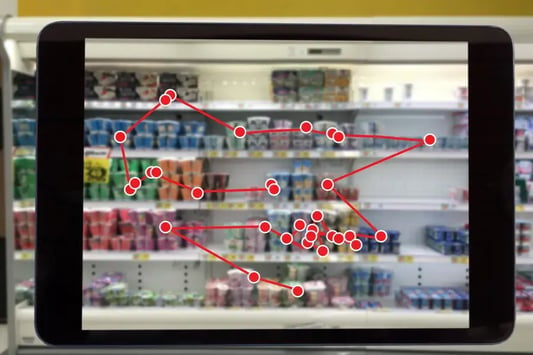
But forecasting is only one piece of the puzzle. Computer vision in retail helps grocery retailers keep a constant eye on shelf conditions, identifying issues before customers notice them. Shelf scanning robots provide a live view of in-store inventory, while replenishment automation turns those insights into action, ensuring products are reordered when they’re actually needed. Together, these technologies feed into end-to-end process networks that connect what’s happening on the shelf to the decisions being made across inventory, planning and supply chain operations.
How grocery retailers reduce food waste with AI
 Nowhere is the impact of AI more apparent than in perishables, where even small improvements in planning can significantly reduce waste and improve availability. Produce, dairy, bakery and prepared foods carry expiration risk that compounds quickly when forecasting falls short. AI agents trained on actual sales velocity, markdown history and supplier lead times generate order quantities that reflect genuine demand rather than inflated safety stock. The result shows up directly in gross margin: less overstock, fewer emergency markdowns and less shrink.
AI-powered demand forecasting at the SKU and store level allows retailers to move beyond broad assumptions and plan against true demand, improving availability while minimizing unnecessary inventory. Grocery retailers who deploy these models consistently reduce shrink in perishable categories. Precision replaces the guesswork. Addressing phantom inventory is part of that precision: when shelf reality matches system records, markdown and replenishment decisions land correctly. That accuracy also feeds dynamic pricing decisions, where AI agents recommend markdown timing and depth on near-expiry items to clear stock before waste occurs rather than after.
AI decisioning vs traditional forecasting in grocery
Traditional grocery forecasting was built on historical averages, buyer intuition and spreadsheet-driven planning cycles. Those methods were designed for a retail environment with smaller assortments and more stable demand patterns. Today’s grocery landscape is defined by greater complexity, faster-changing consumer behavior and far more variables than traditional approaches were built to handle.
The distinction matters. AI decisioning doesn't just produce a forecast. It acts on one. Rather than generating a number that a planner then interprets and manually converts into a purchase order, AI agents generate recommended actions (buy this quantity, at this location, at this price and by this date) and flag exceptions for human review. This shift from passive reporting to active recommendation closes the AI ROI gap that many retailers experience when forecasting tools receive investment but execution stays in manual workflows. Purchasing pattern analysis feeds these recommendations continuously, so the system sharpens with every transaction cycle.
The distinction matters. Traditional forecasting tools generate insights, but teams still have to decide what to do with them. AI decisioning takes the next step by turning forecasts into recommended actions, whether that’s adjusting order quantities, reallocating inventory or identifying exceptions that need attention. By connecting insights directly to decisions, retailers can close the AI ROI gap that often emerges when forecasting improves but execution remains manual. Purchasing pattern analysis helps keep those recommendations relevant over time, continuously incorporating new customer behavior and transaction data as conditions change.
Demand forecasting and inventory alignment in grocery retail
Demand forecasting and inventory optimization are inseparable in grocery. A forecast that doesn't translate directly into inventory positioning decisions produces no operational value. It simply generates a number that someone else has to act on.
AI agents operating across end-to-end process networks help retailers keep forecasts, allocation, replenishment and inventory movements aligned as conditions change. When demand shifts because of a weather event, a viral social media trend or a competitor promotion, the system can adjust recommendations across the business in near real time rather than waiting for the next planning cycle. This faster response supports out-of-stock reduction efforts by helping retailers keep products available when and where customers want them, while minimizing the online lost sales that occur when shoppers encounter unavailable items and choose a competitor instead.
Supply chain AI also enables grocery retailers to model multiple scenarios simultaneously (promotional lifts, new product launches and seasonal peaks) and pre-position inventory before demand materializes rather than reacting after the fact. That proactive posture separates high-performing grocery operators from those perpetually chasing stockouts and overstock at the same time.
How personalization AI drives grocery customer loyalty
 Personalization in grocery has moved well beyond generic email promotions and segment-based offers. Recommendation engines grocery now power in-app product suggestions, targeted promotions and automated replenishment reminders that reflect each shopper's actual purchase history. Customer engagement AI analyzes basket composition, visit frequency and category preferences to surface offers that feel relevant rather than random. Relevant offers drive conversion at a higher rate than broadcast promotions. When shoppers receive offers that align with their needs, they’re more likely to engage, return and remain loyal over time.
Personalized retail media and loyalty programs now operate as interconnected systems. Retailers can better match shoppers with relevant brand offers, improve campaign performance and create more value from their first-party data. At the same time, fraud detection retail capabilities help protect loyalty programs from coupon abuse, duplicate accounts and other activities that can undermine program effectiveness. Together, these capabilities help retailers strengthen customer relationships while improving the performance of their loyalty and media initiatives.
Agentic AI and the future of grocery planning
Agentic AI grocery represents the next evolution step in grocery operations. Where earlier AI tools produced recommendations for humans to approve, today’s AI agents now execute decisions autonomously within defined parameters, adjusting prices, triggering replenishment orders, reallocating inventory between locations and updating promotional plans without waiting for sign-off on every action
The reason is simple: the volume and complexity of decisions required across thousands of SKUs, multiple channels and hundreds of stores has outgrown what planning teams can realistically manage manually. As grocery operations become more dynamic, retailers are looking for ways to make faster, more consistent decisions at scale while allowing teams to focus on higher-value strategic work.
Multi-agentic retail AI takes this further by coordinating multiple AI agents across functions (forecasting, pricing, inventory and promotions) so that decisions made in one domain automatically account for constraints and opportunities in others. A markdown decision on a perishable item triggers a corresponding adjustment in the replenishment order for that SKU, preventing the system from ordering more of a product already being cleared. This coordination across back-end operations AI eliminates the siloed decision-making that has historically caused grocery retailers to optimize one metric at the expense of another. Cashierless checkout and automated checkout systems extend this autonomous execution to the front end of the store, removing friction at the point of purchase and feeding transaction data back into demand models as each transaction completes.
Connect with invent.ai to advance your grocery AI strategy
The grocery retailers leading their markets in 2026 aren't treating what are the latest AI technologies used in grocery retail as a research question. They've answered it operationally. AI-powered demand forecasting, inventory optimization, computer vision in retail, personalized marketing and agentic AI grocery are no longer emerging capabilities. These tools form the standard operating toolkit of high-performing grocery retailers.
The AI ROI gap closes fastest for operators who move from pilot to production AI deployment with a clear sequencing plan and a platform built for grocery-specific complexity. Invent.ai delivers AI decisioning purpose-built for grocery and convenience retailers, spanning AI-powered demand forecasting, inventory optimization, pricing and personalized retail media.
Explore the full scope of grocery and convenience AI to see where the technology delivers the most measurable value. Connect with the invent.ai team to build a grocery AI strategy that generates measurable results from day one.