
.svg)

Peak season planning is not a once-a-year exercise for retail teams. It is the operating discipline that determines whether demand spikes become profitable growth or avoidable strain. When preparation starts early, merchandising, supply chain, store operations and ecommerce teams can align around one plan instead of reacting in silos once pressure builds.
Many teams improve early execution by aligning capacity with demand before operational gaps appear. The planning window is narrower than many teams assume. As reported by Deloitte’s 2026 forecast, holiday retail sales are projected to total between $1.70 trillion and $1.71 trillion during the November 2026 through January 2027 period, representing an increase of 4.0% to 4.8% from the same period in 2025.
For retailers, that makes early decisions around demand, inventory, labor and fulfillment increasingly important.
What is peak season planning?
Peak season planning is the cross-functional work of preparing for the highest-volume period of the retail calendar. It covers demand forecasting, inventory management, seasonal staffing, fulfillment operations and returns management.
The objective is straightforward: have the right products, people and processes ready when demand peaks.
That means deciding how much inventory to commit, when to replenish it, where to position stock and how to respond when demand differs from the original plan.
How to build a peak season planning checklist your operations team will actually use
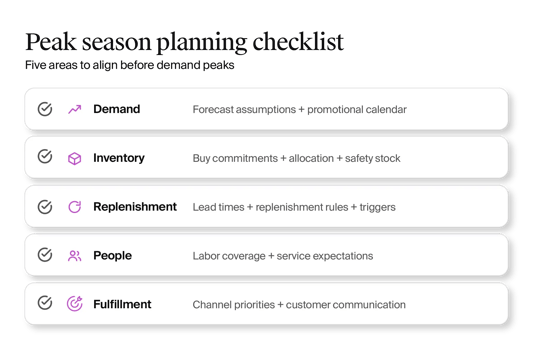 A useful peak season planning checklist is short, owned by named decision makers and reviewed weekly. It should not become a static document after kickoff.
Build it around the functions carrying the greatest operational risk: planning, merchandising, supply chain, store operations and ecommerce. Each item should answer three questions:
- Who owns the action?
- When is it due?
- What signal would trigger a change?
Planning teams should establish demand planning assumptions, promotional calendars and buy commitments. Merchandising can confirm category priorities, allocation rules and exceptions for key items. Supply chain teams should validate replenishment planning, vendor lead times and safety stock thresholds. Store and digital teams can define labor coverage, service expectations and customer communication during peak.
Teams managing mixed assortments can also improve decisions by using inventory management approaches tailored to hard goods and soft goods.
Keep the checklist operational rather than aspirational. If an item cannot be reviewed in a weekly meeting or linked to a measurable signal, it probably does not belong on the live plan.
The inventory decisions made in September that determine January margin
Some of the most consequential peak decisions are made months before the first holiday order ships. September choices around buy quantities, allocation, inventory optimization and buffer stock management influence whether January starts with healthy sell-through or excess inventory.
Once demand accelerates, there is less room to correct an imbalance without affecting margin.
This is where responsive forecasting and replenishment become important. If demand is underestimated, inventory can land in the wrong locations. If replenishment logic is too static, stock may remain protected on paper while stores or digital fulfillment nodes run short.
Working capital is another consideration. Carrying too much of the wrong inventory through holiday season operations can reduce flexibility later in the quarter. Carrying too little increases the risk of stockouts and lost sales.
The objective is not simply to hold more inventory. It is to position enough stock to meet demand while retaining room to adjust as the season develops.
Peak season planning vs. year-round demand management
Peak planning should build on year-round demand management, not operate as a separate process.
Everyday planning establishes the baseline: reliable data, consistent forecasting, accurate inventory positions and clear ownership. Seasonal preparation adds additional considerations such as promotional lift, higher service expectations, tighter scenario review and greater demand volatility.
That distinction matters for retailers managing both replenishment products and seasonal assortments. Some categories may require earlier commitments or additional safety stock, while others need greater flexibility as demand develops.
Using the same underlying data and accountability structure makes it easier to introduce seasonal adjustments without creating a separate planning process.
Peak season planning for cross-channel retailers
For retailers selling through stores, ecommerce, marketplaces and direct-to-consumer channels, inventory decisions cannot be made independently by channel.
Demand can shift quickly between locations, creating simultaneous overstocks and shortages. That makes order fulfillment strategy an important part of preparation.
Before volume peaks, teams should determine which locations can serve as ship-from-store nodes, which inventory should remain available for stores and where digital orders should pull from first.
Promotional campaign alignment also matters. A promotion can create a sudden demand spike in one channel while another retains excess inventory.
Customer communication should be planned alongside fulfillment. If an item is likely to sell out or arrive later than usual, clear messaging can help manage expectations. The best tools for supply chain capacity management in retail help teams identify the right product mix and keep inventory positioned where demand occurs.
How demand forecasting accuracy shapes peak season outcomes
Forecast quality influences decisions well beyond the forecast itself.
Accurate demand forecasting supports inventory positioning, replenishment, labor planning and fulfillment capacity. Poor forecasts can create the opposite chain reaction: excess stock in some locations, shortages in others and more pressure to use costly corrective actions.
Teams should therefore monitor sell-through performance throughout the season rather than waiting for a post-season review. A category moving faster than expected may require different replenishment rules or inventory transfers. A slower category may call for reallocation or a change in promotional strategy.
AI-led planning can help teams test scenarios and incorporate new signals as conditions change. Forecasting will not eliminate uncertainty, but it can give planners more time to act before an exception becomes a margin problem.
Staffing for peak season without sacrificing service levels
Seasonal staffing is another critical input, but headcount alone does not solve the service challenge.
Temporary workforce planning should reflect where and when demand actually occurs, whether the pressure is in stores, warehouses or customer support. A plan with enough total hours can still fall short if coverage is misaligned with the busiest days and shifts.
Service expectations should be established before peak begins, including task priorities, training requirements and escalation paths.
This is particularly important in fulfillment operations. Inventory arriving on time does not help if there is insufficient labor to receive, pick, pack or process it.
As demand changes, labor coverage should be treated as an adjustable operating input rather than a fixed seasonal assumption.
The inventory decisions made before peak
Before peak begins, retailers need clear rules for replenishment planning, automated replenishment and buffer stock management.
The central questions are where inventory should sit, how quickly it should move and how much reserve is justified.
More stock can improve availability, but it can also increase markdown exposure and tie up working capital. Less stock protects cash but raises the risk of stockouts. The right balance depends on demand volatility, supplier lead times, product characteristics and channel priorities.
Inventory transfers can sometimes correct an imbalance faster than waiting for a new replenishment cycle. That makes continuous review important even after the initial allocation is complete.
Returns management as a peak season planning priority
Returns management should be part of the peak plan from the beginning rather than treated as a cleanup exercise afterward.
Return volume consumes warehouse space, labor and processing capacity at a time when those resources are already under pressure. Teams should account for inspection workflows, disposition timing and the space required to process returned merchandise.
The speed at which products can re-enter sellable inventory also affects availability and working capital.
Returns should feed into post-season performance analysis as well. Separating genuine demand from demand that ultimately comes back helps teams refine future buy, staffing and fulfillment assumptions.
How technology changes peak season planning
 Technology becomes particularly useful when it helps teams identify changes early and connect those signals to decisions.
That includes digital infrastructure stress testing, cybersecurity during high-traffic periods and continuous performance monitoring across inventory, demand and fulfillment.
Peak conditions can change quickly. A sudden shift in channel demand, inventory availability or fulfillment capacity can turn a sound plan into an outdated one.
The value of technology is therefore not another dashboard. It is the ability to surface exceptions, evaluate what has changed and help teams determine what to do next.
AI-led planning can support this process by allowing teams to evaluate scenarios and adjust decisions as actual conditions diverge from the original plan.
Why post-season analysis is the first step in next year’s peak plan
The end of peak season should start the next planning cycle.
Post-season performance analysis gives teams an opportunity to review sell-through performance, margin, stockouts, overstock, labor coverage, fulfillment and service gaps while the season is still fresh.
The most useful questions are practical:
- Which categories sold through as expected?
- Where did demand planning miss the mark?
- Did inventory optimization assumptions hold across channels?
- Did planners have enough time to respond to changing demand?
- Did promotional timing support or distort performance?
- Where did returns create unexpected capacity or inventory pressure?
The answers should feed directly into the next round of peak season preparation.
A strong review does more than document what happened. It updates the assumptions, thresholds and decision rules that shape the next season.
Improve your peak season planning with invent.ai
Strong peak preparation is not built on a single forecast or spreadsheet. It depends on a repeatable operating rhythm that connects demand, inventory and execution as conditions change.
invent.ai helps retail teams make connected decisions across demand forecasting, inventory, replenishment, allocation and pricing. Instead of treating each decision as a separate planning exercise, teams can evaluate changing demand and inventory conditions together and determine the next action.
That matters most during peak, when the cost of waiting can increase quickly.
If your team is preparing for the next surge and wants to strengthen holiday season operations, replenishment decisions and cross-channel execution, connect with invent.ai.