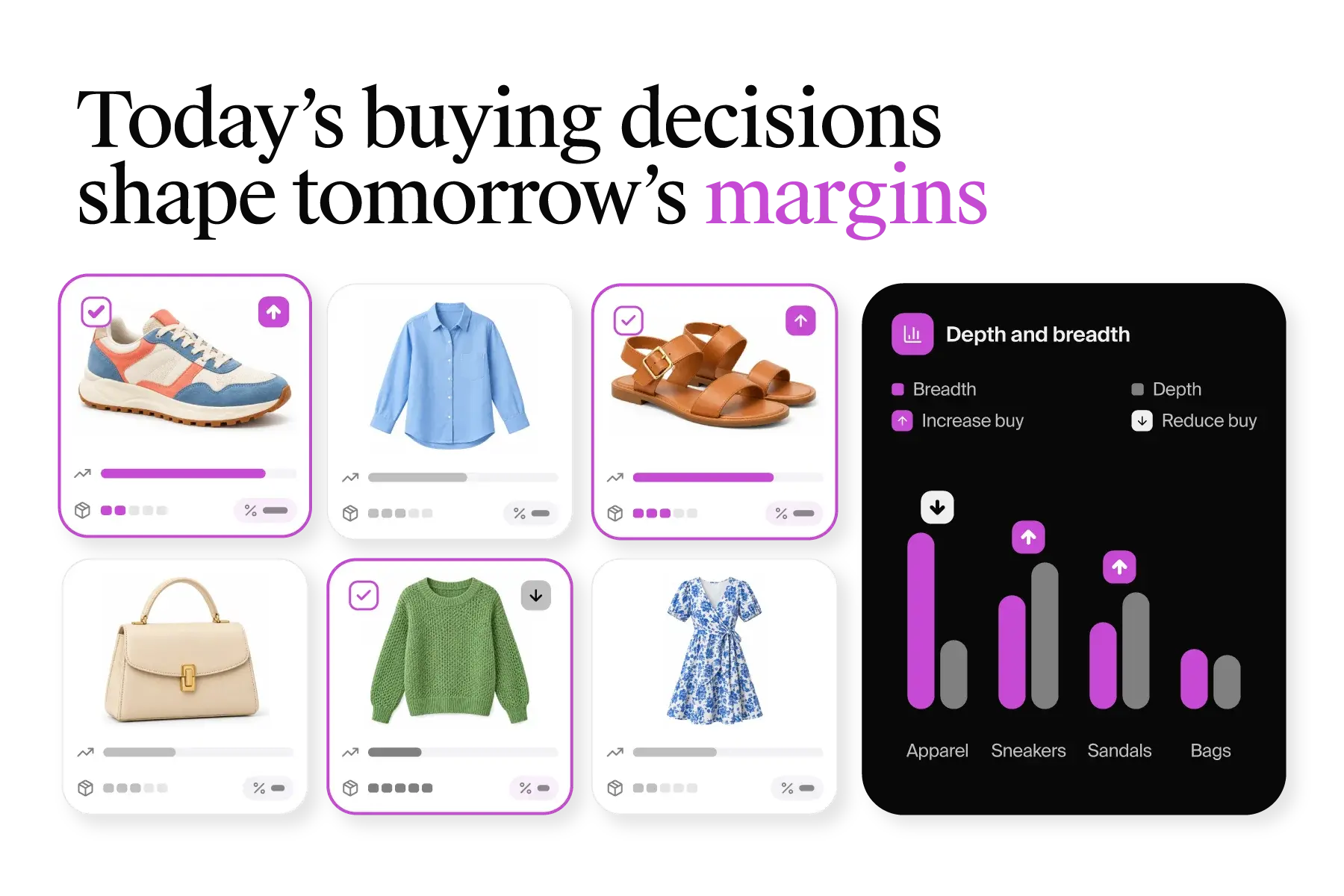
Spring 2027 may still be months away, but retailers are already making buying decisions that will shape inventory exposure and margin performance in Q1. How much depth should go into proven styles and how does it affect assortment in retail? Where should teams introduce newness? And how much inventory should they commit before demand becomes clearer?
These decisions are connected. A deeper buy may improve availability but increase markdown exposure if demand softens. A broader assortment may capture emerging trends but spread inventory too thin across styles and locations. The real trick is to ensure that your assortment plans are based on fact and in consideration of the whole planning, inventory and pricing process, such as how one invent.ai fashion retail client had previously recouped up to 6% of lost sales and reduced markdown risks.
For some retailers, spring 2027 commitments are already in place. Others still have opportunities to adjust quantities, refine their assortment mix or reconsider where inventory will be allocated. In either case, the decisions made before the season begins determine how much flexibility teams have when demand changes.
The challenge isn't simply predicting what shoppers will want next spring. It's understanding the trade-offs behind each buying decision and keeping enough flexibility to respond as conditions evolve.
What current demand signals mean for spring 2027 buys
Last spring's performance is a useful starting point for assortment planning, but it doesn't necessarily reflect what shoppers will want in 2027.
Consumer preferences, price sensitivity and category demand can shift between buying cycles. A product that performed well last season may face different competitive conditions, while an underperforming category could show signs of renewed demand.
Retailers need to evaluate more than historical sales when deciding where to invest.
Recent sell-through, promotional response, inventory aging and changes in demand can help teams distinguish between products that consistently perform at full price and those that depend on discounting to move.
Consider two categories with similar sales volumes. One maintains strong full-price sell-through with relatively stable demand. The other generates comparable revenue but requires frequent promotions and carries more excess inventory at the end of the season.
Treating both categories as equally strong could lead to very different margin outcomes. That distinction matters as planning teams determine where to increase investment, reduce exposure or maintain flexibility for in-season adjustments.
Price sensitivity also deserves attention. McKinsey's State of Fashion 2026 highlights continued pressure on consumer spending and the importance of value in purchasing decisions. For assortment planners, that reinforces the need to evaluate demand alongside pricing assumptions rather than relying on volume forecasts alone. Imagine for a moment that a retailer in the northern US has already selected its assortment for much of spring 2027, but the potential effects of El Nino lead to a prolonged demand for winter apparel.
With insight and monitoring agents, retail teams can identify changes in demand, reallocate inventory through transfer optimization, maintain optimal inventory sell-through and mitigate emerging risks, like potentially shifting markdowns toward overstock of spring gear earlier, if appropriate and as new information becomes available. Those signals provide additional context for reviewing assortment decisions before further commitments are made.
Where to commit depth and where to preserve flexibility
 One of the most consequential assortment decisions is determining how much inventory to commit to individual products and how broadly to distribute investment across the assortment.
Buying deeper into proven products can support availability and reduce the risk of missing sales. But that approach also concentrates inventory exposure if demand falls short of expectations.
Expanding assortment breadth creates opportunities to introduce new styles, colours and price points. However, spreading the same inventory budget across more products can leave individual styles understocked or create fragmented inventory that becomes difficult to manage.
Neither approach is inherently better. The right balance depends on demand confidence, product characteristics, lead times and the retailer's ability to respond during the season.
For example, a retailer planning its spring footwear assortment may have reliable demand history for core styles but less certainty around emerging silhouettes.
Committing greater depth to proven products could make sense where demand remains consistent. For newer styles, smaller initial commitments may provide an opportunity to evaluate early performance before increasing exposure, provided supplier lead times allow it.
The same logic applies across categories, but the available options will differ. Long-lead-time products may require earlier commitments and greater reliance on forecasting. Products with shorter replenishment cycles can offer more flexibility to adjust quantities as demand becomes clearer.
Rather than applying the same buying rules across every category, retailers can establish different commitment thresholds based on demand uncertainty, margin expectations and inventory risk.
This is where scenario planning becomes particularly valuable. Teams can compare the implications of deeper buys, broader assortments or reduced commitments before deciding how to allocate available inventory budgets.
The goal isn't to eliminate uncertainty. It's to understand which decisions carry the greatest exposure and where flexibility is worth preserving.
How allocation and replenishment change the assortment equation
Choosing the right assortment is only part of the challenge. Retailers also need to determine where inventory should go and how quantities should change as demand develops.
A product can perform well overall while still creating margin pressure if too much inventory reaches lower-demand locations and too little reaches stores where customers are willing to buy at full price.
Consider a spring apparel collection expected to perform across multiple regions. Historical sales may support a broad distribution, but differences in local demand, store performance and inventory capacity can make a uniform allocation inefficient.
Some stores may require greater depth in specific styles or sizes, while others would benefit from a smaller initial allocation. Those decisions affect both availability and the likelihood of excess inventory later in the season.
Early allocation scenarios allow retailers to evaluate how inventory distribution could affect sell-through, stockout exposure and markdown risk before receipts arrive.
They also create opportunities to preserve flexibility. Rather than committing all available inventory to stores immediately, retailers may be able to retain stock centrally and allocate additional units as demand becomes clearer. The feasibility of that approach depends on lead times, distribution capacity and service requirements.
Replenishment decisions then become an extension of the original assortment strategy. If a product begins outperforming expectations, retailers need to determine whether additional inventory is available, where it should be directed and whether replenishment will arrive while demand remains strong.
If performance weakens, continuing to replenish against the original plan can increase exposure unnecessarily. Connecting assortment planning with automated replenishment helps teams respond to actual demand rather than treating initial buying assumptions as fixed throughout the season.
The objective is to keep inventory aligned with demand as conditions change, not simply to execute the original assortment plan more efficiently.
Connect buying, pricing and inventory decisions before commitments lock
 Assortment, pricing and inventory decisions are often managed by different teams, but their financial implications are closely connected.
A buying team may increase depth based on projected demand. A pricing team may anticipate greater promotional activity in the same category. Meanwhile, allocation teams may be working with store-level demand patterns that suggest inventory should be distributed differently. When those assumptions aren't considered together, retailers risk committing inventory against plans that don't fully reflect the economics of the season.
For spring 2027, that creates several important questions. How would a change in expected selling price affect the quantity worth buying? Which categories can support deeper commitments without increasing markdown exposure? Where would a different allocation strategy improve the opportunity for full-price sell-through?
These aren't decisions that should wait until inventory begins underperforming. Retailers can evaluate alternative scenarios before commitments become fixed, considering how changes in demand, pricing, inventory quantities and allocation affect expected performance.
That process also helps distinguish between inventory that is already committed and inventory that can still be adjusted. For products already on order, the focus may shift toward allocation, receipt timing or opportunities to redirect inventory. For products with open buying decisions, teams may still be able to change quantities or revise the assortment mix.
Both situations require visibility into the same underlying business conditions, but the available actions are different. This is where connected retail decision-making becomes even more important.
Rather than evaluating forecasts, buying plans, allocation and pricing independently, invent.ai brings these decisions together through forecasting and optimization models that help retailers understand changing conditions, evaluate trade-offs and determine what to do next. For planning teams, that means looking beyond whether a forecast has changed to understand what the change means for inventory commitments, availability and margin. It also creates a more consistent basis for reviewing decisions as the season approaches.
Protect Q1 margin before the season begins
Spring 2027 margin performance won't be determined by a single buying decision. It will reflect how retailers balance assortment breadth and depth, manage inventory commitments, distribute stock and respond when demand differs from expectations.
Some decisions will already be fixed by the time Q1 begins. Others will remain open through allocation, replenishment and in-season inventory adjustments. The opportunity now is to understand where the business has flexibility, where risk is concentrated and which decisions could have the greatest impact on full-price sales.
That requires more than a better forecast. Retailers need to connect demand signals with the decisions that determine how much inventory to buy, where to position it and when to adjust course.
The earlier teams understand those trade-offs, the more options they have to protect margin before markdowns become necessary. And
Get in touch to see how invent.ai connects forecasting, inventory planning, allocation and pricing to help retailers make more informed decisions across the business.