
.svg)
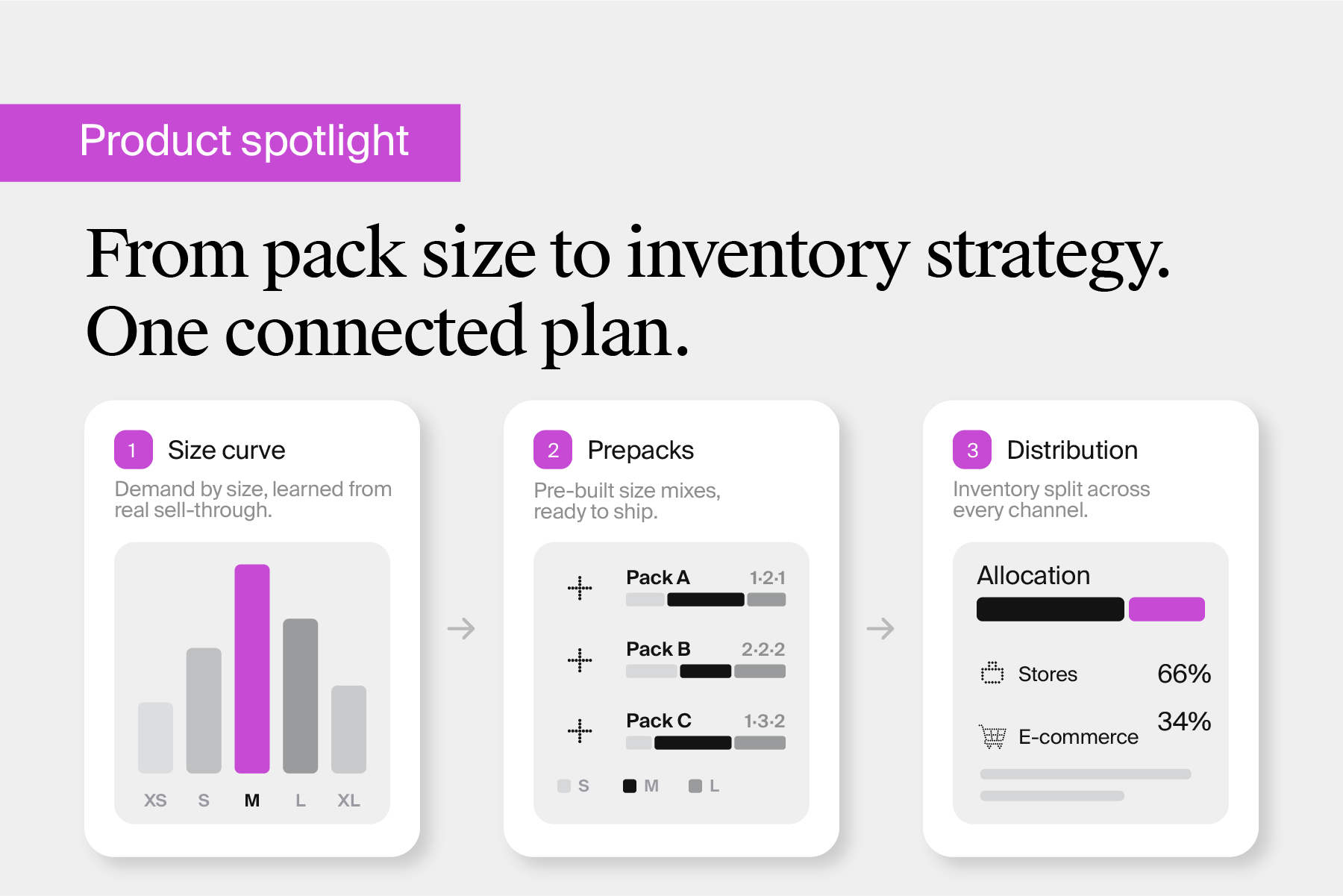
Inventory performance is often decided long before products reach a store or a fulfillment center. It starts with the way inventory is structured, how sizes are distributed, how products are grouped into prepacks and how those packs move through the network.
These decisions sit upstream of allocation but they shape whether inventory will actually match demand once the season begins.
For most retailers, allocation still comes down to historical averages, fixed vendor pack structures and a lot of spreadsheet work leading to familiar problems. Some sizes sell out early, others pile up in the wrong places and teams spend the season trying to fix decisions from months ago.
Size prepack optimization by invent.ai helps apparel, sporting goods and footwear retailers define size profiles, set prepack composition and plan inventory deployment before purchase orders are created. This includes optimizing prepack structures for initial store allocation while ensuring inventory reserved for e-commerce and future replenishment is aligned with expected demand.
Where size decisions actually shape inventory performance
Once inventory is committed, most flexibility is already gone. The way sizes are shaped at the start of planning has a direct effect on how products perform across stores, channels and regions.
Size demand is never the same universally. It shifts by product, category, store cluster and channel. A size mix that works in one group of stores can be completely off in another, even for the same item. This is usually where issues begin. Not in allocation, but in the assumption that one size curve can work across the whole network.
Size prepack optimization by invent.ai focuses on this earlier step by building demand-driven size profiles before the plan is locked in.
Instead of relying on broad historical averages, invent.ai uses AI to identify demand-driven size profiles across product subcategories, fit types, size families and store demand clusters. For large retailers, this can mean thousands of distinct size profiles that vary by product, geography and channel.
The AI determines the appropriate level of granularity, extracts meaningful demand signals even when historical data is sparse and separates true customer demand from inventory and assortment constraints that may have influenced past sales. This creates size profiles that reflect what customers are likely to buy rather than simply repeating historical outcomes.
Turning size profiles into prepack decisions
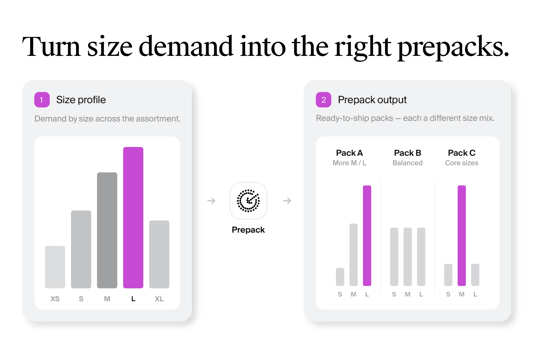 Prepack decisions sit between planning and logistics. They define how inventory physically moves through the network but they also define how well that inventory matches demand.
In many retail setups, prepack structures come from vendor standards or legacy planning rules. Once they’re set, they rarely change even when demand shifts.
With size prepack optimization, prepack composition is not fixed. It’s calculated from demand and adapts to granular assortment (not all stores will carry all sizes).
The system uses proprietary AI-driven optimization to determine the ideal prepack composition based on expected demand patterns across stores, channels and assortments.
This becomes increasingly important when retailers manage complex size runs such as waist and inseam combinations, neck and sleeve dimensions or suit sizing. The number of possible pack configurations can quickly become too large for traditional planning methods to evaluate effectively.
Invent.ai evaluates these combinations at scale and identifies the optimal prepack structures while balancing demand alignment, operational complexity and execution requirements.
The platform also determines how many distinct prepack configurations are required across store clusters, helping retailers serve localized demand without introducing unnecessary complexity into execution.
Aligning deployment to real demand patterns
Once size profiles and pack structures are defined, the next question is where that inventory should actually go. Store networks aren’t uniform. Some stores need full size ranges while others only need core sizes. E-commerce and distribution centers (DCs) behave differently again and often absorb variability that stores cannot.
Size prepack optimization brings these differences into the planning step instead of treating them as something to fix later.
Inventory is distributed across stores, channels and DCs based on expected demand patterns rather than post arrival adjustments. This means inventory is already placed with intent before it enters the network which reduces reactive moves later in the season.
Removing manual work between planning and execution
A big part of retail planning isn’t deciding what to do. It’s turning those decisions into something the system can execute.
Historically, planners build size curves in spreadsheets, adjust prepack structures and then manually convert everything into purchase orders and allocation files. When assumptions change, the entire process repeats.
Size prepack optimization removes that translation step.
Once size profiles, prepack composition and deployment logic are defined, purchase orders are generated automatically in the correct structure. This includes pack-level logic and distribution across suppliers and destinations.
Planners move from building execution files to reviewing structured outputs that already reflect planning decisions.
Planning becomes iterative instead of linear
Retail planning is never final on the first pass. Buy quantities change, demand shifts and store strategies evolve.
In most workflows, every change means starting again in spreadsheets.
With size prepack optimization, planners can adjust inputs and immediately see how those changes affect size profiles, prepack composition and deployment outcomes.
AI-generated recommendations are recalculated dynamically as planners evaluate different scenarios, allowing teams to understand the downstream effect of assortment, quantity and deployment decisions before inventory is committed.
This makes it easier to compare options before committing inventory instead of fixing issues after the fact. The focus shifts from fixing plans to building better ones.
Understand the reasoning behind every recommendation
Retail planning teams often need more than recommendations. They need confidence in why a decision was made.
As part of the invent.ai AI-decisioning platform, planners can use Remi, the retail merchandise intelligence agent, to explore the reasoning behind size profile, prepack and deployment recommendations.
Teams can ask questions about specific recommendations, understand which demand signals influenced a decision and evaluate alternative scenarios without manually tracing calculations across spreadsheets and planning systems.
This provides greater transparency while helping planners move faster and make more informed decisions.
What changes when structure is defined earlier
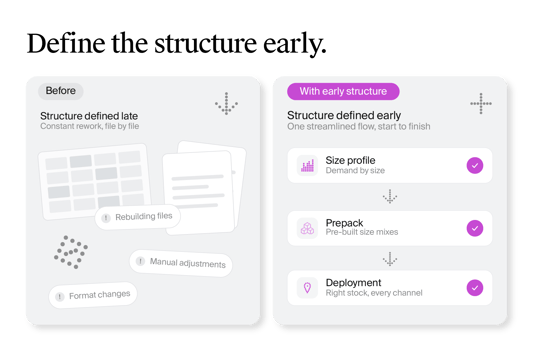 When inventory structure is defined before purchase orders are created, the effect shows up in both day-to-day work and overall results.
For planners, it removes repetitive manual work. They aren’t constantly rebuilding files or translating decisions into different formats. They can spend more time on assortment decisions and understanding demand.
For the business, inventory enters the network in a way that is closer to real demand from the start. This leads to better size availability, fewer imbalances and less reliance on markdowns or rebalancing later in the season.
A connected planning inventory structure with invent.ai
Size prepack optimization is part of the invent.ai AI-decisioning platform where forecasting, inventory planning, allocation and execution are connected in one flow.
Instead of treating size planning and prepack design as separate steps, the system handles them as part of a continuous process that links demand to structure and then to execution.
Retailers aren't only deciding what to buy. They’re deciding how inventory should exist before it is bought. That shift carries through the entire season in how inventory moves, sells and gets corrected.
When structure is right at the start, everything downstream becomes easier to manage and closer to actual demand.
To see how invent.ai helps retailers define size profiles, configure prepack composition and automate purchase order creation, speak with a retail AI expert today.