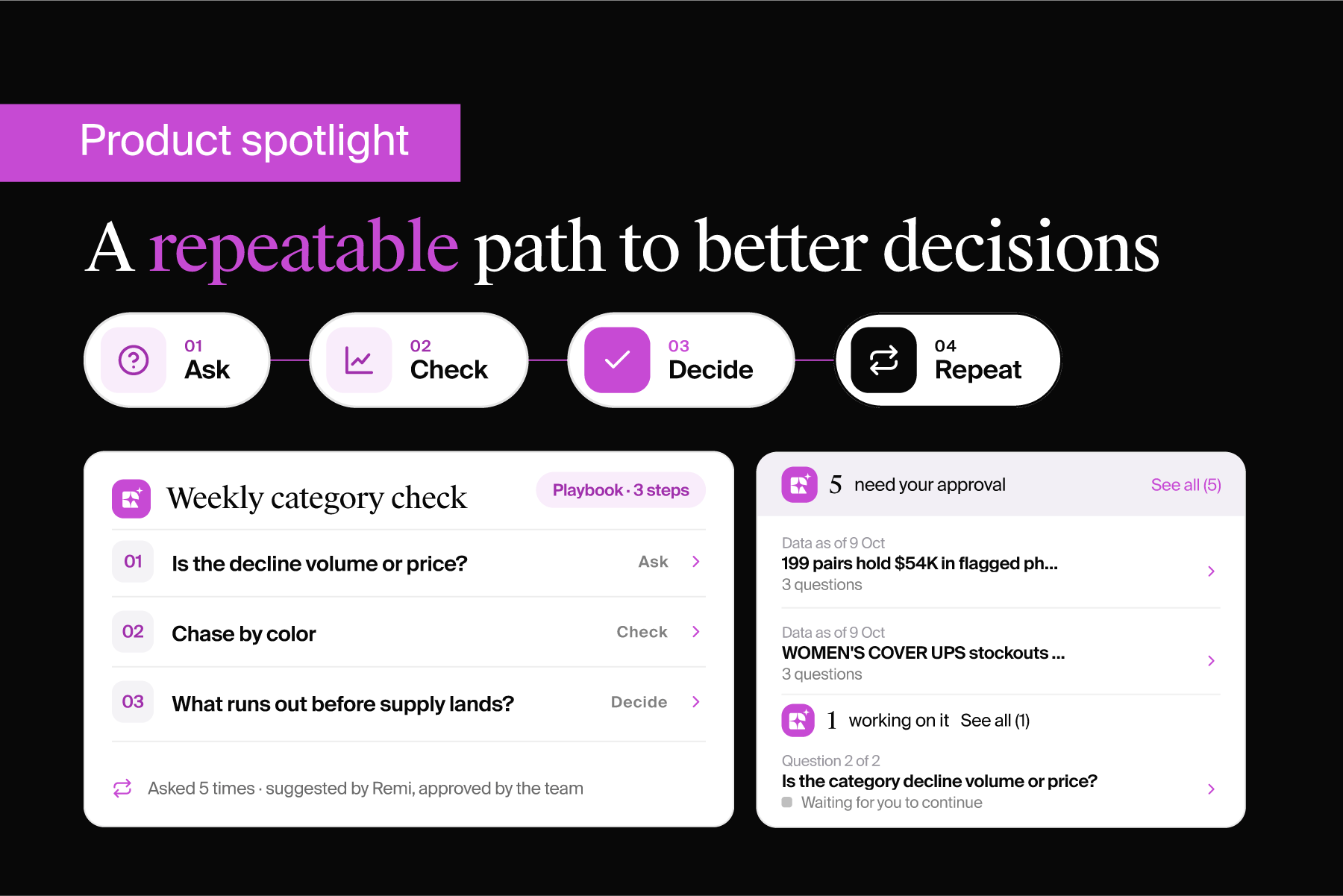
Every retail team has people who know which questions to ask. A senior buyer knows how to investigate a category slowdown. A planner knows which sizes to check before a stockout. A merchandising leader knows when a change in average selling price points to a shift in product mix.
This expertise develops through experience, but often stays with the people who have built it. Teams can end up repeating the same analysis, approaching a problem differently or missing a follow-up question that changes the conclusion.
Remi Playbooks help retailers turn this expertise into reusable workflows. Within invent.ai’s AI-decisioning platform, Remi lets users define their own sequences of instructions based on how they investigate business performance, evaluate opportunities and determine next steps. These sequences can be saved as playbooks and scheduled to run automatically, so results are ready when users log in rather than requiring them to initiate each step manually. Experts can review, refine and approve playbooks before making them available across the organization.
Each playbook provides a repeatable starting point for common retail tasks, helping teams apply established methods while retaining the judgment needed to interpret results.
Turn recurring questions into reusable workflows
Investigating a change in category performance often involves questions about sales, units, average selling price, product mix and inventory. Experienced planners know which details to examine and in what order, but others may need to work out that sequence independently.
Playbooks capture recurring questions and actions in an ordered workflow. A weekly category check guides planners through changes in sales. A color and size chase helps identify where inventory needs attention, while a stockout watch provides a consistent way to investigate availability risks.
Workflows can also extend beyond analysis. A playbook might identify opportunities to recover margin, investigate the underlying causes and develop an action plan. Another might consolidate inventory risks across locations into an executive summary for leadership.
Build around how teams work
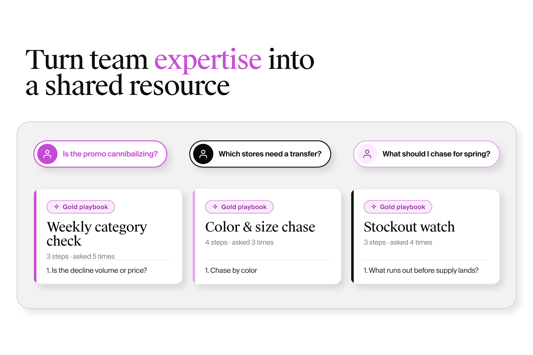 Users create playbooks by defining the sequence of instructions they would normally enter into Remi Chat. These instructions can cover sales, promotions, markdowns, inventory and other retail planning activities, with each step building on the previous one.
Rather than relying on generic checklists teams can tailor workflows to their business requirements. A playbook focused on color-level inventory, for example, might include size-level analysis when the category requires a closer look.
Users can save these sequences and schedule recurring runs, allowing Remi to complete the work before needing results. This reduces repetitive manual effort and gives planners more time to focus on findings that require attention.
Experts stay in control
Users determine which instructions belong in a playbook, how they are ordered and when the workflow should run. They can refine the sequence as business requirements change, ensuring the analysis continues to reflect how their teams work.
For example, a merchandising expert might build a playbook that examines category performance, identifies products contributing to declining margin and evaluates potential adjustments. A planner could create a separate workflow focused on availability risks across stores and distribution centers.
Each workflow reflects the expertise of the person who created it, making established methods easier to repeat and refine over time.
The right next step still depends on the category, current conditions and the business decision at hand. Playbooks provide structure without replacing professional judgment.
Run playbooks alongside other work
Users can choose how Remi runs a playbook. Running the full sequence lets the workflow progress through each prompt, while the step-by-step option pauses after each step so users can review the result and ask follow-up questions before proceeding.
Users can also schedule playbooks to run in advance, allowing recurring analysis and other tasks to be completed before they begin their day.
Playbook statuses such as "Active," "Not Completed" and "Awaiting Input" help users track progress and identify workflows that require attention.
This visibility allows teams to manage multiple workflows while keeping track of completed work and outstanding steps.
Look beyond the original question
A consistent sequence of questions is useful, but teams also need to understand what the data actually shows. Invent.ai’s insights & monitoring agents help identify changes in business performance, while reasoning agents help investigate the factors behind those changes. Together, these capabilities help retail teams move beyond the initial question and examine the evidence.
For example, a team might ask whether a category’s decline is driven by volume or price. However, the data may show that revenue and units have both increased year over year while average selling price has fallen. The figures challenge the original assumption, making further investigation necessary before the team decides how to respond.
Remi breaks down the figures, explains how each factor contributes and presents supporting data in an interactive table. Remi also highlights the limits of the available data.
Within a playbook, Remi can go further by coordinating different AI agents through a predefined sequence of instructions. A workflow might identify the item-location combinations with the highest lost sales, investigate the root causes and simulate how changes to planning parameters could affect the results.
Because playbooks use the same capabilities available through Remi Chat, workflows are not limited to analytical questions. Remi can route requests to the appropriate agents, including reasoning and simulation agents, to support more complex, multi-step tasks.
A playbook provides a repeatable workflow, while Remi helps users test assumptions, investigate root causes, evaluate scenarios and understand what the evidence supports.
Connect analysis to the next decision
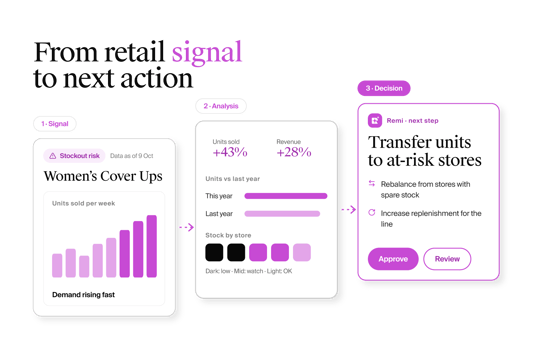 Retail analysis is most useful when it helps teams determine what to do next. A change in demand, an availability issue or a shift in product mix may call for a different response depending on inventory levels, timing and business priorities.
Remi Playbooks can connect these stages within a single workflow. Rather than stopping after identifying an issue, a playbook can investigate contributing factors, evaluate potential responses and organize the findings into a recommended action plan.
For example, a workflow investigating lost sales could identify affected products and locations, examine inventory availability and demand patterns, then simulate potential adjustments to replenishment parameters. The resulting analysis gives planners the context needed to evaluate the recommended next steps.
By bringing investigation, reasoning and simulation into a repeatable process, playbooks help teams move from identifying problems to evaluating what to do about them.
Share expertise across the organization
Retail teams rely on experience to make sense of changing demand, inventory and product performance. When working methods remain undocumented, the same analysis may be repeated or the same problem approached in different ways.
Remi Playbooks help retailers capture proven methods in reusable workflows that can be run and refined as needed. By defining the questions, analysis and follow-up tasks involved in recurring processes, users can preserve established approaches and reduce the need to start from scratch.
As teams build and refine these workflows, they create a more consistent foundation for retail decision-making, with less time spent repeating routine work and more time available to evaluate results.
To learn more about how invent.ai supports retail decision-making, get in touch.