
NRF 2027 is bringing the retail industry back to New York City for three days of technology demonstrations, industry conversations and new approaches to some of retail's most persistent challenges. From store operations to inventory optimization and customer experience, NRF offers a look at where retail technology is headed and what retailers should prioritize next.
But as AI becomes a standard part of the retail technology conversation, the questions buyers are asking are changing. It's no longer enough for a solution to generate more accurate forecasts, surface insights or automate individual tasks. Retailers need technology that connects decisions across their business and helps teams act on changing conditions before opportunities are lost.
At NRF Retail's Big Show, the distinction between AI that provides information and AI that drives decisions will be one of the most important considerations for retail leaders evaluating their next technology investment.
What to expect at NRF 2027
Taking place January 10-12, 2027, at the Javits Convention Center in New York City, NRF 2027 will bring together retailers, technology providers and industry leaders to explore the next generation of commerce innovation solutions.
With “Fast forward to the future of retail” as the event's theme, this year's big show will put a spotlight on how retailers are adapting to new technologies, changing consumer expectations and growing operational complexity.
Across the show floor, visitors can expect product demonstrations, discussions on AI adoption and technology designed to improve how retailers plan, operate and serve customers.
Several areas are particularly relevant for retail technology buyers:
- AI and automation: Solutions designed to reduce manual work, accelerate analysis and support operational decisions.
- Supply chain and inventory optimization: Technologies connecting demand forecasting, replenishment, allocation and end-to-end merchandise flow.
- Store operations: Tools that improve product availability, support in-store execution and help teams respond to changing demand.
- Customer experience: Innovations connecting inventory availability, personalization and shopper journey optimization.
- Emerging startups: New approaches to retail challenges, alongside established technology providers expanding their AI capabilities.
For buyers, the opportunity extends beyond discovering new technology. It's a chance to understand which solutions can work together, fit existing workflows and deliver measurable business outcomes.
See retail AI in action
 AI will be a major focus of NRF's 2027 flagship event, but not every solution addresses the same business problem. Some tools focus on forecasting. Others provide analytics, automate specific workflows or help teams find information faster. Each can offer value, but retailers should consider what happens after an insight is generated.
Does the technology explain why demand is changing? Can it evaluate the financial implications of different responses? Does it recommend an action, and can that action move into execution with appropriate oversight?
These questions help distinguish technology that supports isolated tasks from platforms that coordinate decisions across the business.
During live solution showcases, retail leaders should look beyond polished interfaces and ask vendors to demonstrate realistic scenarios. A sudden increase in demand, for example, should trigger more than just a revised forecast. It may require adjustments to inventory allocation, replenishment priorities, purchasing decisions and pricing.
The value comes from connecting those decisions rather than leaving teams to reconcile recommendations across separate systems.
Turn demand signals into profitable decisions
Retailers have more information available than ever, but turning that information into profitable decisions remains a challenge. Demand changes, inventory moves, costs fluctuate and promotional activity influences purchasing behavior. Each change can affect multiple parts of the business, yet many planning processes still operate through disconnected systems and manual handoffs.
Consider a product selling faster than expected. A forecasting tool might identify the increase in demand, while an inventory system highlights potential stockouts. The disconnect between teams comes from having to determine whether to expedite an order, rebalance stock between locations or adjust future purchasing.
Each option affects revenue, margins and inventory differently. And the longer it takes to make a decision, the fewer options retailers may have.
This is where AI decisioning changes the equation. Instead of simply identifying a problem, AI can help retailers evaluate their options, understand the trade-offs and determine which actions are most likely to deliver the best business outcome.
For retailers exploring retail technology at NRF 2027, the question isn't just what a solution can predict. It's what it helps their teams do next.
Connect planning, inventory and pricing
Pricing and promotions can shift demand, creating a cycle of constant adjustments. When planning functions operate independently, retailers risk solving one problem while creating another.
For example, a promotion might drive unexpected demand in one region while the same product sits unsold in another. Without visibility across forecasting, allocation and replenishment, teams may order additional inventory to address the shortage rather than redistribute existing stock. By the time the new inventory arrives, the promotion may be over, leaving the retailer with excess stock and increased markdown pressure.
Connected retail planning helps teams see the bigger picture and make decisions that account for what's happening across the business.
That means connecting decisions throughout the planning lifecycle:
- Preseason: Align forecasts, merchandise plans, assortments and buying decisions with financial goals.
- In-season: Adjust allocation, replenishment and inventory transfers as demand changes.
- End-of-season: Coordinate pricing, promotions and markdowns to improve sell-through while protecting margins.
Rather than treating forecasting, inventory and pricing as separate activities, retailers can evaluate how one decision affects another.
As buyers compare supply chain and planning solutions at NRF 2027, it's worth asking how well these capabilities work together and how quickly teams can respond when plans need to change.
Know what to look for at NRF 2027
With so much happening across the show floor, it's easy to spend three days at Retail's Big Show collecting brochures and watching demonstrations without getting closer to a decision.
A little planning can make those conversations much more useful.
Before building your meeting schedule, think about where your teams are spending the most time, which decisions are slowing down operations and where disconnected processes are affecting performance. Then bring those challenges into vendor conversations.
A few questions worth asking during product demonstrations include:
- What decisions can the platform help us make? Look beyond individual features to understand how the technology supports your broader planning process.
- What happens after an insight is generated? Can the system recommend an action, or does your team still need to figure out the next step?
- How are trade-offs evaluated? Ask how recommendations account for revenue, margin, inventory and availability.
- How much control do our teams have? Understand how users can review, adjust and approve recommendations.
- What results have other retailers achieved? Look for measurable improvements in business performance, not just technical capabilities.
It's also worth exploring emerging startups alongside established providers. Different approaches can help clarify which capabilities matter most to your business.
The goal shouldn't be to see every technology solution on the floor, but to leave with a clearer understanding of which solutions can address your biggest challenges.
Meet invent.ai at NRF 2027
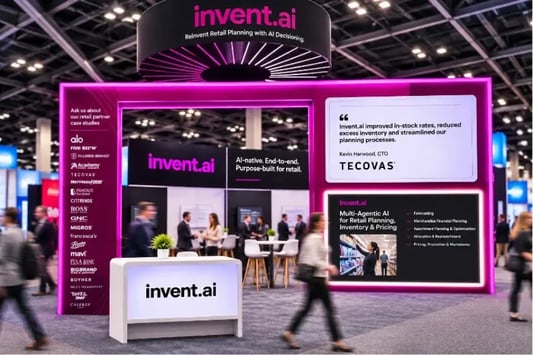 At Booth #4265, invent.ai will show retailers what happens when forecasting, merchandise planning, inventory and pricing work together on one AI-decisioning platform.
Our approach is simple: AI that acts, not just predicts.
Instead of relying on disconnected forecasts, dashboards and recommendations, invent.ai connects decisions across the entire retail planning lifecycle. Teams can identify opportunities, evaluate options and turn approved recommendations into action, all while keeping revenue, margin and inventory goals in focus.
You'll also meet Remi, our AI orchestration agent that helps retail teams stay ahead of what's changing with ease.
Know before you ask, with Remi
Remi continuously monitors business conditions, identifies emerging risks and opportunities, and recommends actions based on their potential business value. It explains what's happening, helps teams explore different scenarios and supports execution once changes are approved.
At NRF 2027, visitors can see how invent.ai and Remi work together to help retailers make faster, more connected decisions without adding more manual work.
The results speak for themselves. Across retail implementations, invent.ai has demonstrated:
- 8–11% more revenue with the same or less inventory.
- 6–8% higher gross margin.
- 80% less manual work.
- Proven value in as little as 90 days.
Retailers don't need more information to sort through. They need a better way to decide what to do with it. Join us January 10-12 at Booth #4265 to see how connected planning and proactive AI decisioning can help your team move from insight to action.