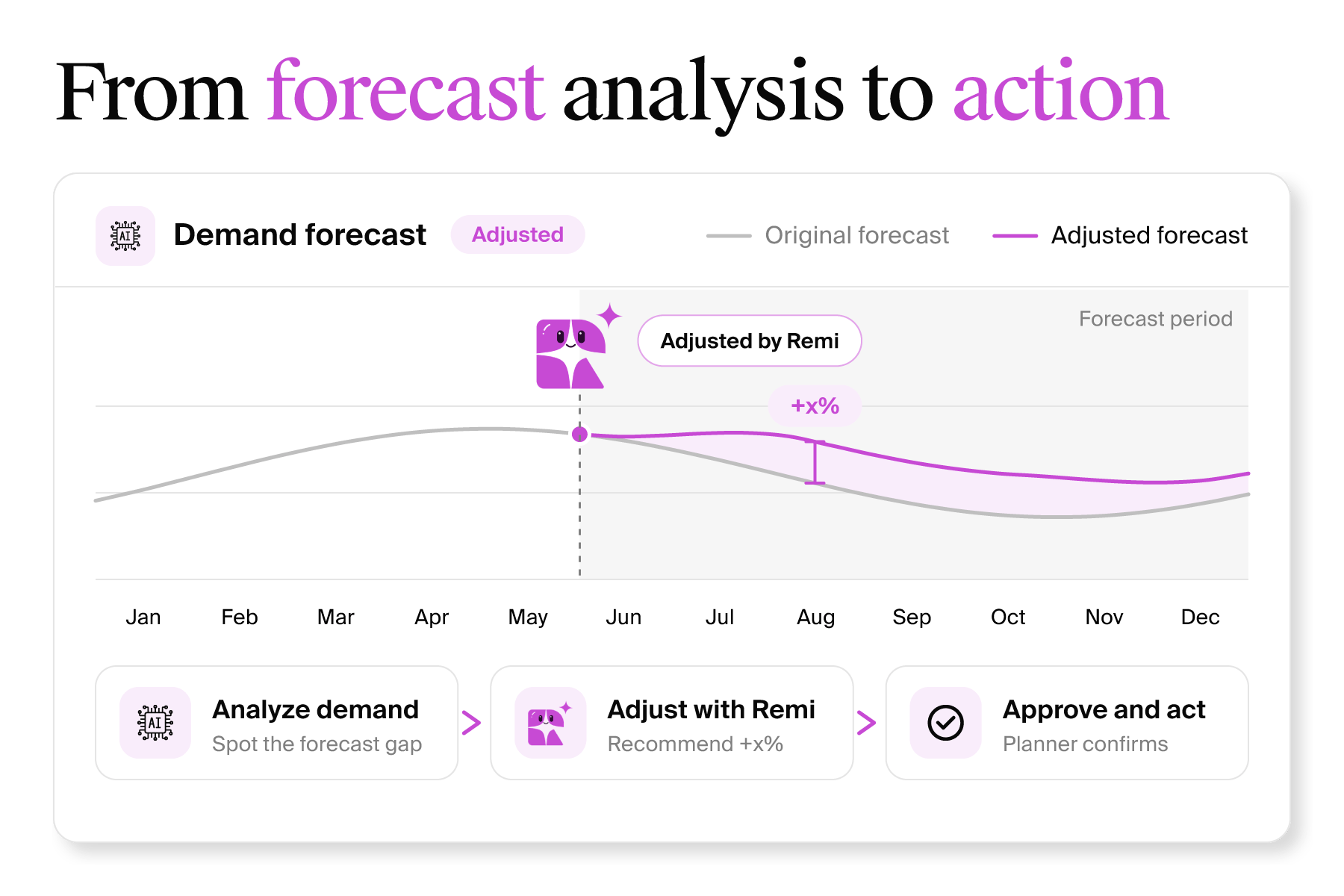
Retail demand forecasting has become increasingly sophisticated, but the process of acting on a forecast hasn't always kept pace. Retailers can analyze demand patterns, investigate unexpected changes and understand the factors influencing future sales. Yet turning those findings into adjustments often requires a separate, manual process.
For demand planners managing thousands of products across multiple locations, this disconnect creates unnecessary work. Identifying why a forecast needs to change is one task. Locating the relevant products, calculating revised values and updating individual forecast cells is another. The more steps required between analysis and execution, the harder it becomes to respond as demand conditions evolve.
Invent.ai's reasoning agents, powered by Remi, help close this gap by connecting forecast analysis with the ability to take action. With a new conversational editing capability within invent.ai's AI-decisioning platform, planners can investigate a forecast, request adjustments through natural language, review proposed changes and approve them without leaving the conversation.
Rather than treating forecasting as a sequence of disconnected activities, Remi connects reasoning and execution within a continuous decision-making workflow.
Why forecast analysis needs a direct path to action
AI demand forecasting helps retailers anticipate future demand by identifying patterns across historical sales, product performance and other business signals. These forecasts inform in-season and pre-season planning decisions, but human judgment remains essential when conditions change.
An upcoming promotion may generate stronger sales than anticipated, while a local event, competitor activity or unexpected shift in product availability could require planners to revise demand expectations. Understanding these changes is only part of the process. Once a planner determines that a forecast needs adjusting, that decision should be reflected in the plan.
Traditionally, this means moving between analysis and editing workflows. A planner might investigate an unexpected forecast through an AI assistant, identify the reason behind it and determine the appropriate response. Applying that decision, however, still requires navigating to the forecast editing interface, locating the relevant products and dates, and manually entering revised values.
For teams managing extensive assortments and frequent demand changes, these additional steps take time away from evaluating exceptions, assessing trade-offs and making planning decisions. Connecting forecast reasoning with execution allows planners to act on their analysis without repeating work across separate interfaces.
Introducing conversational forecast editing with Remi
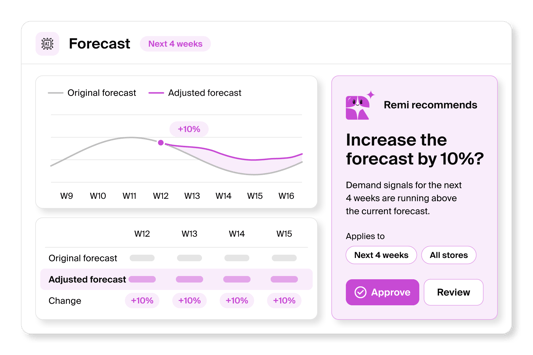 Reasoning agents extend Remi's forecasting workflow by allowing planners to make adjustments directly through natural-language conversations.
The new forecast editing capability lets planners use Remi alongside reasoning agents to investigate demand expectations and request changes based on their findings. Rather than calculating and entering revised values manually, planners can describe the intended adjustment, and Remi prepares the corresponding changes for review.
For example, a planner could ask Remi to:
- Increase next week's forecast by 10% for a selected product
- Apply last year's values to a specified date range
- Adjust forecasts across a supported product aggregation
- Update demand forecasts for specific events, such as holidays or promotions
Consider a retailer preparing for an upcoming promotional event. After reviewing demand expectations, a planner determines that the forecast should be increased to reflect anticipated promotional activity. Instead of returning to the forecast grid and updating individual cells, the planner can request the adjustment directly through Remi.
The proposed changes are then presented for review, keeping the analysis and resulting decision connected within the same workflow.
Keeping planners in control of forecast decisions
Making forecast adjustments easier doesn't mean removing human oversight. Retailers need confidence that changes reflect the planner's intent and follow established operational controls.
Before an adjustment is applied, Remi presents a before-and-after preview showing the proposed forecast values. Planners can evaluate the changes and approve them before they're saved.
Existing restrictions remain in place, preventing conversational edits to historical, locked or otherwise non-editable forecast cells.
This approach combines the efficiency of conversational AI with the accountability required for retail planning. Remi helps translate instructions into forecast adjustments, while planners retain control over which changes are executed.
Connecting forecasting with broader retail decisions
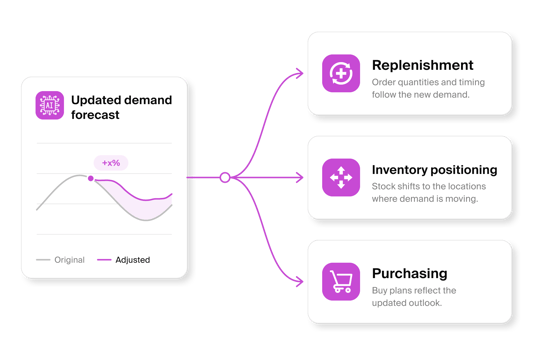 Forecast adjustments influence more than projected sales. Changes in expected demand can affect replenishment requirements, inventory positioning, purchasing decisions and product availability across stores and distribution centers.
Through Remi, planners can explore these connected decisions within the same conversational workflow. For example, a planner could review a product's demand forecast, ask about replenishment needs for the coming weeks and investigate whether current inventory levels can support an upcoming promotion.
Rather than switching between separate tools to gather information, planners can use Remi to explore related forecasting and replenishment questions, understand the implications of changing demand and determine where further action may be needed.
This reflects invent.ai's broader approach to AI decisioning, connecting forecasting, inventory and replenishment to help retailers make more informed decisions as business conditions change.
Moving beyond predictions to decisions
Better forecasts are essential, but prediction accuracy alone doesn't determine how effectively retailers respond to changing demand. Teams also need to understand why conditions are shifting, evaluate potential responses and put approved decisions into action.
Reasoning agents help connect these activities by bringing forecast explanations and conversational editing into the same workflow. Planners can investigate a forecast, determine what needs to change and approve the adjustment without moving between separate processes.
The result is less time spent on repetitive editing and more time focused on the decisions that influence inventory availability, operational efficiency and profitability.
See how invent.ai brings reasoning and execution together in retail planning. Explore reasoning agents.