
.svg)
Retailers rarely enter their first peak season with every part of an AI deployment fully proven. The data may be in place, the use case approved and the model tested, but peak season introduces a different level of pressure. Demand moves faster, exceptions increase and decisions that once had days to resolve may need attention within hours.
That is where an AI operating model becomes important.
Technology can generate recommendations, but retailers still need a clear way to interpret those recommendations, manage exceptions and decide when human judgment is required. Without that structure, even a successful implementation can become harder to manage as the business scales.
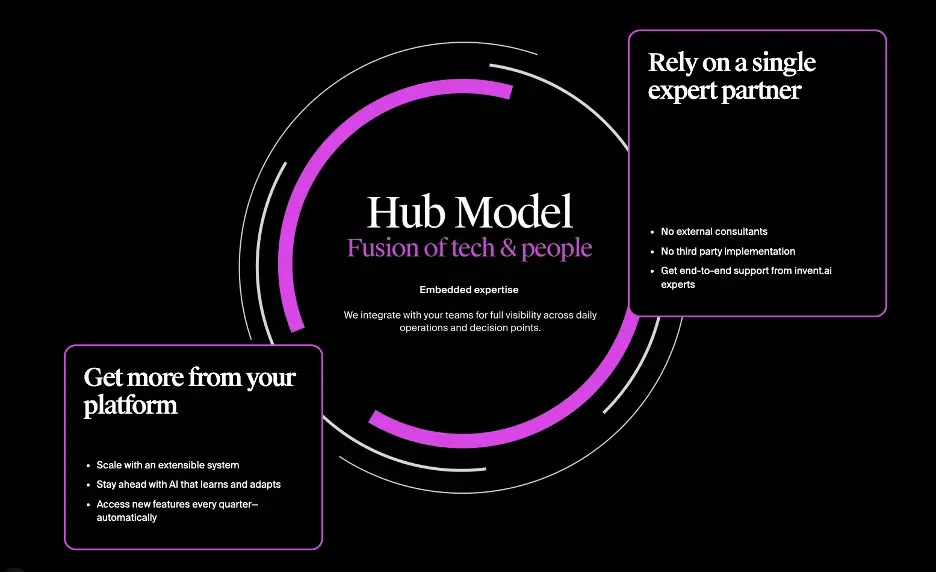
invent.ai's Hub Model is designed to provide that structure. It combines the AI platform with dedicated retail expertise and ongoing Customer Success support, helping teams navigate in-season decisions, resolve issues and continuously improve how they use AI in daily operations.
What is a Hub Model?
The Hub Model is invent.ai's support model for retailers using AI-decisioning in production.
A dedicated team works alongside the retailer after implementation, helping monitor performance, investigate exceptions, support planners and coordinate with the teams responsible for acting on AI recommendations. The relationship continues as the retailer moves from initial deployment into broader operational use.
This matters because AI adoption is not a one-time implementation event. Retail conditions change continuously. Demand patterns shift, business priorities evolve and new exceptions appear as the number of decisions increases.
A practical enterprise AI operating model needs to account for those changes.
The Hub Model connects technology and a human in the loop design to support better decision-making. Demand patterns shift, business priorities evolve and new exceptions emerge. An effective operating model must be able to respond as those conditions change.
Why first peak seasons matter
The first peak season is when a retail AI deployment moves from controlled implementation into a much more demanding operating environment. Forecasting errors can become more visible as demand increases. Inventory decisions carry greater consequences. Planners have less time to investigate exceptions and teams across merchandising, inventory, supply chain and technology need to stay coordinated.
This increases the need for a disciplined AI governance framework. Active use creates more chances for inconsistency, duplication and shadow AI proliferation if teams improvise methods under pressure.
This is also where organizational readiness becomes more important. Clear ownership, escalation paths and decision rights help teams respond without creating unnecessary handoffs. A defined human-in-the-loop approach also gives planners a consistent way to review recommendations, apply business context and intervene when needed.
Technology is only one part of that process. People, processes, technology and data need to work together.
What the operating model changes for peak season
 Deloitte's 2026 research on AI operating models projects that production-ready AI use cases will increase from 44% in late 2025 to 67% by 2028. As more AI moves into production, the challenge increasingly shifts from experimentation to sustained execution.
For retailers, peak season puts that execution under pressure.
Teams need to know:
- Who owns an exception?
- When should a recommendation be reviewed?
- When does a planner override the recommendation?
- Who investigates an unexpected result?
- How quickly can an issue be escalated?
- How does the organization capture what it learns and improve the process?
An effective AI operating model gives teams a consistent answer to those questions.
The Hub Model supports this process by keeping dedicated expertise close to the retailer's day-to-day decisioning. Instead of treating implementation as the end of the engagement, the model provides continued support as teams build experience and encounter new operating conditions.
How the Hub Model supports in-season execution
Peak season brings faster demand shifts, more exceptions and less time to resolve them. The Hub Model keeps a dedicated invent.ai team close to daily operations, helping retailers investigate exceptions, review recommendations and determine the right response as conditions change.
This creates a practical enterprise AI operating model with clear escalation and a human in the loop design. Retail teams stay in control of decisions while ongoing expert support helps with change management for AI as new workflows become part of daily operations.
The model also connects teams across planning, inventory, merchandising and technology through a hub-and-spoke model, combining centralized expertise with the flexibility to make decisions within each function. The result is a more consistent way to manage AI decisioning when retail moves fastest.
How retailers move from pilot to production
A successful pilot shows that AI can work. Moving into production requires an operating model that can support it every day.
As adoption expands, retailers need clear ownership, defined escalation paths and a consistent approach to human oversight. Questions around overrides, exceptions and decision rights become part of daily operations, making organizational readiness just as important as the technology itself.
The Hub Model supports that transition by keeping expert support connected to the retailer beyond implementation. It helps teams refine workflows, manage exceptions and build the processes needed to operate AI decisioning at scale, creating a more practical path from pilot to production.
How a coordinated retail operating model reduces friction
 AI decisioning often spans planning, merchandising, inventory and technology teams. When responsibilities are unclear, simple questions can turn into delays, especially during peak season.
A coordinated AI operating model gives teams a shared structure for ownership, escalation and decision-making. Instead of creating another layer of process, it helps cross-functional AI teams work from the same information and respond more consistently as conditions change.
The Hub Model provides that coordination in practice, connecting retail teams with ongoing expertise while keeping decision ownership with the people closest to the business.
What real world deployment looks like
Real-world deployment means AI becomes part of the decisions teams make every day. Forecasting, replenishment, allocation and inventory decisions need to work within existing processes, with clear ownership when conditions change.
As adoption grows, organizational readiness becomes increasingly important. A defined AI maturity model can help retailers establish how AI is introduced, governed and expanded, while people-process-technology-data alignment keeps those elements working together.
For larger organizations, a federated AI model can balance local decision-making with enterprise oversight. Supporting processes such as an MLOps automation pipeline and AI governance framework can help maintain consistency as use cases expand.
The Hub Model supports this progression by keeping expert support connected to day-to-day execution. Retailers can manage exceptions, refine workflows and build the experience needed to move AI from a successful pilot into a repeatable operating model.
Boost your first peak season with the right support model
The move from a successful pilot into an AI operating model means making AI part of the retailer’s everyday decision-making. Instead of proving the technology in a controlled setting, teams are using its recommendations across real forecasting, replenishment, allocation and inventory decisions, with clear ownership and processes for managing exceptions.
Ready to scale AI from a successful pilot into your everyday operations? Get in touch with us to build the right support model for your peak season.