
.svg)

Retail demand forecasting sits at the center of inventory, pricing and replenishment decisions. During the holiday season, the challenge becomes even greater. Promotions can create demand spikes, weather can change buying behavior and emerging trends can shift demand away from historical patterns.
A forecast built only on historical sales can miss those changes. A stronger approach combines actual data with a repeatable workflow for identifying demand shifts, reviewing exceptions and connecting forecast changes to inventory decisions.
This is where AI workflow orchestration can help. Rather than treating forecasting as a single model output, retailers can coordinate data inputs, forecasting models, exception handling and planner review as one connected process.
What retail demand forecasting has to solve
Retail demand forecasting has to answer three connected questions: what customers will want, where they will want it and when demand will change.
That becomes difficult during periods of volatile demand. Holiday calendars reset the seasonal baseline. Promotions can pull demand forward or increase the volume of specific products. Weather can accelerate or delay demand in particular regions. New trends can make historical sales less representative of what shoppers will buy next.
The challenge spans SKUs, stores, channels and time horizons. A single blended average rarely provides enough precision for allocation, replenishment or inventory planning.
Strong retail demand forecasting starts with actual data across sales, inventory, promotions, pricing, weather and other relevant demand drivers. It then needs a process for determining which signals matter, when a forecast should change and when a planner needs to intervene.
Why promotions, weather and trends need to work together
Holiday retail demand forecasting becomes more difficult when multiple demand drivers move at once.
A promotion may indicate that demand will increase, but the size and timing of that increase can vary by store, product and channel. Weather can amplify or suppress that demand. A sudden trend can shift demand toward a different product or category altogether.
These signals cannot always be evaluated independently.
For example, a cold-weather forecast may increase the expected demand for winter apparel. A promotion running at the same time may create an additional lift. If a product is trending on social media, demand could move beyond both historical seasonality and planned promotional lift.
The forecasting process needs to distinguish between these effects rather than simply adding every signal together.
Advanced analytics can incorporate multiple demand drivers and help retailers account for factors such as promotions, local weather and other external variables.
Why AI workflow orchestration matters for forecasting
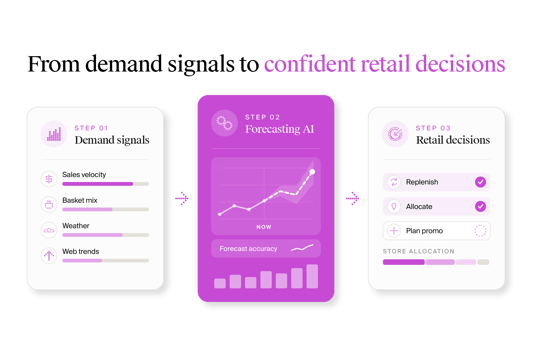 AI workflow orchestration gives planning teams a repeatable path from raw inputs to forecast review and action.
Instead of asking a planner to manually collect data, compare forecasts and determine which exceptions matter, the workflow can coordinate those steps automatically.
A forecasting workflow might:
- Collect sales, inventory, promotion, pricing and weather data.
- Check data completeness and identify anomalies.
- Select or route to the appropriate forecasting model.
- Compare forecast results against thresholds and historical patterns.
- Identify significant changes in demand.
- Route exceptions to the appropriate planner.
- Connect approved forecast changes to inventory decisions.
This is where AI agent coordination and multi-agent orchestration can support more complex planning workflows. Different AI agents can handle specific tasks, such as validating inputs, analyzing demand drivers, identifying anomalies or preparing an exception summary, while planners remain responsible for decisions that require business judgment.
Model orchestration can also help determine which forecasting approach should be applied based on product behavior, location, seasonality and planning horizon.
The goal is not to add more AI layers to the process. It is to coordinate the right work at the right point in the planning cycle.
The role of an AI control plane in planning operations
An AI control plane can provide a central layer for coordinating data, models, workflows and human approvals.
For retail demand forecasting, that means the operating layer can help determine:
- Which data sources should feed the forecast
- Which models or agents should handle specific forecasting tasks
- Which exceptions require human review
- What thresholds should trigger intervention
- Which approved changes should flow into downstream planning decisions
This creates a more traceable forecasting process. When a forecast changes significantly, planners can see which demand signals contributed to the change and why the workflow routed the exception for review.
That traceability matters during peak periods. A forecast miss may come from a late promotion update, an inventory data issue, an unexpected weather event or a genuine shift in customer demand. Teams need to identify the cause before deciding how to respond.
Where LLMs fit into demand forecasting
Large language models can support forecasting workflows, but they should not be confused with the forecasting model itself.
LLM orchestration can help coordinate tasks such as summarizing exceptions, explaining forecast changes, generating planner notes or translating complex outputs into actionable information.
Prompt orchestration can standardize how those tasks are performed. Consistent prompts and structured outputs make it easier for planning teams to compare exceptions and maintain a repeatable review process.
For example, an LLM-based workflow could summarize a significant forecast change by identifying the relevant promotion, recent sales movement and weather change, then present that information to a planner for review.
The forecast still needs to be grounded in actual retail data and appropriate forecasting methods. The language model supports the workflow around the forecast rather than replacing the underlying demand model.
Use the right signals for better forecasts
Retail demand forecasting improves when teams combine the signals that actually influence demand rather than relying on sales history alone.
Key inputs can include:
- Historical sales
- Current inventory positions
- Promotion calendars
- Pricing changes
- Holiday calendars
- Weather patterns
- Local events
- Regional demand differences
- Channel behavior
- Product substitutions
- Recent demand trends
Data quality remains critical. A forecasting system cannot compensate for incomplete promotion calendars, inaccurate inventory positions or delayed sales feeds.
This is especially important during the holiday season, when demand can change quickly and planners have less time to correct mistakes.
Common failure points in retail demand forecasting
- Incomplete or inconsistent data: Late store feeds, outdated promotion files and inventory mismatches can weaken the forecasting baseline before the model even runs.
- Overreliance on historical patterns: Historical data provides an important foundation, but it may not capture a new promotion, unusual weather event or emerging product trend.
- Poor exception handling: A forecast can be statistically sound and still fail operationally if planners do not know which changes require attention.
- Disconnected planning workflows: Forecasting, allocation and replenishment decisions become harder when each team works from different data or assumptions.
- Too much manual intervention: When planners spend too much time collecting data, reconciling files and preparing reports, less time is available for decisions that require retail expertise.
- Autonomous workflow automation: Reduces repetitive steps by moving routine tasks forward automatically while routing material exceptions to planners.
How teams improve forecast accuracy
Teams improve retail demand forecasting when they evaluate performance at the level where decisions are actually made.
Instead of relying only on an overall accuracy percentage, planners can review forecast error by:
- Product
- Store or region
- Channel
- Time horizon
- Promotion
- Season
- Demand pattern
This helps teams identify where bias and error are concentrated and determine which demand drivers contributed to the miss.
The review process should also connect directly to inventory actions. If demand increases beyond the forecast, the workflow should help planners determine whether allocation, replenishment or other inventory decisions need to change.
Clear thresholds can make that process repeatable. When forecast error or demand movement crosses a defined threshold, the workflow can automatically trigger a review and assign ownership for the next action.
Weather as a forecasting signal
 Weather can become an important input for retail demand forecasting when category demand shifts quickly.
Cold snaps, heat waves and storms influence shopper behavior, but the effect varies by business. Apparel, beverages, seasonal goods and convenience categories may show stronger sensitivity to weather than other categories.
The operational question is straightforward: when does weather change demand enough to require a change to the plan?
Teams can use historical patterns and actual data to identify those relationships, then incorporate relevant weather signals into recurring forecasting workflows.
The result is a process that can respond to meaningful changes without requiring planners to manually monitor every market and category.
Build a better forecasting workflow with invent.ai
Reliable retail demand forecasting requires more than a model that predicts the next sales number.
Retailers need a connected process that brings together actual sales, inventory, promotions, pricing, weather and other relevant demand signals. AI workflow orchestration can help coordinate that work, identify meaningful changes and route exceptions to the right planner.
With the right workflow, teams can automate routine data checks, apply appropriate forecasting models, identify unusual demand patterns and connect approved forecast changes to inventory decisions.
Model orchestration, AI agent coordination and autonomous workflow automation can support that process by moving routine work forward while keeping planners involved where business judgment matters.
For retailers preparing for peak season, the objective is not simply a more accurate forecast. It is a forecasting process that helps teams recognize changing demand and act on it before those changes become stockouts, excess inventory or markdowns. Connect with an invent.ai retail expert to get started.