
.svg)
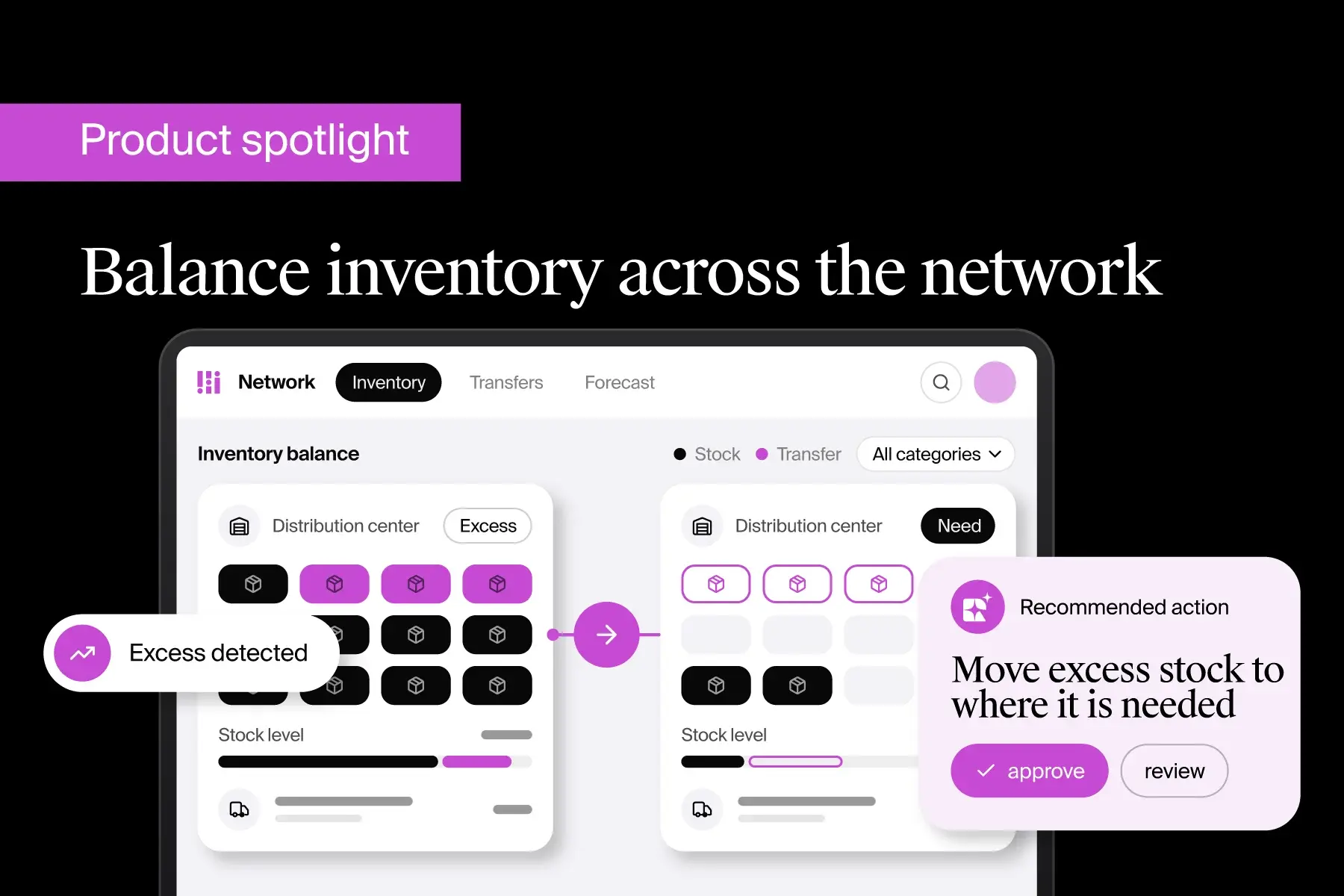
Excess inventory at some distribution centers (DCs) can drive up holding costs, while DCs facing supply gaps may struggle to replenish connected stores on time or in sufficient quantities, leading to lost sales.
Inventory doesn’t always need to be purchased, expedited or replenished. Sometimes it’s already somewhere else in the network. One DC may have excess inventory while another is facing a supply gap. However, identifying an opportunity to move inventory is only part of the decision. Teams also need to consider demand, inventory positions, costs, available transfer lanes and whether another item could help address the same supply need. This makes DC rebalancing a network decision, not simply a transfer task.
The invent.ai AI-Decisioning Platform helps retailers evaluate inventory across distribution centers and identify opportunities to rebalance stock based on current conditions. By connecting demand, inventory and network constraints, teams can determine which movements make sense and where inventory should go next.
Keeping inventory balanced across the DC network
Inventory positions can change quickly across a distribution network. One DC may accumulate excess inventory while another starts to face a supply gap. Without a connected view of the network, teams may see those positions as separate problems and respond independently.
Invent.ai evaluates inventory across the network to identify these imbalances and surface potential rebalancing opportunities.
Instead of asking only where inventory is available, teams can consider where it is needed, how much is needed and whether moving it makes sense given current conditions.
This helps retailers make better use of inventory already in the network before turning to additional supply.
Evaluating DC-to-DC transfer opportunities
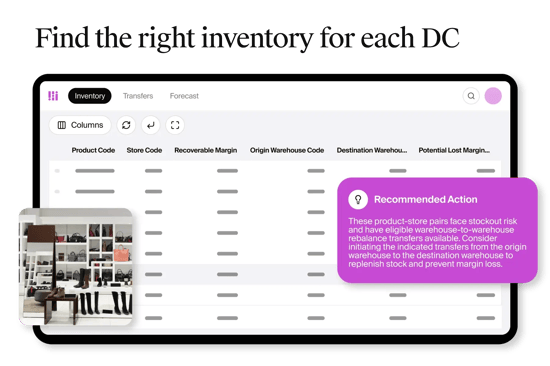 A potential transfer isn’t simply a matter of finding excess inventory at one DC and moving it to another. Demand can change, inventory positions can shift and transfer requirements can vary across the network.
The platform evaluates these factors together to identify potential DC-to-DC transfers as part of the wider rebalancing decision and help teams determine where inventory may need to move. This gives planners a more connected view of the network when deciding how to respond to supply gaps and inventory imbalances.
Accounting for network constraints
Not every inventory transfer is possible within a retailer’s distribution network. A DC may have inventory another location needs, but that inventory may not be eligible to move between those locations based on network rules, transfer paths or other operational constraints. A movement that looks logical based on inventory levels alone may therefore not be an option.
AI decisioning can account for these constraints when evaluating rebalancing opportunities, helping teams focus on movements that fit the network they actually operate.
This gives teams a more practical view of which inventory can move, where it can go and which rebalancing options are worth considering.
Considering substitutable item families
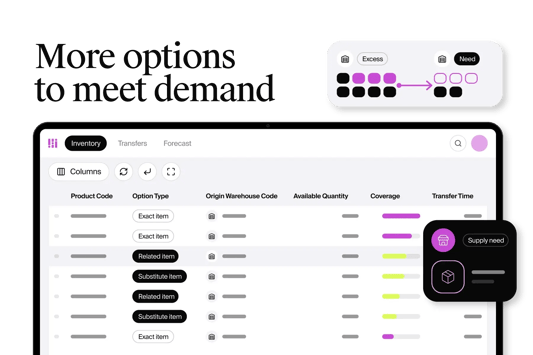 Sometimes the exact item needed at a DC isn’t available elsewhere in the network. For certain products, however, related or substitutable items may provide another way to address a supply need.
The platform can evaluate rebalancing opportunities across substitutable item families, giving teams a broader view of the inventory available across the network.
Rather than treating every SKU as an isolated inventory position, teams can consider relevant product relationships when evaluating how to address a gap.
Combine AI recommendations with retail expertise
Identifying a rebalancing opportunity is only part of the decision. Planners also need to understand the trade-offs before moving inventory. A transfer that addresses a supply gap at one DC may create a shortage elsewhere, while a substitutable item may not be appropriate for every location or demand scenario.
The invent.ai AI-Decisioning Platform combines specialized AI agents with planner expertise to identify opportunities, explain recommendations and support decisions while keeping teams in control.
Through Remi, the supervisory AI agent within the platform, teams can view recommendations and analysis across insights, analytics and reasoning capabilities in one workflow. Remi helps planners understand why a rebalancing opportunity has emerged, which factors shape the recommendation and what alternatives may be available. This gives teams the context they need to assess trade-offs, apply their knowledge of the business and decide whether to approve, adjust or override a proposed action.
Make better use of inventory already in the network with invent.ai
DC rebalancing isn’t about moving more inventory. It’s about making better decisions with the inventory already available.
Inventory may be available in one DC while another DC has a supply need. By evaluating demand, inventory positions and network constraints together, invent.ai helps teams identify opportunities to rebalance inventory across the network.
Whether the right action involves a direct DC-to-DC transfer, working within available transfer paths or considering substitutable item families, teams can evaluate the options within a connected decisioning workflow.
With invent.ai, retailers can determine where inventory needs to move as conditions change and make better use of inventory already available across the network.
Get in touch to learn how AI decisioning can support inventory decisions across your distribution network.