
.svg)
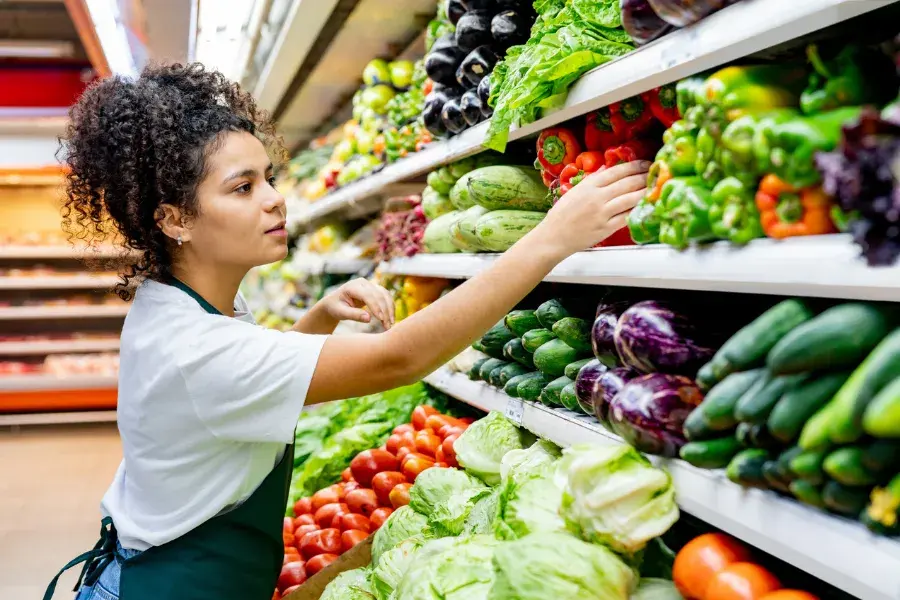
Grocery inventory management runs on one core assumption: that what you ordered yesterday reflects what customers will buy tomorrow. When that assumption breaks down, and in grocery it breaks down constantly, the consequences land fast. Stockouts empty shelves before the weekend rush. Overstock fills backrooms with produce that won't survive another 48 hours.
Grocery inventory management failures don't announce themselves in advance; they show up as shrink reports, markdown losses and customers who quietly switch to a competitor.
The gap between forecast and reality has always existed in grocery. What has changed is the cost of tolerating it.
What grocery inventory management actually involves
Grocery inventory management covers every decision between a purchase order and a customer's cart: what to order, how much, when, where to position it and how to move it before it expires. That sounds manageable until you factor in the scale, thousands of SKUs, multiple temperature zones, daily replenishment cycles and demand that shifts with weather, promotions and local events.
According to Food Logistics, more than $384 billion worth of food goes unsold or uneaten annually in the United States, with grocery stores alone seeing roughly 30% of food go unsold each year, contributing to an estimated 16 billion pounds of retail food waste. That number reflects a system where demand forecasting consistently lags the actual behavior of shoppers, and where the cost of that lag accumulates quietly until it becomes impossible to ignore.
Effective grocery inventory management requires actual data that connects purchasing patterns to shelf-level decisions. Without that connection, buyers rely on averages that obscure the variance driving most of the waste.
Perishables vs. center store: why they can't be managed the same way
Perishable goods management and center store management operate on fundamentally different timelines. A can of soup tolerates a two-week overstock. A bunch of bananas does not. Fresh item management demands tighter order quantities, faster sell-through and a direct line between day level data and replenishment decisions.
Center store categories allow for broader safety stock levels and longer lead times. Perishables require buyers to work with much narrower windows, often ordering for a 24 to 48 hour horizon, which means any lag in historical sales data or seasonal demand planning creates immediate exposure. The two categories need separate logic, separate reorder points and separate review cadences.
Demand forecasting strategies for grocery stores
Most grocery retailers still build forecasts from weekly averages. Weekly averages miss the Tuesday spike after a competitor runs out of stock. Weekly averages miss the Friday afternoon surge in prepared foods. Weekly averages miss the weather-driven demand shift that empties the soup aisle on a cold Monday.
Accurate demand forecasting in grocery requires day level data at the SKU and location level, combined with external signals, weather, local events and promotional calendars, that explain why demand deviates from the baseline. Seasonal demand planning adds another layer, accounting for the predictable but often underestimated swings that hit produce, beverages and holiday-adjacent categories. Retailers rethinking how forecasts connect to financial and operational decisions can start with grocery retail planning as a foundation for the broader architecture.
Stock replenishment and ordering workflows: where forecasts meet the shelf
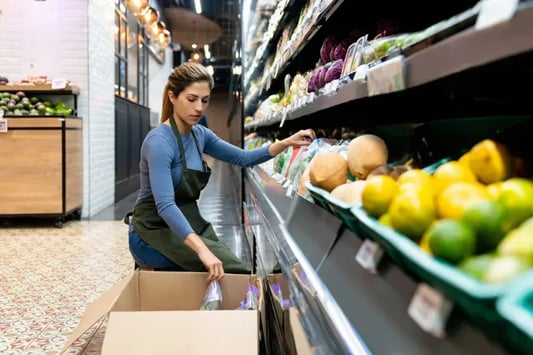 Stock replenishment translates a forecast into an action. When the forecast is wrong, the replenishment order is wrong, and the shelf reflects that within hours. Ordering workflows that depend on manual review of par levels introduce delay and human error at exactly the point where speed and accuracy matter most.
Replenishment automation removes that delay. Automated reordering systems tied to POS integration can trigger purchase orders the moment on-hand inventory crosses a defined threshold, without waiting for a buyer to run a report. Reorder points calculated from actual historical sales data, rather than static minimums, keep safety stock levels calibrated to current demand patterns rather than last quarter's averages.
FIFO, FEFO and shelf life management in practice
FIFO (first in, first out) and FEFO (first expired, first out) are the two rotation standards that determine whether perishables reach customers before they expire or end up in the compactor. FIFO works well for categories where all units share the same shelf life. FEFO matters when lot dates vary, which happens frequently with dairy, deli and fresh bakery items.
Shelf life management and expiration date tracking require more than a policy posted in the backroom. Barcode scanning at receiving and at the shelf edge gives teams the day level data needed to enforce rotation and flag items approaching their sell by date before they become waste. SKU tracking at the lot level makes expiration date tracking actionable rather than theoretical.
How to reduce food waste through better inventory planning
Food waste reduction starts with ordering accuracy. Overordering is the primary driver of spoilage in fresh categories, and overordering almost always traces back to a forecast that failed to account for recent demand shifts. Spoilage reduction follows directly from tighter demand forecasting, and when order quantities reflect actual expected sell-through, less product sits on the shelf past its useful life.
Slow moving item markdowns serve as a secondary defense. When a product moves slower than forecast, a timely markdown can accelerate sell-through and recover margin that would otherwise disappear entirely. Sustainability practices in grocery increasingly treat waste reduction as both an operational and a reputational priority, and the data to support those practices already exists in most retailers' systems.
Inventory visibility for physical and online grocery stores
Inventory visibility means knowing what you actually have on hand, not what the system says you have. Phantom inventory, where a product appears in stock in the system but has already been sold or misplaced, drives both stockouts and inaccurate replenishment orders. For physical stores, inventory visibility depends on accurate barcode scanning, disciplined receiving processes and regular reconciliation between system records and physical counts.
Online grocery adds another layer of complexity. A customer placing an order through a mobile app expects the item to be available. When inventory visibility breaks down, the result is substitutions, cancellations and the kind of friction that drives customers to competitors. Retailers managing both channels need unified stock data that reflects actual availability across every fulfillment point. Online lost sales tied to poor inventory accuracy rank among the most direct and measurable costs of visibility gaps in grocery operations.
Cycle counting vs. full inventory audits for grocery retailers
Full physical inventory counts disrupt operations and produce a snapshot that ages quickly in a high velocity grocery environment. Cycle counting, counting a rotating subset of SKUs on a continuous schedule, keeps inventory records accurate without shutting down the floor.
A well-designed cycle counting program uses ABC inventory classification to prioritize which items get counted most frequently. A-class items, typically high velocity or high value SKUs, warrant weekly or even daily counts. C-class items, slower movers with lower risk, can rotate on a monthly schedule. Mobile inventory access allows store teams to conduct counts and reconcile discrepancies without returning to a fixed terminal, which reduces the time between count and correction.
Inventory shrinkage and loss prevention in grocery stores
Inventory shrinkage in grocery comes from four sources: theft, administrative error, vendor fraud and spoilage. Each requires a different response, but all four share a common enabler, poor inventory visibility. When stock records are inaccurate, shrinkage hides inside the variance between expected and actual on-hand quantities.
Shrinkage control programs that combine cycle counting, barcode scanning at receiving and loss prevention strategies at the point of sale can identify where shrinkage originates and at what rate. POS integration that ties sales data directly to inventory deductions closes one of the most common sources of administrative error. SKU tracking at the item level makes it possible to distinguish between theft, spoilage and data entry mistakes, a distinction that matters when deciding where to invest in prevention.
Cloud based inventory systems for multi-location grocery chains
Multi-location grocery chains face a version of the inventory problem that single-store operators don't: the same SKU can be overstocked at one location and out of stock at another, simultaneously. Cloud based inventory systems give buyers and planners a unified view across all locations, making it possible to identify imbalances and act on them before they become waste or lost sales.
Cloud based inventory systems also support shelf space optimization at scale. When planners can see sell-through rates, inventory shrinkage data and reorder points across every store in a single interface, they can make range and allocation decisions based on actual performance rather than assumptions. The grocery retail playbook for multi-location operators now centers on centralized data access as a prerequisite for consistent execution.
What AI is doing to stock replenishment in grocery retail
.webp?width=533&height=355&name=Grocery%20inventory%20breaks%20when%20forecasts%20lag%20reality%20-%20inside%202%20(1).webp) AI changes the math on stock replenishment by processing more variables than any manual system can handle. Weather forecasts, promotional lift factors, local event calendars, supplier lead time variability and historical sales data all feed into replenishment models that update order recommendations continuously as new day level data arrives.
AI changes the math on stock replenishment by processing more variables than any manual system can handle. Weather forecasts, promotional lift factors, local event calendars, supplier lead time variability and historical sales data all feed into replenishment models that update order recommendations continuously as new day level data arrives.
Replenishment automation powered by AI doesn't just reduce the time buyers spend on routine orders, it reduces the error rate on those orders by removing the cognitive load of managing thousands of SKUs simultaneously. Automated reordering at the SKU level, calibrated by AI-generated reorder points and safety stock levels, keeps shelves stocked without the overstock that drives spoilage. The AI for grocery capabilities available today extend across forecasting, allocation, replenishment and pricing, giving retailers a connected set of tools rather than isolated point solutions.
Grocery inventory management software: what to look for in 2026
The right inventory management software for a grocery retailer in 2026 needs to do more than track stock levels. It needs to connect POS integration data to replenishment logic, support expiration date tracking and shelf life management for perishables, enable cycle counting through mobile inventory access and generate reorder points from actual demand patterns rather than static rules.
Buyers evaluating platforms should also look for ABC inventory classification capabilities, slow moving item markdowns triggers and loss prevention strategies built into the workflow rather than bolted on as an afterthought. Cloud based inventory systems that scale across locations without requiring separate instances for each store reduce both IT overhead and the risk of data silos that undermine inventory visibility. Sustainability practices tracking, which measures waste by category, location and cause, rounds out the feature set for retailers who need to report on food waste reduction alongside financial performance.
Strengthen grocery inventory management with invent.ai
Lagging forecasts cost grocery retailers in spoilage, stockouts and the customers who leave when shelves don't deliver. Invent.ai's AI-decisioning platform connects demand forecasting, replenishment automation and inventory visibility into a single system built for the pace and complexity of grocery retail. One of our customers, Migros, reduced inventory days by more than 11% and cut lost sales by 1.3% within five months of deployment.
Want to learn how they did it? Speak with an invent.ai retail expert to see what tighter grocery inventory management can do for your operation.
The gap closes when the system does
Forecast accuracy and grocery inventory management are not separate problems. Every stockout, every markdown on expired produce and every pound of food that goes to waste traces back to a gap between what the system predicted and what customers actually did. Closing that gap requires day level data, replenishment automation, disciplined perishable goods management and the right inventory management software to connect all of it. The retailers who close that gap first will carry less waste, serve more customers and operate with margins that reflect the effort they put into getting inventory right.